

It takes time to create work that’s clear, independent, and genuinely useful. If you’ve found value in this newsletter, consider becoming a paid subscriber. It helps me dive deeper into research, reach more people, stay free from ads/hidden agendas, and supports my crippling chocolate milk addiction. We run on a “pay what you can” model—so if you believe in the mission, there’s likely a plan that fits (over here).
Every subscription helps me stay independent, avoid clickbait, and focus on depth over noise, and I deeply appreciate everyone who chooses to support our cult.
PS – Supporting this work doesn’t have to come out of your pocket. If you read this as part of your professional development, you can use this email template to request reimbursement for your subscription.
Every month, the Chocolate Milk Cult reaches over a million Builders, Investors, Policy Makers, Leaders, and more. If you’d like to meet other members of our community, please fill out this contact form here (I will never sell your data nor will I make intros w/o your explicit permission)- https://forms.gle/Pi1pGLuS1FmzXoLr6
Recently, I partnered with Manning Publications to create a special learning path for the Chocolate Milk Cult. The result was the book, “Engineering AI at Scale: Platforms, RAG, Agents, and Reliability”, a practitioner’s handbook where we compiled insights from various Manning titles to give you one source of truth covering the foundations of ML platforms, prompt engineering, enterprise RAG, AI agents, LLM operations, and reliable deployment strategies.
Don’t worry, I won’t tell you to buy the book. I actually can’t— the book is completely free (get it here). So if you need an comprehensive guide to building production AI Systems at scale, with references to further reading, check it out. We’ll adapt it’s lessons into a series here.
In Chapter 2 of this series, we will cover the following—
Applying nine foundational prompt patterns that solve common AI interaction challenges
Using structural patterns to establish consistent model behavior and output quality
Employing contextual patterns to identify overlooked risks, gaps, and blind spots in your content
Implementing transformational workflows that enhance content quality
Combining patterns effectively to handle complex prompting challenges
PS— (you can catch the previous chapters in the archive)
Executive Highlights (TL;DR of the Article)
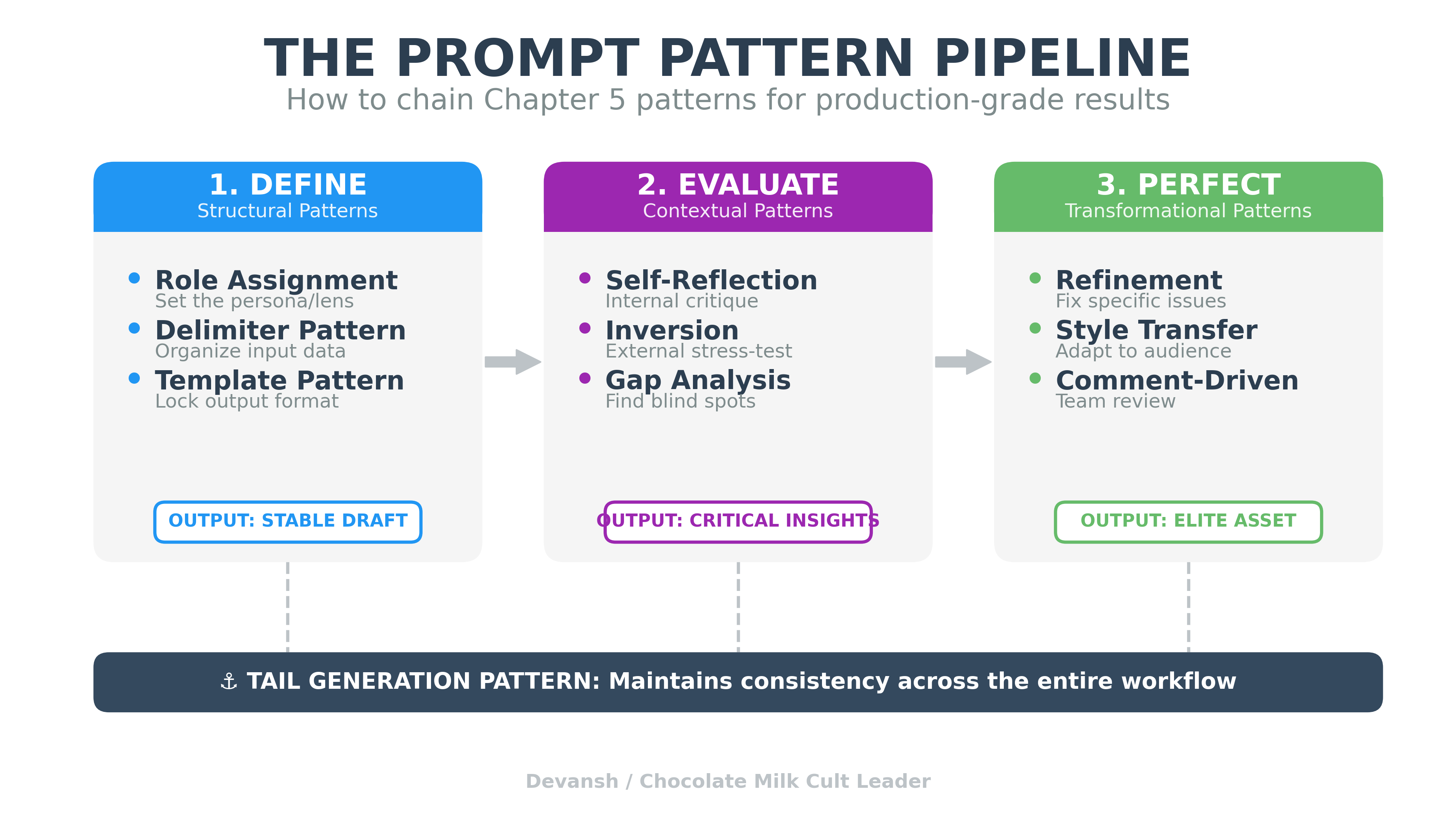
Prompt engineering isn’t improvisation—it’s nine validated patterns split into three categories: structural patterns set up the task, contextual patterns expose blind spots, transformational patterns fix what you find
The killer workflow most people miss: run Self-Reflection or Inversion first to surface problems, then Refinement second to fix them—this two-step chain is why some people get polished outputs while others iterate forever
Role Assignment is the highest-leverage single move: assigning “direct response copywriter with 25%+ open rates” doesn’t just change tone, it shifts which token distributions the model samples from—you’re activating different expertise patterns before generation even starts
Inversion flips you from commander to interrogated: instead of telling the model what to do, you hand it your content and ask it to attack from a skeptical CFO’s perspective, a confused user’s perspective, a risk-averse executive’s perspective—external viewpoints you literally cannot generate yourself because you’re too close to your own work
Template Pattern sounds basic but unlocks scale: define output schema once with placeholders, reuse across hundreds of variations, eliminate the formatting inconsistencies that currently eat your revision cycles
Style Transfer solves the “same deck, five audiences” problem: write once for technical team, transform to executive summary, transform to customer-facing copy—core information stays identical, voice adapts, no information loss from manual rewrites
I put a lot of work into writing this newsletter. To do so, I rely on you for support. If a few more people choose to become paid subscribers, the Chocolate Milk Cult can continue to provide high-quality and accessible education and opportunities to anyone who needs it. If you think this mission is worth contributing to, please consider a premium subscription. You can do so for less than the cost of a Netflix Subscription (pay what you want here).

I provide various consulting and advisory services. If you‘d like to explore how we can work together, reach out to me through any of my socials over here or reply to this email.
Prompt patterns
Prompt patterns define the mode of interaction between you and the model, systematic approaches that have been tested across thousands of professional applications. Just as design patterns in software engineering provide battle-tested solutions to recurring programming problems, prompt patterns offer validated frameworks for common AI communication scenarios that eliminate trial-and-error approaches.
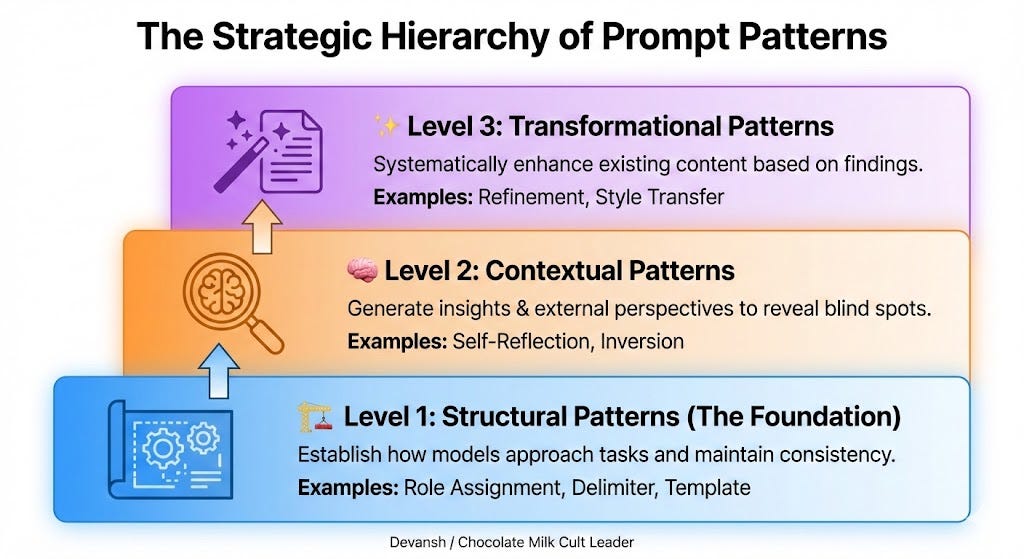
These patterns operate at the strategic level above structural and linguistic elements. While you might use delimiters to organize information and direct language to communicate clearly, the underlying pattern determines your fundamental approach—whether you’re asking the model to generate original content, critically evaluate existing work, systematically refine outputs, or transform materials for different contexts.
The power of prompt patterns lies in their transferability across domains and contexts. Once you understand how Self-Reflection works, having models systematically evaluate their outputs against quality criteria, you can apply this strategic approach across diverse scenarios from improving study guides to validating business strategies. The specific content changes, but the interaction methodology remains consistent and reliable.
2.1 Introduction to nine foundational patterns
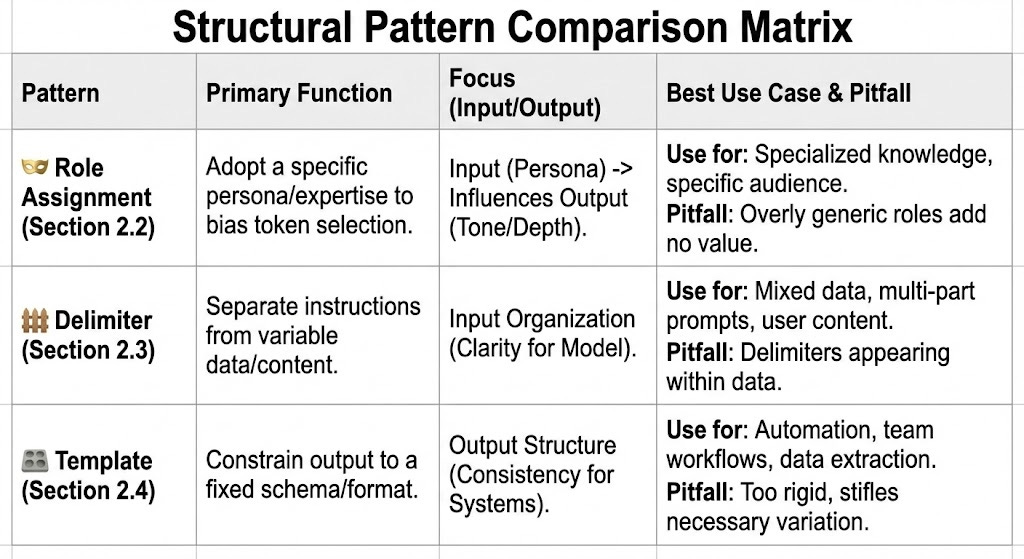
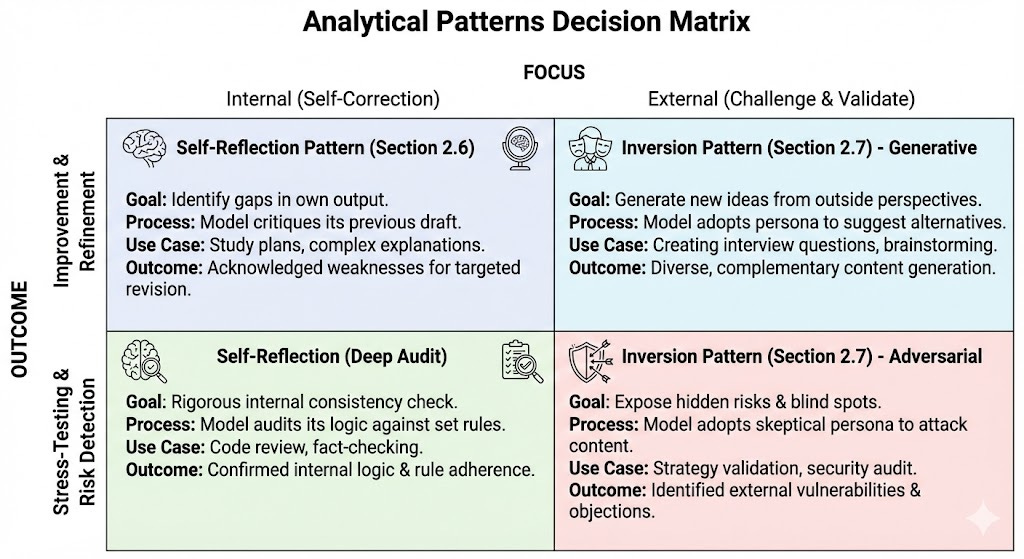
This chapter introduces nine foundational patterns organized into three strategic categories that build upon each other: structural patterns (Role Assignment, Delimiter, Template, Tail Generation) establish how models approach tasks and maintain consistency; contextual patterns (Self-Reflection, Inversion) generate insights and external perspectives that reveal blind spots; and transformational patterns (Refinement, Style Transfer, Comment-Driven Generation) systematically enhance existing content based on analytical findings.
Through practical examples and hands-on exercises, you’ll develop strategic judgment to select appropriate patterns for different challenges and combine them effectively for complex, multistep workflows. These validated interaction strategies provide the foundation for the comprehensive prompt templates, where individual patterns combine with structural and linguistic elements to create complete, production-ready solutions for recurring professional applications.
2.2 Role Assignment Pattern
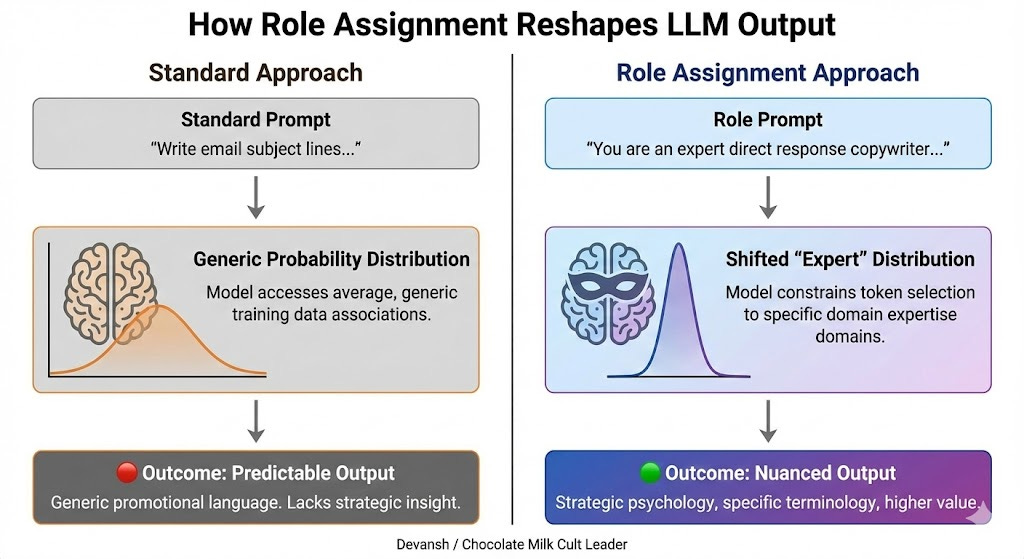
The Role Assignment Pattern instructs the language model to adopt a specific persona, professional expertise, or voice before executing tasks. This pattern directs the model to generate outputs consistent with domain-specific training patterns and linguistic associations, fundamentally shaping the probability distributions the model uses for token selection from the beginning.
Unlike simple style instructions that modify presentation after content generation, role assignment changes the analytical framework and expertise the model applies. When you assign a role such as data scientist, creative director, or financial advisor, you’re directing the model to generate text that matches patterns associated with how professionals in those fields communicate in the training data.
Use role assignments when you need specialized knowledge you lack, specific audience targeting, or professional credibility that generic responses can’t provide. Skip this pattern for simple tasks or when you already have strong domain expertise, as the additional tokens may not improve results. Role assignment typically eliminates two to three revision cycles by delivering domain-appropriate outputs immediately.
2.2.1 Practical example: Email subject line optimization
A marketing manager needs to write compelling subject lines for a Black Friday email campaign promoting wireless headphones but wants to test different strategic approaches.
Standard prompt without Role Assignment
(RD) Write 3 email subject lines for a Black Friday sale on wireless headphones.
Here are three polished subject line options for your Black Friday wireless headphones campaign:
Unbeatable Sound, Unmissable Price: Black Friday Wireless Headphones Sale
This Black Friday: Premium Wireless Headphones Up to 50% Off
Hear the Difference—Black Friday Wireless Headphones Deals Inside
Would you like me to also create variants optimised for urgency and FOMO (e.g., “Ends Tonight” style), or keep them more professional and product-focused?
Role Assignment Pattern applied
(RD) You are a direct response copywriter who has optimized email campaigns for major electronics retailers and consistently achieves 25%+ open rates. Write 3 email subject lines for a Black Friday sale on wireless headphones.
Here are three high-performing subject lines tailored for a Black Friday campaign on wireless headphones:
“Black Friday Exclusive: Wireless Headphones from £49—Today Only”
a (Urgency + Price anchor = strong open incentive)“Cut the Cord, Keep the Sound—Up to 60% Off Wireless Headphones”
b (Benefit-driven + savings front-loaded)“Your Black Friday Upgrade: Premium Wireless Headphones at Half Price”
(Positioned as an upgrade, aspirational appeal)
Would you like me to also draft matching preview text lines (the snippet that shows next to the subject line) so the campaign feels more complete?
The role-assigned version demonstrates sophisticated understanding of direct response psychology: strategic annotations explaining the psychology behind each approach (“Urgency + Price anchor = strong open incentive”), benefit-driven messaging (“Cut the Cord, Keep the Sound”), and upgrade positioning (“Your Black Friday Upgrade”). The generic approach uses predictable promotional language that lacks strategic insight about what drives email engagement.
Notice how the copywriter persona shapes every element: providing strategic annotations that explain the psychology, positioning products as upgrades rather than just discounts, and offering proactive follow-up suggestions to enhance campaign effectiveness.
2.2.2 Hands-on practice
Practice applying the Role Assignment Pattern by experimenting with different professional personas for the same underlying task. For each scenario that follows, try at least two different role assignments and observe how expertise and perspective shift the approach, vocabulary, and recommendations:
Create homepage copy for a sustainable fashion brand. Try assigning roles of “brand strategist with luxury fashion experience” versus “conversion copywriter specializing in eco-conscious millennials.” Notice how risk tolerance and recommended messaging strategies change between brand-focused and conversion-focused approaches.
Analyze whether someone should invest in renewable energy stocks. Compare outputs when you assign roles of “conservative financial advisor focused on retirement planning” versus “ESG investment specialist with venture capital background.” Compare technical depth and implementation focus between conservative versus growth-oriented perspectives.
Write a response to negative social media coverage about a restaurant. Compare approaches from “PR crisis specialist with restaurant industry experience” versus “local business owner who’s handled similar situations.” Analyze how authority level affects response strategy and communication tone.
As you practice, pay attention to how specific expertise creates more nuanced, actionable outputs compared to generic professional roles. The most effective role assignments activate targeted knowledge patterns and produce outputs with greater professional authenticity and practical value. While role assignment shapes the expertise and perspective the model applies to your task, organizing complex information within your prompts requires a different approach, which brings us to the Delimiter Pattern.
2.3 Delimiter Pattern
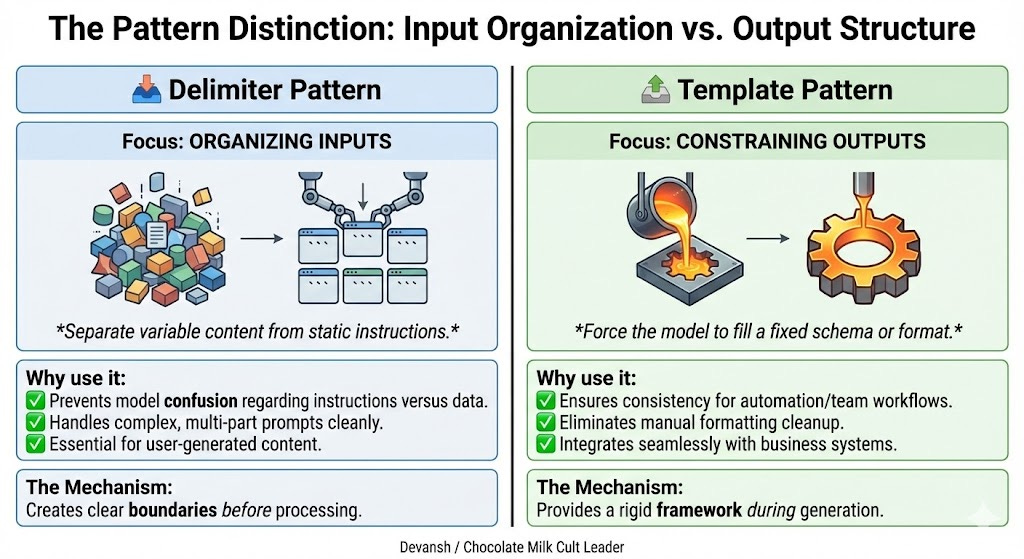
The Delimiter Pattern, a structural element for separating variable content from fixed instructions, is analyzed here in depth. Delimiters such as triple backticks (```), XML tags, or markdown headers can enclose placeholders such as {variable_name}. Yet delimiters can also transform complex, multipart prompts into structured, professional templates where variable content is clearly distinguished from static instructions.
Choosing your delimiters
Use triple backticks () for data or content with special characters, you can specify input types such as json or ```sql for additional clarity. XML tags (<data>...</data>) work best when you need semantic structure or nested organization, while markdown headers () provide excellent visual hierarchy for section organization. While modern models handle mixed content reliably, delimiters remain essential when processing user-generated content or very long prompts where clear boundaries improve consistency.
This pattern transforms complex, multipart prompts into structured, professional templates where variable content is clearly separated from static instructions. The combination of delimiters and input parameters creates reusable frameworks that team members can easily populate with different data.
NOTE If templates produce inconsistent results, ensure that your delimiters don’t appear within variable content itself, switch delimiter types to avoid conflicts.
Use delimiters with input parameters when building reusable prompt templates, working with multiple data sources, or creating prompts that others will maintain. Visual clarity benefits human readers more than model processing, but consistent organization prevents edge cases and makes template debugging straightforward.
2.3.1 Practical example: Brand positioning analysis
A marketing team needs a reusable template for quick competitive positioning analysis.
Prompt without Delimiter Pattern
(RD) Compare {brand_a} which says “{brand_a_message}” versus {brand_b} which says “{brand_b_message}” and identify the key positioning difference in one sentence.
Prompt with Delimiter Pattern
(RD) Compare the brand positioning below and identify the key difference in one sentence.
{brand_a}
{brand_a_message}
{brand_b}
{brand_b_message}
Prompt with Delimiter Pattern (inputs injected)
(RD) Compare the brand positioning below and identify the key difference in one sentence.
Tesla
Accelerating the world’s transition to sustainable energy
BMW
The ultimate driving machine
NOTE Since modern models produce consistent analysis regardless of delimiter organization, we focus on template structure rather than response comparison. Other patterns in this chapter will show model outputs when they demonstrate actual behavioral differences in how models process and respond to different prompt approaches.
The delimiter pattern creates clear boundaries around each input parameter, making it obvious which content belongs to which brand. Both templates use identical input parameters, but the organized version makes it easy to see the structure, update individual elements, and identify which variable controls which piece of content.
This organizational approach serves multiple practical purposes. The combination of delimiters and input parameters creates templates that team members can quickly populate without formatting concerns. Teams using organized delimiter templates experience fewer template modification errors and can onboard new members to existing prompts more efficiently. The consistent structure works across different scenarios, and when troubleshooting unexpected outputs, organized sections help identify which data inputs might need adjustment. These organizational benefits become even more valuable as prompt complexity increases, what might seem like overkill for simple comparisons proves essential when managing templates with multiple variable sections.
2.3.2 Hands-on practice
Practice applying the Delimiter Pattern with input parameters to create maintainable prompt templates. For each scenario, identify both the delimiter structure and the variable content that should be parameterized:
Create a template for comparing employee performance reviews using {employee_name}, {manager_feedback}, {peer_reviews}, {self_assessment}.
Design a customer support analysis format with parameters {channel_type}, {conversation_transcript}, {resolution_status}, {satisfaction_score}.
Build a vendor evaluation structure using {vendor_name}, {pricing_details}, {technical_specs}, {references}.
Strong organizational patterns that combine delimiters with input parameters create prompt templates that are professional, maintainable, and scalable across different team members and use cases. The Template Pattern extends this organizational foundation by providing structured output frameworks where delimiters organize inputs and templates shape outputs, creating complete prompt engineering systems.
2.4 Template Pattern
The Template Pattern requests structured output in a fixed schema, ensuring consistency and reproducibility across similar tasks. Here, we examine the pattern as a reusable problem-solving approach that creates predictable outputs ideal for automation and team collaboration.
This works because structured output constrains the model’s generation process to follow predictable patterns. When you provide placeholders such as [Name] or [Advantage], you’re creating specific completion targets that bias the model’s token selection toward defined information types rather than generating free-form responses.
Unlike the Delimiter Pattern, which organizes input content, the Template Pattern controls output structure. You provide a framework with placeholders that the model fills with appropriate content, creating consistent formats that integrate seamlessly with business processes, content management systems, or data analysis workflows.
Use template patterns when outputs need consistent formatting across multiple uses, when results feed into automated systems, or when multiple team members generate similar content types. Skip this pattern for one-off creative tasks where format flexibility matters more than standardization. Well-designed templates eliminate formatting inconsistencies that otherwise require manual cleanup.
2.4.1 Practical example: Competitive analysis reports
A product manager needs to generate consistent competitive analysis summaries that integrate with the team’s strategic planning process.
Prompt without Template Pattern
(RD) Analyze the competitive positioning of our project management software against Asana. Keep your response to 2-3 sentences.
Our project management software is positioned as a focused, AI-driven automation platform, whereas Asana emphasises broad team collaboration and task tracking. By deeply integrating task extraction, contextual automation, and document handling, we differentiate on intelligent workflow execution rather than manual organisation. This creates an advantage for companies seeking efficiency gains over feature breadth.
Prompt with Template Pattern
(RD) Analyze our project management software against Asana using this template. Keep each section to one sentence:
Competitor: [Name]
Primary Advantage: [Their strongest differentiator]
Our Opportunity: [Where we can compete effectively]
Recommendation: [One specific strategic action]
Here is the requested comparison, formatted with your template:
Competitor: Asana
Primary Advantage: Mature ecosystem with robust integrations and established brand trust.
Our Opportunity: Differentiate through deeper automation, contextual intelligence, and customization for specific verticals.
Recommendation: Focus on building advanced AI-driven task automation that reduces manual overhead and outpaces Asana’s incremental feature set.
Would you like me to run the same one-sentence analysis against other major competitors (e.g., Monday.com, ClickUp, Trello) for a broader strategy view?
The template version delivers structured, actionable intelligence that slots directly into strategic planning documents and enables easy comparison across multiple competitors, eliminating the manual formatting work that unstructured analysis requires. The consistent format ensures no critical analysis elements are overlooked, while creating outputs that integrate seamlessly with existing business processes.
Well-designed templates balance structure with flexibility—specific enough to ensure consistency, flexible enough to accommodate varied content. Use concrete placeholder names ([Primary Advantage] not [Thing 1]) and limit templates with four to six sections to prevent rigid, artificial responses.
2.4.2 Hands-on practice
Practice applying the Template Pattern to create standardized outputs that integrate with existing business processes. For each scenario, design a template structure that ensures consistency, while allowing natural content variation:
Create a customer interview summary template for UX research with sections for: user background, primary pain points, feature requests, and overall satisfaction. Keep each section to one sentence for concise stakeholder updates.
Design a weekly team performance template covering: completed objectives, identified blockers, resource needs, and next week priorities. Structure it for consistent manager reviews across different team leads.
Build a vendor evaluation framework including: core capabilities, pricing structure, implementation timeline, and risk assessment. Format it for easy comparison across multiple potential partners.
Effective templates create predictable, professional outputs that eliminate formatting inconsistencies and ensure comprehensive coverage of required information. The Tail Generation Pattern builds on this foundation by helping you start content creation with specific opening elements that guide the model’s continuation approach.
2.5 Tail Generation Pattern
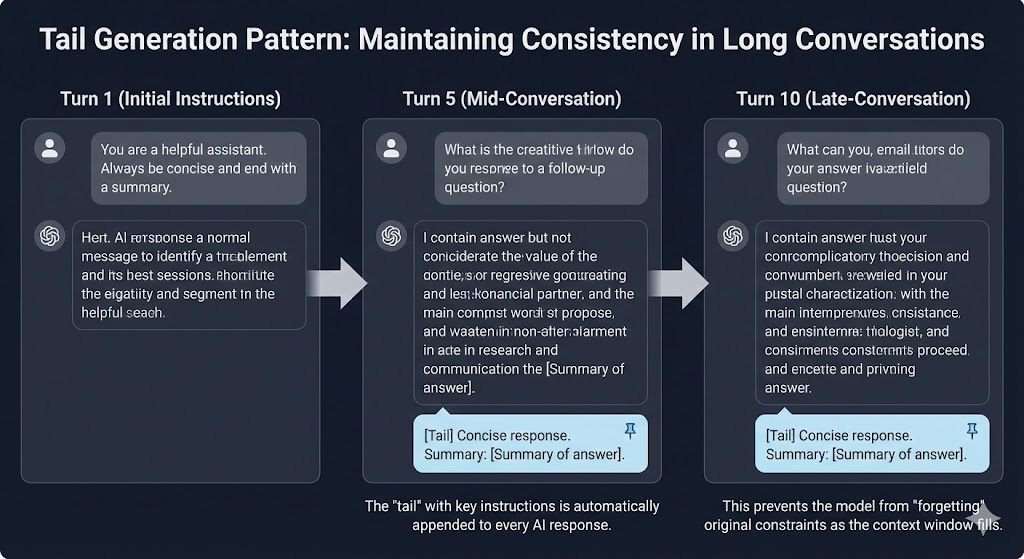
The Tail Generation Pattern maintains task consistency by having the model restate key instructions or parameters within each response, preventing behavioral drift in extended conversations or multiturn workflows. This pattern addresses fundamental limitations in conversational interfaces, both finite context windows and restricted message history that cause models to lose critical task parameters and constraints, leading to inconsistent behavior across extended interactions.
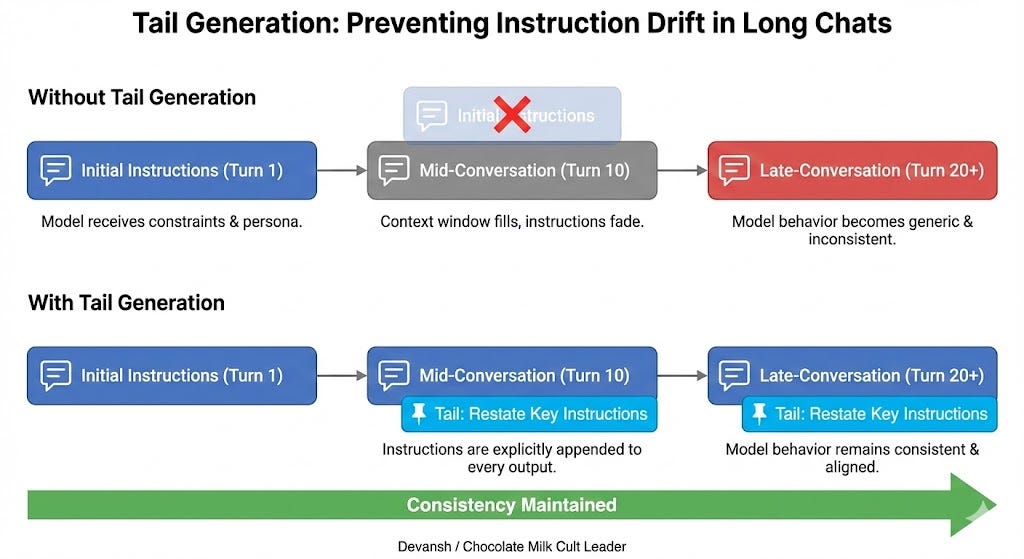
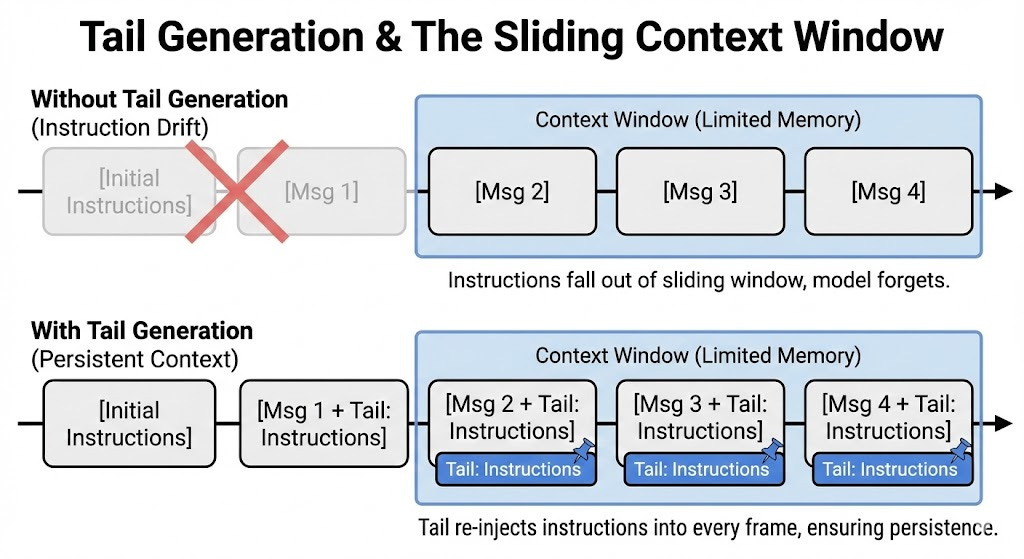
Modern language models face two key limitations in conversational interfaces: finite context windows and restricted access to conversation history. Even when conversations remain within context window limits, many interfaces limit how many previous messages the model can access. This creates problems for conversational interfaces such as OpenAI’s ChatGPT and Anthropic’s Claude, where users expect consistent behavior throughout extended interactions, but the model gradually loses access to original instructions as the conversation progresses. Tail generation solves this by having the model explicitly restate key instructions within each response, ensuring they remain visible regardless of context window or message history limitations.
Use tail generation primarily for chat interfaces such as ChatGPT or Claude where you need behavioral consistency across extended conversations. This pattern proves especially valuable for customer service sessions, research assistance spanning multiple queries, creative projects requiring consistent voice, or any extended interaction where instruction drift would compromise effectiveness. In production systems, the assistant’s task is typically preserved by system prompts that remain consistently available, making tail generation less critical. Skip this pattern for single-exchange tasks, simple interactions, or when advanced memory systems preserve earlier message context. Note that tail generation consumes additional output tokens per response, and since output tokens cost more than input tokens in most APIs, this creates meaningful ongoing expenses that should be weighed against consistency benefits. The pattern becomes irrelevant in more complex implementations that include persistent memory systems preserving context from earlier messages.
Unlike external memory systems or conversation restarts, tail generation embeds persistence directly into model output without requiring additional infrastructure, making it ideal for conversational interfaces where seamless user experience matters as much as instruction compliance.
2.5.1 Practical example: Customer service consistency
Customer service AI needs to maintain specific behavioral guidelines across an extended support session.
Prompt without Tail Generation Pattern
(RD) You are a customer service representative. Always be professional, offer specific solutions, ask for order numbers when relevant, and end by asking how else I can help.
[ 16 messages later… ]
(RD) My headphones stopped working.
That’s frustrating. Try checking the battery or restarting your device.
Prompt with Tail Generation Pattern
(RD) You are a customer service representative. Always be professional, offer specific solutions, ask for order numbers when relevant, and end by asking how else I can help. End each response by restating: “My approach: professional tone, specific solutions, request order numbers when needed, ask how else I can help.”
[ 16 messages later… ]
(RD) My headphones stopped working.
I understand how frustrating that must be. Let’s troubleshoot this systematically— first, please check if they’re fully charged, then try resetting them by holding the power button for 10 seconds. Could you also provide your order number so I can check warranty status? How else can I help you today?
My approach: professional tone, specific solutions, request order numbers when needed, ask how else I can help.
The contrast demonstrates how tail generation maintains all original behavioral parameters, professional tone, specific solutions, order number requests, and consistent closing, while the version without the pattern loses these guidelines and provides generic, unhelpful responses.
Common pitfalls
Avoid overly wordy tail generation that consumes excessive tokens or feels unnatural to users, especially considering that output tokens cost more than input tokens. Keep restatements concise and focused on truly critical parameters rather than restating every instruction. Also avoid creating tail generation that becomes so formulaic that it interferes with natural conversation flow. The restatements should feel integrated rather than as mechanical appendages to responses.
2.5.2 Hands-on practice
Practice applying the Tail Generation Pattern across different extended conversation scenarios. For each situation below, create prompts that include appropriate tail generation to maintain instruction persistence:
Design a prompt for an AI that sorts emails into urgent/routine categories across hundreds of messages. Include tail generation that preserves classification criteria, escalation rules, and privacy guidelines even after the context window fills.
Create a prompt for reviewing user-generated content that must consistently apply community guidelines, document violations, and trigger appropriate escalations across extended moderation sessions. Design tail generation that maintains these critical parameters.
Develop a prompt for a multisession novel writing assistant that needs to preserve character voice consistency, narrative perspective, and story constraints across writing sessions that may be separated by days or weeks.
Focus on identifying which specific instructions are most critical to preserve and practice natural integration of restatement rather than awkward repetition. The Self-Reflection Pattern builds on this reliability foundation by having models evaluate and improve their own outputs before final delivery.
2.6 Self-Reflection Pattern
The Self-Reflection Pattern is applied after the language model has generated an initial response, prompting the model to generate analysis of its own output using evaluative language patterns for strengths, weaknesses, and areas for improvement. Rather than accepting first-draft responses, your prompt the model to generate evaluative text about its previous output and produce content identifying potentially overlooked elements or gaps. Self-reflection typically precedes the refinement pattern, creating a systematic evaluation-then-improvement workflow for high-quality outputs.
This is a critical pattern in prompt engineering because it transforms potentially flawed first-draft responses into systematically improved solutions, preventing costly implementation of incomplete recommendations. Models generate responses that appear comprehensive but may lack critical considerations or practical constraints. By prompting the model to generate critical analysis of its previous output, you elicit explicit identification of these limitations rather than discovering them during real-world application. This systematic self-evaluation creates a quality assurance layer that makes prompt engineering reliable for professional applications were getting it right the first-time matters.
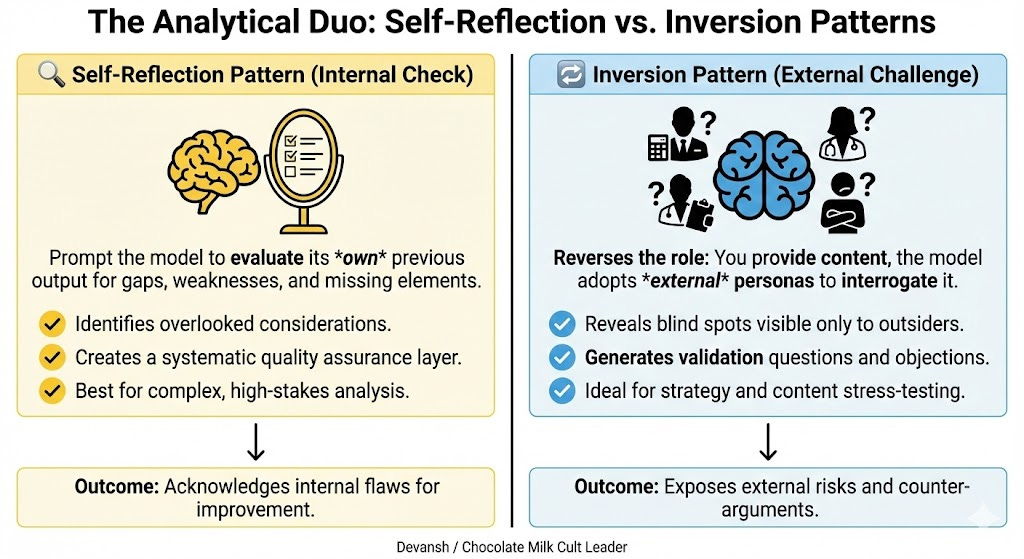
Use self-reflection for complex analysis, strategic recommendations, technical solutions, or any high-stakes output where quality outweighs speed. Apply this pattern when implementation costs make revision expensive, when outputs will be shared with stakeholders, or when you’re working in unfamiliar domains. Skip self-reflection for simple factual queries, urgent requests, or when satisfied with initial output quality. Note that this pattern requires additional tokens for the evaluation step, making cost-benefit analysis important for routine applications.
2.6.1 Practical example: Study plan development
A student needs a comprehensive study plan for an important exam but wants to ensure no critical elements are overlooked before committing to the approach.
TIP Replace {subject_exam} with details about any subject or exam you’re preparing for to make this example immediately applicable to your situation.
Initial prompt template
(RD)
Subject and Exam Details
{subject_exam}
Create a comprehensive study plan for this exam. Keep your response to 3-4 sentences.
Prompt with variables injected
(RD)
Subject and Exam Details
Advanced Statistics final exam covering hypothesis testing, regression analysis, and statistical modeling. Exam is in 4 weeks, worth 40% of final grade, includes both multiple choice and problem-solving sections.
Create a comprehensive study plan for this exam. Keep your response to 3-4 sentences.
Focus on reviewing lecture notes and textbook chapters systematically, dedicating 2 hours daily to different topics in rotation. Practice problem-solving with past exams and online exercises, emphasizing hypothesis testing and regression calculations. Create summary sheets for key formulas and statistical concepts to review during the final week before the exam.
Self-Reflection Pattern applied
(RD) Could you please self-reflect on your study plan above? Identify what you did well and what important elements you may have overlooked. Keep your analysis to 3-4 sentences.
My plan addressed daily study scheduling, topic rotation, and formula review effectively. However, I failed to consider your current knowledge level assessment, specific weak areas that need extra attention, study group opportunities, or practice timing under exam conditions. I also overlooked stress management techniques, backup time for difficult concepts, and how to balance this exam prep with other coursework demands.
The self-reflection generates identification of important gaps in active learning techniques, progress tracking, and sustainable study practices that weren’t apparent in the initial plan but are essential for effective exam preparation. This critical evaluation provides the foundation for systematic improvement of the original recommendations.
2.6.2 Hands-on practice
Practice applying the Self-Reflection Pattern to identify gaps and improvements in initial outputs. For each scenario, request an initial response, then prompt the model to critically evaluate its own recommendations:
Ask for healthy meal prep recommendations for a busy schedule, keeping responses to three sentences. Then apply self-reflection to examine whether the model considered dietary restrictions, budget constraints, cooking skill level, and storage limitations.
Request advice for learning a new programming language, limiting responses to three to four sentences. Use self-reflection to identify whether prior experience, available time, learning style preferences, and practical application goals were adequately addressed.
Get recommendations for improving sleep quality, keeping responses concise at three sentences. Apply self-reflection to evaluate whether the model considered work schedules, stress factors, health conditions, and environmental constraints.
Focus on having the model identify substantive strategic gaps rather than minor tactical improvements and use self-reflection to reveal the critical elements that initial responses often miss. The Inversion Pattern takes a completely different approach by flipping task direction entirely, helping you generate training data, validate reasoning, or approach problems from reverse perspectives.
2.7 Inversion Pattern
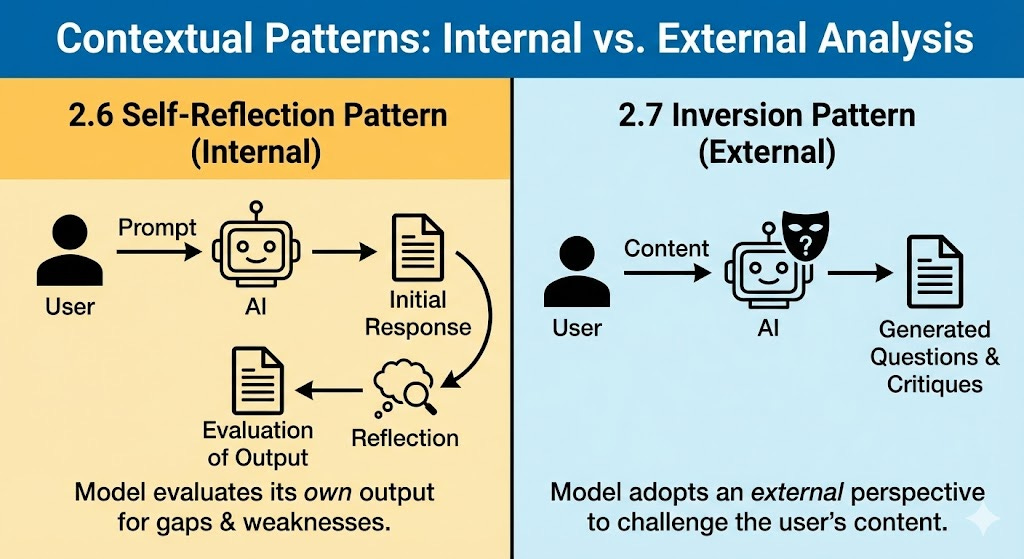
The Inversion Pattern fundamentally reverses the analytical relationship between user and model by flipping from Task → Execution to Content → Analysis. Traditional prompting follows a directive flow where you define what you want done, and the model executes those instructions. Inversion transforms the model from executor into interrogator, you provide content, and the model generates questions, critiques, or challenges of that material. This approach elicits analytical output patterns rather than just execution patterns from the model’s training, creating a fundamentally different approach to problem-solving through systematic external perspective.
This pattern solves critical problems that internal review cannot address because role reversal generates genuinely external analytical frameworks. When you’re embedded in your own thinking, you cannot see assumptions, gaps, or weaknesses that are obvious to outside observers. By prompting the model to generate questions from different professional perspectives, you elicit identification of blind spots that internal analysis misses. The inversion mechanism works because models can generate analytical approaches different from your natural perspective. A skeptical client perspective generates risk-focused analysis, while a technical implementer perspective produces feasibility-focused content, generating content you wouldn’t naturally consider. This makes inversion uniquely powerful for training data generation, reasoning validation, and content improvement where external scrutiny reveals hidden weaknesses.
Use the Inversion Pattern when you need systematic external perspective on existing content, want to identify knowledge gaps before high-stakes presentations, or need to generate complementary materials like interview questions or FAQ entries. Unlike patterns that modify task execution (Role Assignment, Template) or organize information (Delimiter), inversion changes who does the analyzing, making it essential when your proximity to content creates blind spots. Skip inversion for simple factual content where obvious questions add little value, urgent tasks where additional analysis isn’t practical, or when external perspectives won’t improve outcomes. Inversion typically initiates multistep workflows where you answer the model’s questions, then apply the Refinement Pattern to improve original content based on insights gained through systematic external interrogation.
2.7.1 Practical example: Marketing strategy validation
A marketing director has developed a campaign strategy but wants to identify potential objections from different stakeholders before presenting them to leadership.
TIP Replace {strategy_content} with any strategy document, proposal, or content you want examined from multiple external perspectives.
Initial prompt template
(RD)
Marketing Strategy
{strategy_content}
Generate challenging questions from three different perspectives: a cost-conscious CFO focused on financial risk, a data-driven performance marketer focused on measurement, and a brand-protective executive focused on reputation risk. Keep responses to 2-3 questions total, with each question as one sentence.
Prompt with Variables Injected
(RD)
Marketing Strategy
Launch a premium product line targeting millennials through Instagram and TikTok campaigns emphasizing sustainability and social impact. Budget: $200K over 6 months. Expected 25% increase in brand awareness and 15% revenue growth from new customer acquisition.
Generate challenging questions from three different perspectives: a cost-conscious CFO focused on financial risk, a data-driven performance marketer focused on measurement, and a brand-protective executive focused on reputation risk. Keep responses to 2-3 questions total, with each question as one sentence.
Here are three challenging questions framed from each perspective:
Cost-Conscious CFO (Financial Risk)
* How do we justify allocating $200K to a 6-month campaign without guaranteed ROI when less expensive channels could drive similar awareness?
Data-Driven Performance Marketer (Measurement)
* What specific KPIs and attribution models will we use to prove a direct link between Instagram/TikTok engagement and the targeted 15% revenue growth?
Brand-Protective Executive (Reputation Risk)
* How do we ensure our sustainability and social impact messaging is credible and not perceived as “greenwashing” by a skeptical audience?
The inversion reveals critical gaps in ROI justification, measurement methodology, and credibility concerns across different stakeholder perspectives that weren’t apparent in the original strategy but represent essential preparation areas for leadership presentation.
2.7.2 Hands-on practice
Practice applying the Inversion Pattern to systematically generate external analytical perspectives on your content. For each scenario, use inversion to have the model interrogate content from specific professional viewpoints:
Present a product launch timeline and ask the model to generate questions from both an operations manager concerned about logistics and a customer success manager worried about support readiness.
Share a budget allocation proposal and have the model adopt perspectives of both a department head fighting for resources and an executive evaluating strategic priorities across competing initiatives.
Provide a hiring strategy and ask the model to question it from viewpoints of both a diversity advocate focused on inclusive practices and a hiring manager concerned about execution timelines.
Focus on having the model adopt genuinely different analytical frameworks rather than generic questioning and use the systematic external interrogation to identify substantive strategic gaps that internal review typically misses. The Refinement Pattern naturally follows inversion by helping you systematically address weaknesses revealed through external perspective analysis.
2.8 Refinement Pattern
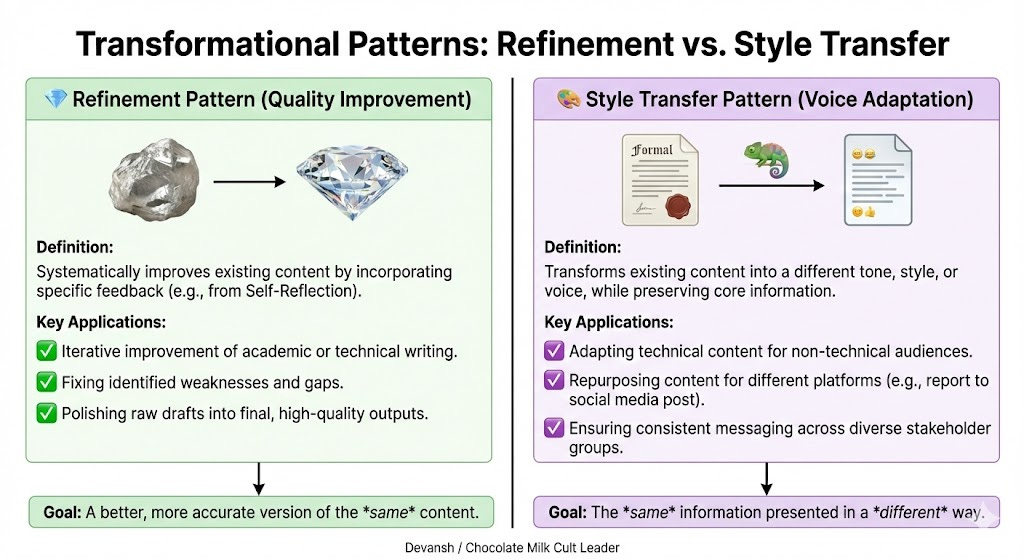
The Refinement Pattern systematically improves existing content by incorporating specific feedback, recommendations, or insights generated through other prompt patterns. This pattern operates as the implementation phase of multistep workflows and should never be used in isolation: after Self-Reflection identifies weaknesses or gaps, refinement addresses those specific problems; after Inversion generates challenging questions, refinement incorporates your answers into improved content. Refinement transforms raw material into polished outputs through targeted improvements rather than complete regeneration.
This pattern solves the critical problem of translating analytical insights into actionable improvements. Self-reflection might reveal that your study guide lacks concrete examples for complex concepts, but without refinement, you’re left with criticism rather than solutions. Inversion might generate challenging questions about your explanation from a confused reader’s perspective, but without integration of your responses, the original content remains vulnerable to those same confusion points. The quality of refinement directly correlates with the quality of preceding analysis, weak self-reflection generates generic improvements, while thorough analysis generates targeted, meaningful enhancement.
Use the Refinement Pattern after applying Self-Reflection or Inversion patterns that have generated specific, actionable improvement recommendations. This pattern is essential for academic writing, study materials, explanatory content, or any work where iterative improvement based on analysis creates superior outcomes. Skip refinement when initial outputs already meet requirements, when time constraints make multiple iterations impractical, or when preceding analysis fails to identify concrete improvement areas. To prevent meaning drifting during refinement, use explicit constraints such as “preserve the original [methodology/argument structure/core concept], while improving [specific elements identified in analysis]” and consider using delimiters to separate unchangeable content from refinement targets.
2.8.1 Practical example: Study explanation improvement
A student has written an explanation of a concept they’re studying but wants to improve it based on systematic evaluation before using it for exam preparation.
TIP Replace {concept_explanation} with any concept explanation, study note, or educational content you want to systematically improve through analysis and refinement.
Initial prompt template
(RD)
Concept Explanation
{concept_explanation}
Please evaluate this explanation and keep your response to 3-4 sentences.
Prompt with variables injected
(RD)
Concept Explanation
The water cycle is the process where water moves around Earth through different stages. Water evaporates from oceans and lakes, forms clouds, then falls as rain. This process repeats continuously and is important for life on Earth.
Please evaluate this explanation and keep your response to 3-4 sentences.
Your explanation of the water cycle is clear and captures the essential stages of evaporation, condensation, and precipitation. However, it could be improved by including transpiration from plants and infiltration into the ground, which are also key processes. The phrasing “forms clouds” is correct but could be more precise by naming the process as “condensation.” Overall, it is a good beginner-level summary, but a little more detail would make it more accurate and complete.
Self-Reflection applied
(RD) Please self-reflect on this water cycle explanation. What important elements might be missing that would help someone actually understand and remember this concept? Keep your analysis to 2-3 sentences.
The explanation is missing mention of processes such as transpiration, infiltration, and runoff, which show how water moves through land and living systems, not just the ocean and sky. It also does not explain the role of the sun’s energy in driving the entire cycle, which is crucial for understanding why it repeats. Including these elements would make the concept more memorable by connecting it to everyday experiences like plants, rivers, and sunlight.
Refinement Pattern applied
(RD) Based on your self-reflection, please refine the original water cycle explanation to address the missing elements you identified. Preserve the original simple, accessible tone while adding the practical elements you noted as missing. Keep the refined version to 4-5 sentences.
The water cycle is the continuous movement of water around Earth, powered by the sun’s energy. Water evaporates from oceans, lakes, and rivers, and plants release water through transpiration; together, these form water vapor that condenses into clouds. When the clouds become heavy, water falls as rain or snow, which can soak into the ground (infiltration) or flow across the land into rivers and back to the sea (runoff). This repeating cycle connects the sky, land, and living things, making it essential for life on Earth.
The refinement systematically addresses gaps identified through self-reflection, adding missing processes (transpiration, infiltration, runoff), explaining the sun’s driving role, and connecting abstract concepts to everyday experiences, while preserving the original accessible tone and foundational accuracy.
2.8.2 Hands-on practice
Practice applying the Refinement Pattern to improve content based on systematic feedback from other prompt patterns. For each scenario below, create initial content, apply either Self-Reflection or Inversion, then use refinement to implement improvements:
Write an explanation of how democracy works for a civics class (three sentences), apply self-reflection to identify missing elements that would help understanding, then refine addressing conceptual gaps, provide examples, and include memorable details.
Create a summary of the causes of World War I (three to four sentences), use inversion to generate questions from a confused student’s perspective, then refine the summary to proactively answer those questions and improve clarity.
Draft a study technique explanation for effective notetaking (three to four steps), apply self-reflection to examine completeness and potential student confusion, then refine to create more comprehensive guidance that addresses different learning styles and common mistakes.
Focus on systematic improvement rather than complete rewriting, using explicit constraints such as “preserve the original [tone/core concept/basic structure] while improving [specific identified weaknesses]” to prevent meaning drifting during refinement. While the Refinement Pattern preserves original voice and structure during improvement, situations often arise where you need to completely transform how content sounds or appears while maintaining its core information, this is where the Style Transfer Pattern becomes essential.
2.9 Style Transfer Pattern
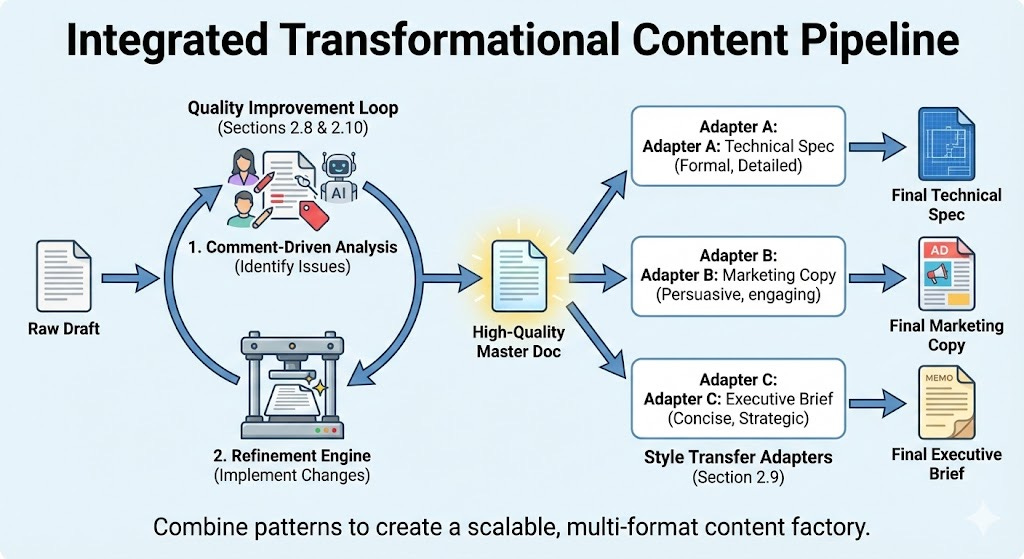
The Style Transfer Pattern transforms existing content into a different style, tone, or voice, while preserving the core information and message. Unlike the Role Assignment Pattern, which shapes content generation from the beginning by having the model adopt a specific persona, style transfer takes completed content and reworks it to match different stylistic requirements. This pattern serves as the systematic solution to the common professional challenge of needing identical information presented effectively across multiple audiences, eliminating the time waste, consistency problems, and quality degradation that occur when manually rewriting content for different stakeholders.
This pattern addresses critical pain points in professional content workflows: manually rewriting content for different audiences is inefficient and error-prone, consuming hours that could be spent on higher-value activities; when people recreate content from scratch multiple times, key information gets lost, added, or changed, creating inconsistencies that undermine credibility; maintaining multiple versions manually creates ongoing cognitive burden and maintenance overhead as information updates; and manual style adaptation often results in either dumbed-down content that loses important nuances or overly complex content that confuses the target audience. Style transfer eliminates these problems by using the model’s learned representations of linguistic patterns to systematically adapt vocabulary, sentence complexity, and structural organization while maintaining factual accuracy and core arguments.
Use the Style Transfer Pattern when you have content that needs to reach three or more different stakeholder groups, when core information must remain identical across versions, or when manual rewriting has previously introduced errors or inconsistencies. This pattern excels at scaling content creation by eliminating revision cycles where manually adapted content misses the mark and reducing quality control burden by maintaining factual consistency across versions. Skip style transfer for one-off communications, when content is already close to the target style, when the audience shift is minimal (such as formal email to slightly less formal email), or when starting with the target style from the beginning would be more efficient than transformation.
2.9.1 Practical example: Technical explanation adaptation
A software engineer needs to explain a complex technical concept to both technical colleagues and non-technical stakeholders but wants to ensure the core information remains consistent across both versions.
TIP Replace {technical_content} with any technical explanation, documentation, or complex concept that needs to be adapted for different audiences.
Initial prompt template
(RD)
Technical Content
{technical_content}
Transform this technical explanation into language suitable for a non-technical executive audience. Preserve all key information while making it accessible to someone without programming background. Keep your response to 2-3 sentences.
Prompt with variables injected
(RD)
Technical Content
Our microservices architecture uses Docker containers orchestrated by Kubernetes to achieve horizontal scaling. Each service runs in isolated containers that can be replicated across multiple nodes, allowing us to handle increased load by spinning up additional instances automatically through the Horizontal Pod Autoscaler based on CPU and memory metrics.
Transform this technical explanation into language suitable for a non-technical executive audience. Preserve all key information while making it accessible to someone without programming background. Keep your response to 2-3 sentences.
We use a modern system that automatically adjusts to demand. Each part of our platform runs independently and can be replicated across many servers, so when activity increases, the system adds more capacity on its own. This ensures smooth performance for customers without requiring manual intervention.
The style transfer successfully transforms technical jargon into executive-friendly language by replacing “microservices architecture,” “Docker containers,” and “Kubernetes” with “modern system” and “platform parts,” while maintaining all essential information about scalability, independence, and automation. The business-focused outcome emphasizes customer benefits and operational efficiency rather than implementation details, making complex infrastructure concepts accessible to nontechnical decision-makers.
2.9.2 Hands-on practice
Practice applying the Style Transfer Pattern to adapt content for different audiences and communication contexts. For each scenario, create original content then transform it to match different stylistic requirements:
Write a technical bug report in formal documentation style (three to four sentences), then transfer it to casual team chat language that maintains all critical debugging information, while using conversational tone and familiar terminology.
Create an academic explanation of a concept from your field of study using formal scholarly language (three to four sentences), then transform it into social media post style that preserves accuracy, while using accessible language and engaging presentation.
Draft a formal project proposal summary with professional business language (three to four sentences), then transfer it to friendly email style suitable for internal team communication that maintains all key project details while using more personal, collaborative tone.
While the Style Transfer Pattern transforms how existing content sounds and appears, situations often require structured collaborative workflows where multiple perspectives systematically improve content quality, which brings us to Comment-Driven Generation.
2.10 Comment-Driven Generation
Comment-Driven Generation represents a structured approach to collaborative content improvement that mirrors professional editorial workflows found in document review and code review processes. This pattern, designed by Richard Davies, coauthor of AI Engineering in Practice (Manning, 2024), transforms unstructured feedback into systematic improvement by organizing comments around specific text selections, thus enabling precise targeting of revision rather than vague general suggestions. Unlike patterns that work with entire documents or generate new content from scratch, Comment-Driven Generation focuses improvement efforts on specific problematic sections, while preserving the overall structure and flow of existing work.
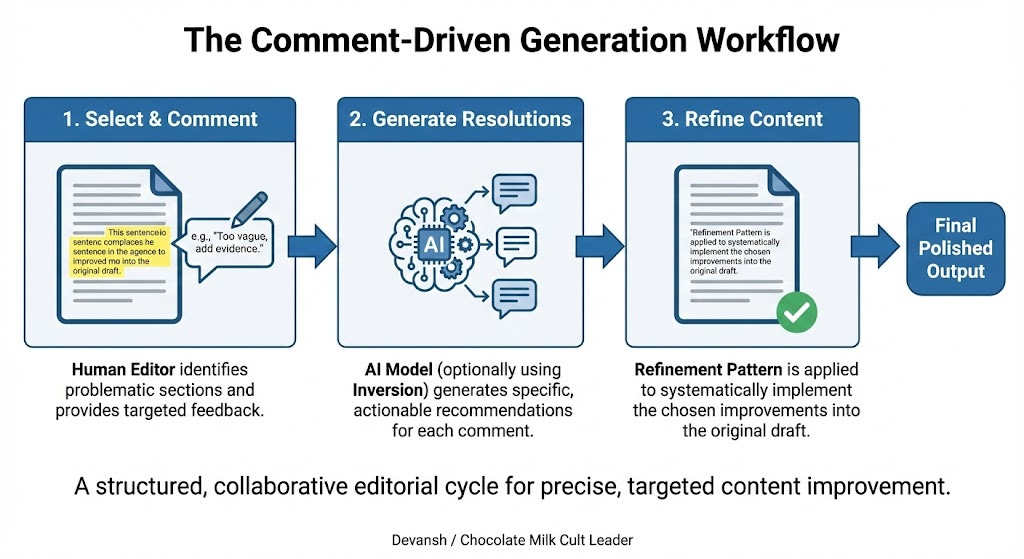
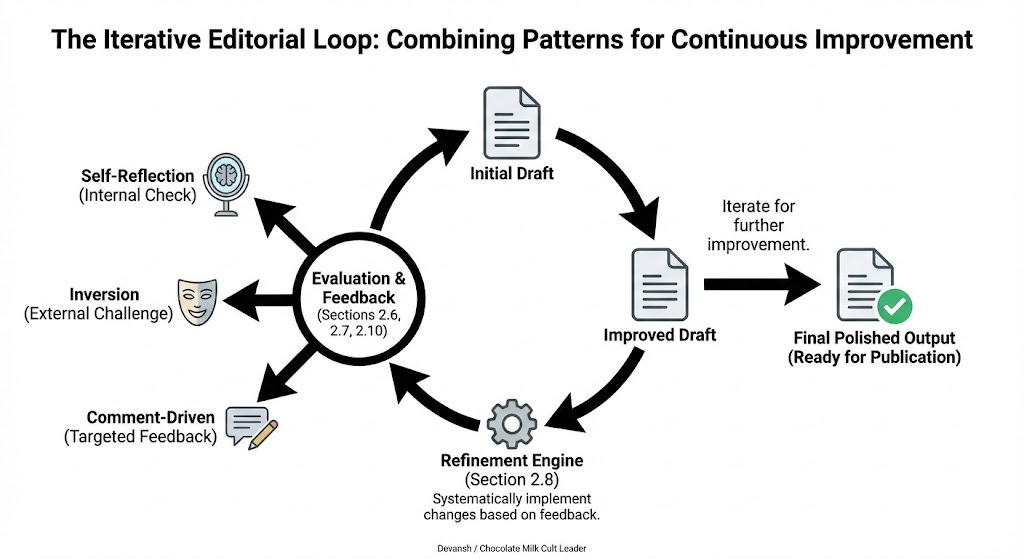
The pattern works by creating explicit relationships between selected text, editorial comments, and potential resolutions, establishing a clear workflow that prevents the common problem of losing track of which feedback applies to specific content sections. You identify specific text segments that need attention, attach targeted comments explaining the improvement needed, and either provide your own proposed solutions or use the Inversion Pattern to have the model generate resolution recommendations. The complete workflow typically involves Comment-Driven Generation to organize feedback, optional use of the Inversion Pattern to generate resolution recommendations, followed by the Refinement Pattern to implement improvements in the original content, which creates a systematic editorial cycle from feedback identification to finished improvement.
This systematic approach is especially valuable when multiple improvements are needed simultaneously, as you can batch several comment–selection pairs into a single prompt, thus creating comprehensive revision guidance, like collaborative editing in professional document review, or pull request feedback workflows. However, this pattern’s effectiveness depends heavily on comment quality, specific, actionable comments, such as “lacks supporting evidence for this claim,” generate useful recommendations, while vague feedback such as “this needs work” produces generic suggestions that don’t drive meaningful improvement. Use Comment-Driven Generation when existing content needs targeted improvements rather than complete rewrites, when working with collaborative teams that need structured feedback workflows, or when you want to preserve most of your original work, while addressing specific problematic sections. This pattern benefits any content creator seeking systematic improvement—including professional documentation, creative writing, academic papers, and personal projects—which makes it valuable for amateur artists, hobbyist writers, and anyone developing content iteratively.
2.10.1 Practical example: Research paper introduction refinement
A graduate student has written a research paper introduction but received feedback from their advisor identifying several areas that need improvement before submission.
TIP Replace {content} with any document, essay, report, or written content that needs targeted improvements based on specific feedback.
Initial prompt template
(RD)
Content
{content}
Editor’s Comments
    Selected Text: “[Selected text goes here...]”
Comment: “[Comment about selected content goes here...]”
---
Selected Text: “[Selected text goes here...]”
Comment: “[Comment about selected content goes here...]”
---
Selected Text: “[Selected text goes here...]”
Comment: “[Comment about selected content goes here...]”
Can you review each of the comments the editor made about the selected content, and make recommendations about how to best resolve them. Keep your response to 2-3 sentences per comment.
Prompt with variables injected
(RD)
Content
Artificial intelligence has become increasingly important in recent years. Many researchers are working on machine learning algorithms that can solve complex problems. This paper examines the use of neural networks in natural language processing applications, specifically focusing on sentiment analysis tasks.
Editor’s Comments
    Selected Text: “Artificial intelligence has become increasingly important in recent years”
Comment: “Too vague - specify what makes it important and provide concrete evidence or statistics”
---
Selected Text: “Many researchers are working on machine learning algorithms that can solve complex problems”
Comment: “Generic statement that doesn’t establish your specific contribution or research gap”
---
Selected Text: “This paper examines the use of neural networks in natural language processing applications, specifically focusing on sentiment analysis tasks”
Comment: “Missing motivation - why is sentiment analysis important and what specific challenge does your approach address?”
Can you review each of the comments the editor made about the selected content, and make recommendations about how to best resolve them. Keep your response to 2-3 sentences per comment.
Here are targeted recommendations for each of the editor’s comments:
Comment 1:
*”Artificial intelligence has become increasingly important in recent years”*
* *Issue:* Too vague.
* *Recommendation:* Replace the general claim with specific indicators of AI’s importance, such as global investment figures, adoption in critical industries, or measurable performance gains in benchmarks. For example, you might reference AI’s role in autonomous driving, healthcare diagnostics, or the fact that AI investments surpassed a certain amount in recent years.
Comment 2:
*”Many researchers are working on machine learning algorithms that can solve complex problems”*
* *Issue:* Generic and lacks contribution or research gap.
* *Recommendation:* Clarify the unique aspect of your work relative to existing research. This could involve noting that while many algorithms exist, most struggle with interpretability, efficiency, or generalization—and your study addresses one of these gaps. Positioning your work against a well-defined challenge strengthens its novelty.
Comment 3:
*”This paper examines the use of neural networks in natural language processing applications, specifically focusing on sentiment analysis tasks”*
* *Issue:* Missing motivation.
* *Recommendation:* Explain why sentiment analysis matters, such as its impact on business intelligence, social media monitoring, or customer service automation. Then specify the exact problem your paper tackles—for example, improving sentiment detection in low-resource languages or handling sarcasm—so readers see both the relevance and the research contribution.
Would you like me to draft revised versions of each sentence directly (as if rewritten for your paper), or just keep them as high-level suggestions?
The Comment-Driven Generation pattern creates structured, actionable recommendations for each identified problem area, demonstrating how organized editorial feedback generates specific improvement pathways that maintain context and prevent revision confusion. Notice how the model generates responses to different types of editorial concern specificity, research positioning, and motivation, with solutions tailored for each comment category. At this point, you would typically apply the Refinement Pattern to implement these recommendations and update the original content, completing the editorial workflow from structured feedback to finished improvement through systematic implementation of the suggested changes.
2.10.2 Hands-on practice
Practice applying Comment-Driven Generation to systematically improve existing content through targeted editorial feedback. For each scenario, identify specific text selections that need improvement and create structured comments that enable precise refinement, working with focused content sections rather than attempting to comment on entire documents simultaneously:
Take a personal statement or cover letter you’ve written and create editorial comments targeting weak sections like generic opening statements, unsupported claims about your abilities, or conclusions that don’t effectively summarize your value proposition. After receiving recommendations, apply the Refinement Pattern to implement the suggested improvements.
Review a technical explanation or tutorial you’ve created and add comments addressing sections where jargon isn’t explained, steps are unclear or missing, or examples don’t effectively illustrate complex concepts for your intended audience.
Examine a project proposal or business plan draft and create targeted comments for sections with vague objectives, unrealistic timelines, insufficient risk assessment, or budget justifications that lack supporting evidence.
While Comment-Driven Generation provides structured collaborative improvement workflows, the foundations of effective prompt engineering ultimately depend on understanding when and how to provide strategic examples that guide model behavior, which leads us to the comprehensive examination of contextual prompting techniques.
Summary
You now have nine proven patterns that transform AI interactions from trial-and-error into reliable, systematic workflows. Structural patterns establish consistent behavior, contextual patterns reveal blind spots through external perspectives, and transformational patterns systematically enhance content quality. These patterns work independently or combine powerfully Self-Reflection identifies gaps that Refinement fixes, while Inversion generates challenging questions that drive strategic improvements.
This systematic approach eliminates guesswork and enables you to tackle any prompting challenge with tested methodologies.
Systematic patterns eliminate trial-and-error prompting. Role Assignment activates domain expertise immediately, while Delimiter organization prevents template errors that waste revision cycles
Template and Tail Generation patterns ensure professional consistency. Structured outputs integrate directly with business workflows, while maintaining behavioral reliability across extended AI interactions.
Self-Reflection and Inversion patterns catch expensive mistakes before implementation. Systematic evaluation reveals overlooked gaps, while external questioning exposes blind spots that internal review misses.
Multistep workflows combine patterns for complex challenges. Self-Reflection identifies weaknesses that Refinement systematically fixes, while Style Transfer adapts content across audiences without recreating from scratch.
Pattern mastery transforms AI interaction from unreliable iteration into predictable professional results. Transferable methodologies work across domains, eliminating costly revisions, while ensuring outcomes of consistent quality.
Thank you for being here, and I hope you have a wonderful day,
Dev <3
If you liked this article and wish to share it, please refer to the following guidelines
That is it for this piece. I appreciate your time. As always, if you’re interested in working with me or checking out my other work, my links will be at the end of this email/post. And if you found value in this write-up, I would appreciate you sharing it with more people. It is word-of-mouth referrals like yours that help me grow. The best way to share testimonials is to share articles and tag me in your post so I can see/share it.

Reach out to me
Use the links below to check out my other content, learn more about tutoring, reach out to me about projects, or just to say hi.
Small Snippets about Tech, AI and Machine Learning over here
AI Newsletter- https://artificialintelligencemadesimple.substack.com/
My grandma’s favorite Tech Newsletter- https://codinginterviewsmadesimple.substack.com/
My (imaginary) sister’s favorite MLOps Podcast-
Check out my other articles on Medium. :
https://machine-learning-made-simple.medium.com/
My YouTube: https://www.youtube.com/@ChocolateMilkCultLeader/
Reach out to me on LinkedIn. Let’s connect: https://www.linkedin.com/in/devansh-devansh-516004168/
My Instagram: https://www.instagram.com/iseethings404/
My Twitter: https://twitter.com/Machine01776819
Devansh once again delivers a timely masterclass as attention shifts to context engineering. This serves as a critical reminder of the significant impact that prompt design holds in the broader context.
As a side note, we've been increasingly focusing on the 'Role Assignment' pattern for intelligence analysis, crisis management, and forecasting, and found a fascinating Stanford paper titled: "Ask WhAI: Probing Belief Formation in Role-Primed LLM Agents" - it explores the distinction between 'roles' and 'expertise' and how these can lead to different reasoning patterns based on different persona prompt design. Worth reading.
“Self-Reflection and Inversion patterns catch expensive mistakes before implementation. Systematic evaluation reveals overlooked gaps, while external questioning exposes blind spots that internal review misses.”
Couldn’t agree more. The inversion patterns seem to be one of my most powerful prompts all the time. The ability to expose blind spots when you challenge the bot to do so is amazing.