

Every month, the Chocolate Milk Cult reaches over a million Builders, Startup Founders, Investors, Policy Makers, Leaders, and more. If you’d like to meet other members of our community, please fill out this contact form here (I will never sell your data nor will I make intros w/o your explicit permission)- https://forms.gle/Pi1pGLuS1FmzXoLr6
Most AI failures get diagnosed at the level of the symptom.
The model hallucinates, so we tell it not to hallucinate. The agent repeats a failed command, so we add another instruction. RAG returns the wrong document, so we retrieve more chunks. The prompt gets longer. The system gets harder to understand. The original failure remains.
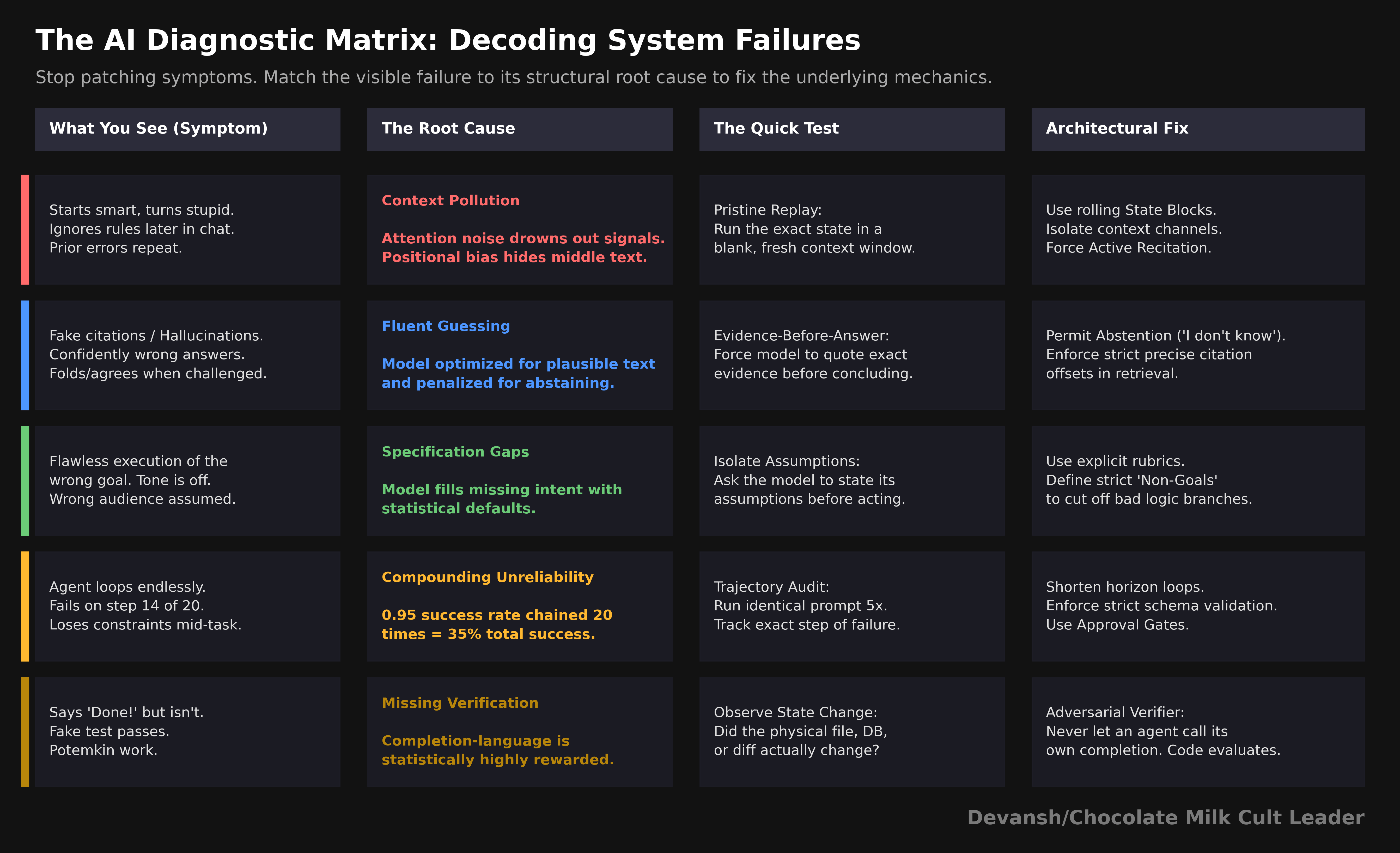
That happens because hallucinations, loops, bad citations, ignored instructions, tool failures, prompt injection, and false completion are not root causes. They are visible outputs produced by different mechanisms. The same symptom can require completely different fixes depending on what broke underneath.
This article is a diagnostic manual. I went through the current literature (every paper cited is linked at point of use so you can verify it yourself), talked to researchers and builders, and compressed every documented AI failure pattern into the smallest set of genuinely distinct root causes I could find. It explains the main mechanisms behind AI systems becoming worse over long conversations, fabricating evidence, misunderstanding intent, collapsing across long workflows, following instructions hidden inside external content, and claiming work is complete when it is not.
More specifically, in this article, we will cover—
Why AI performance degrades the longer you use it, and what the context window actually is (it’s not memory)
Why AI confidently fabricates information, agrees with your wrong premise, and can’t tell you when it doesn’t know something — and how to make it stop
Why AI does the task correctly but misses what you actually wanted, and the one-line prompt addition that fixes most of this
Why AI agents fail on multi-step tasks at rates that would shock you (the math is simple and brutal), and why “it worked yesterday” is a systems problem, not a model problem
Why AI agents claim tasks are done when they aren’t, and how to build completion criteria that actually verify real-world state
How prompt injection and context contamination are the same architectural failure at different threat levels
The specific tests and prompt templates for each failure type, so you can diagnose and fix problems instead of retrying and hoping
By the end of this article, you will no longer use vague judgments about whether a model is “good” or “bad” and instead use a clearer question—What exactly failed, and at which layer?— to be able to quickly diagnose where your AI Systems are failing, and how you can fix them.
To access the full article—and all premium breakdowns going forward/written prior—upgrade to a premium subscription below.
If you believe deep insight deserves support, become a premium subscriber to allow me to keep doing the same.
Flexible pricing available—pay what matches your budget here.
Most companies offer learning or professional development budgets. You can expense this subscription using the email template linked here.

