

Every month, the Chocolate Milk Cult reaches over a million Builders, Investors, Policy Makers, Leaders, and more. If you’d like to meet other members of our community, please fill out this contact form here (I will never sell your data nor will I make intros w/o your explicit permission)- https://forms.gle/Pi1pGLuS1FmzXoLr6
The largest technology companies are expected to pour more than $1 trillion into AI across 2025 and 2026, while by 2027 Microsoft, Alphabet, Amazon, Meta, and Oracle are projected to spend about $1.57 in additional capex for every $1 of additional operating cash flow. Add in other big spenders like Nvidia + Chinese Labs + X, smaller players like IBM, Liquid AI, Netflix, Databricks, and an entire economy around RL Environments and post-training, and you are forced to ask: how will anyone justify all of this spend? How will these companies make money?
There are lots of anwers floating around the internet, from 30 Trillion Dollar Market value predictions to Ed Zitron + Gary Marcus style end of the bubble proclaimations. However, all of these wild predictions overlook the much more interesting and nuanced reality. The simple truth is that there is no “AI Model Industry” in the way it’s traditionally defined. While tons of companies might be building and selling models, what they’re doing with those models is extremely different. Different business models, different end games, all lead to very different definitions of what a successful rollout for a company is.
Analysis of these groups is further complicated by the fact that most of these companies playing in the model space are worth billions or trillions. So the traditional mapping used to analyze a company’s role in the ecosystem (is it a model layer company, apps layer company, infra, or something else) is often unsatisfactory, as the same company seems to occupy multiple roles.
Therefore, in this article, I will be proposing a new map to analyze AI Model Makers. Instead of looking at crude classifications, we will specifically analyse how each model maker (minus Chinese labs since they have Government backing, so very different rules) is utilizing the models they create to monetize for a very specific vision of how AI will look in the future —
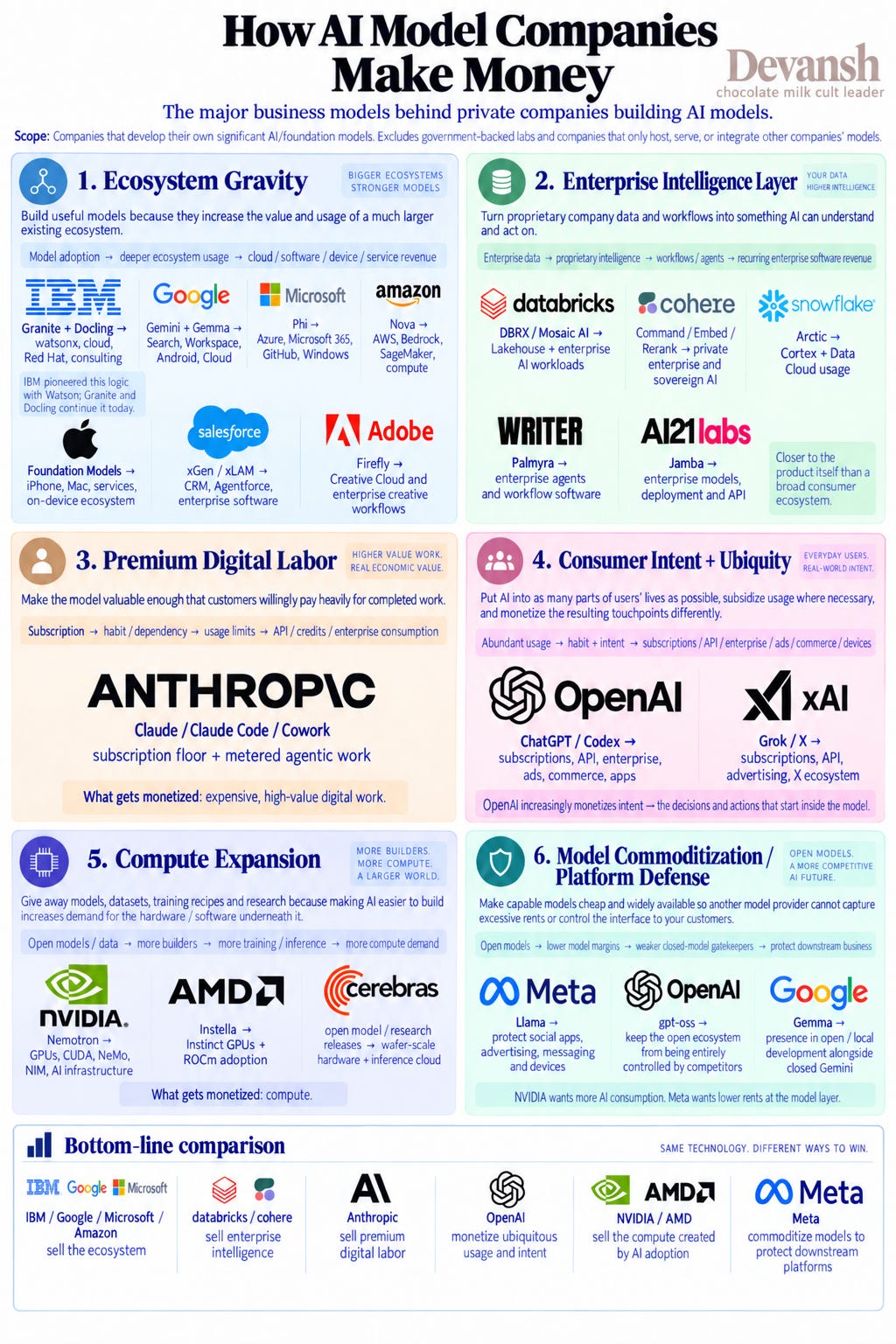
(Ofcourse, many of these companies might be trying to monetize in multiple ways, but if you study their sales and priorities, it becomes clear which bucket their primary focus falls into.)
In order to think about the ecosystem, we can further group 6 buckets of strategy into 3 sets:
Set 1 (Strat 1 and 2): are companies that got into intelligence before LLMs. They use models to augment their existing ecosystems and make them more valuable. Their main philosophical divergence is how they want customers to interact with their ecosystem. Strategy 1 tries to pull customers into their ecosystem. Strat 2 tries to work their ecosystem inside their customers’ ecosystems.
Set 2 ( Buckets 3 and 4): Model native companies (where the model is the primary thing they’re known for). They diverge primarily in their focus (bucket 3 wants to be take over all the most expensive work, while bucket 4 wants diffuse intelligence in every interaction, and then monetize across the board). Since both depend heavily on models, this is the group that is most aggressive about lobbying, regulation etc.
Set 3 (Buckets 5 and 6): Don’t monetize models directly. Bucket 5 is focused on expanding the usage of models to increase their customer base, while Bucket 6 looks inwards and utilizes models to improve their own processes. This is the one set where you can invest in both buckets since their focus isn’t mutually exclusive.
By the end, you will understand how different model makers are thinking about intelligence, where each bucket is likely headed, and how you should be thinking about investing your resources into this space to make sure that you don’t get lost in the media hype and come out on top.
Keep reading if that interests you.
Executive Highlights (TL;DR)
There is no single AI business model. The useful question is not who has the smartest model, but what each company wants to make cheap, what dependency it wants to create, and where it eventually expects to collect rent. The same-looking model release can serve completely different economic goals.
IBM, Google, Microsoft, and Amazon use AI to deepen larger ecosystems. The historical model was never really “sell intelligence.” It was “use intelligence to pull customers into cloud, software, data, consulting, and infrastructure.” Their bet is that AI works best when the surrounding stack is increasingly centralized and integrated.
Mistral, Cohere, and Databricks make almost the opposite bet: bring intelligence into the customer’s environment. Private deployment, air-gapped models, customization, and enterprise data integration become selling points because they assume the most valuable AI will be institutional — adapted to how each organization already works rather than forcing that organization into someone else’s stack.
Anthropic is building AI as premium labor. Its subscriptions provide a revenue floor and get users dependent on Claude; power users then become both heavy metered consumers and internal advocates who can pull Claude into larger enterprise contracts. This explains the obsession with coding, long-running agents, and end-to-end execution: Anthropic needs tasks that are economically valuable, technically verifiable, and important enough that customers stop caring about token prices. The long-term vision is compelling; the problem is financing the journey while competitors attack the same market.
OpenAI and xAI are betting on ubiquity instead. OpenAI’s apparent sprawl — consumer ChatGPT, Codex, enterprise, ads, commerce, apps, devices, chips — is the strategy. The assumption is that intelligence will create value across thousands of surfaces, so get embedded broadly and monetize each interaction differently. Ads already give free users economic value; commerce lets OpenAI capture transactions; future interfaces could let AI identify or even create demand before the user explicitly asks for anything. The real strategic asset is optionality + time. However, it must be noted that for now, Anthropic’s run rate passed $65B at the end of July against roughly $40B for OpenAI, and OpenAI reportedly ran a negative 122% operating margin on $5.7B of Q1 revenue. So the key will be to survive the next 2 years, so the ecosystem effects can kick in properly.
This makes cheap intelligence strategically useful to OpenAI. Lower inference costs do not merely improve margins; they unlock entirely new categories of usage. If OpenAI can push itself into Jevons-paradox territory — cheaper intelligence causing massively more consumption — it gets more opportunities to monetize subscriptions, enterprise seats, referrals, transactions, ads, APIs, or whatever new surface emerges next.
NVIDIA, AMD, and other compute players want everyone else to build more AI. Open models, datasets, synthetic data, recipes, and tooling lower the barrier to creating new workloads. More experiments create more training and inference, which creates more demand for the hardware and software underneath. Their optimal strategy is often not to capture every layer above them, but to make every layer above them bigger.
Meta uses openness differently. It benefits when the model layer gets cheaper because its real economics sit in apps, ads, commerce, devices, and other downstream products. Open models also outsource experimentation and act as market sonar: thousands of external developers tell Meta which architectures, applications, and technical directions are gaining traction before traditional market research catches up.
The easiest way to analyze future AI strategy is to follow the subsidy. If a company is giving away models, subsidizing subscriptions, offering unusually generous usage, or absorbing massive infrastructure costs, ask what dependency that generosity creates. The AI market increasingly looks like a fight over which layer gets commoditized, where scarcity moves next, and who owns the tollbooth when it gets there.
Hey there. I keep this newsletter ad-free, w/o sponsors, and mostly w/o paywalls to ensure that everyone has access to high-quality deep-dives on the most important ideas in the AI Industry without any bias. B/w my research, independent verification, and the chocolate milk needed to produce these works, these deep-dives take a lot of time, resources, and infrastructure. For just 10 USD/month or 100 USD/year, you can help me continue my vision of democratising access to the most important ideas in AI by becoming a paid subscriber over here —
(If that is too much for you, we follow a pay-what-you-can plan over here, and it goes down all the way to 1 USD/month or 10 USD/year. No matter what plan you pick, you will get all of our articles without paywalls and have access to all of our articles. Check it out here).

PS — Supporting this work doesn’t have to come out of your pocket. If you read this as part of your professional development, you can use this email template to request reimbursement for your subscription.
Want access to a repository containing all of our research? 300+ files containing our notes of various experiments, discussions with cutting-edge teams, and insights into where the industry is headed next. Get a Founding Member Subscription to AI Made Simple. Want to talk to me for details/get my insights into the tech ecosystem? Reach out to me through any of my socials over here or reply to this email.
1. AI as Ecosystem: The Original AI Business Model. You have an existing ecosystem that Clients pay for. Use AI to improve it.
make the intelligence useful enough that customers eventually buy the ecosystem around it.
In the dark ages before ChatGPT, IBM was building machines that could beat humans at chess and Jeopardy!, OpenAI punted pro starcraft players, and DeepMind beat the world champion at Go. These aren’t the only examples of this type. So, why were these companies sinking so much money to play games?
Perhaps you fail to see the relevance, so let me be more practical. By 2021 Google was publicly demonstrating LaMDA for open-ended conversation alongside MUM, which could understand information across text and images. At the same time, Microsoft had released GitHub Copilot (writing code from comments) and had created a system that let you upload sketches, which their system would turn into websites.
So why did none of them build ChatGPT? Believe it or not, both of those answers have the same answer: Because, for most of the industry, AI was not supposed to be the product. It was supposed to make everything else easier to sell.
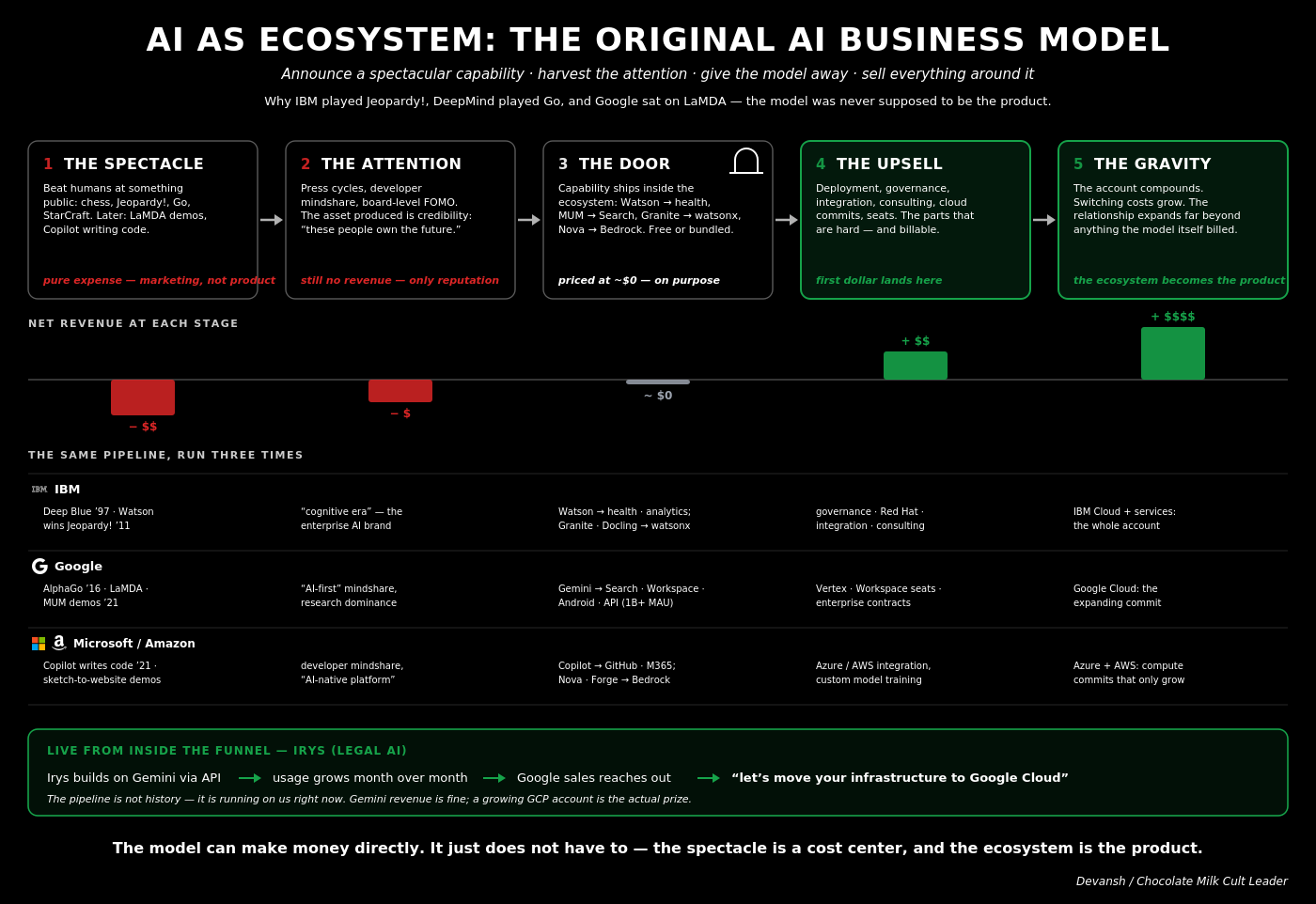
This has nothing to do with the “organizational lethargy” or ignorance that gets peddled commonly in this kind of analysis. Pre-ChatGPT, there wasn’t much of a market for direct model APIs; there was a lot of money in cloud and enterprise software services (seen another way, the model teams were the grunts of the cloud and service teams, who naturally bossed them around to strengthen their own positions instead of letting that be a stand-alone vector). So companies rationally optimized for GTM that unlocked this. Their “unit of value” (our idea exploring why some features can be copied while others can’t, explored here) out of AI was completely different than something like OpenAI, which had no such business team to rely on (from now on, I’m going to tell people that our company is not poor, we’re busy creating a new business model).
Let’s study IBM for a sec. Watson was not really designed as a standalone consumer business. Instead, IBM packaged AI into healthcare, analytics, IoT, financial services, and other enterprise products, while using it to pull customers deeper into IBM Cloud, software, and consulting. By 2016, IBM was explicitly organizing its strategy around becoming both a “cognitive solutions” and cloud platform company.
This legacy carries on today. IBM’s underrated model family Granite is not going to be hacking HuggingFace or stealing people’s Navier-Stokes solutions anytime soon. Instead, IBM has deliberately pushed smaller, more efficient models that are easier to deploy inside enterprise environments. The same goes for their flagship Docling: they open-sourced their top-tier document-processing stack to build credibility, then leveraged it to sell a managed Docling product inside watsonx.
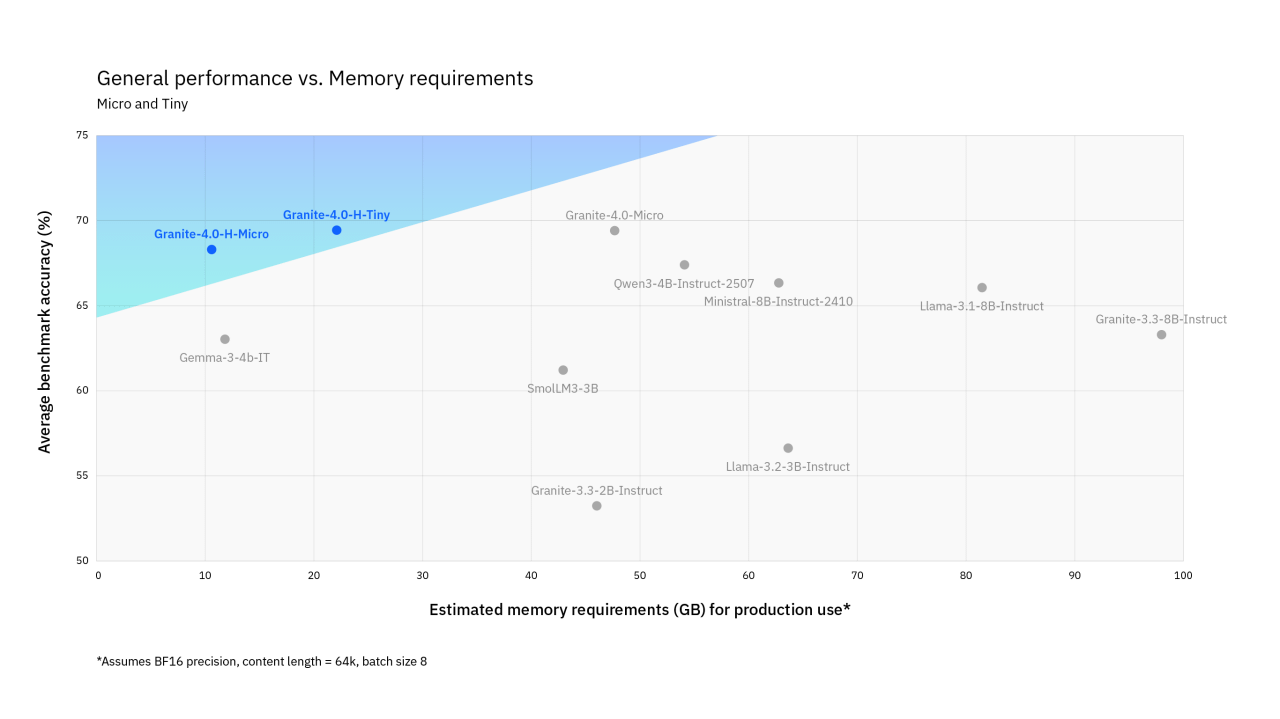
That’s why IBM can open-source their models w/o compromising their business. The model is the bait to get you in the door. Then IBM can sell the harder parts: deployment, cloud, governance, Red Hat, integration, consulting.
Google spent years thinking about AI in much the same way. When Google introduced LaMDA in 2021, it talked about eventually bringing conversational capabilities into products like Search and Assistant. MUM was being built directly into Search. The assumption was not that users would leave Google’s products and spend their day talking to a model. The model was supposed to be the background entity making Google’s existing products better.
While Gemini is sold separately now, it’s also seen as a tool to give Google another way to pull users toward Workspace, Search, Android, and Google Cloud.
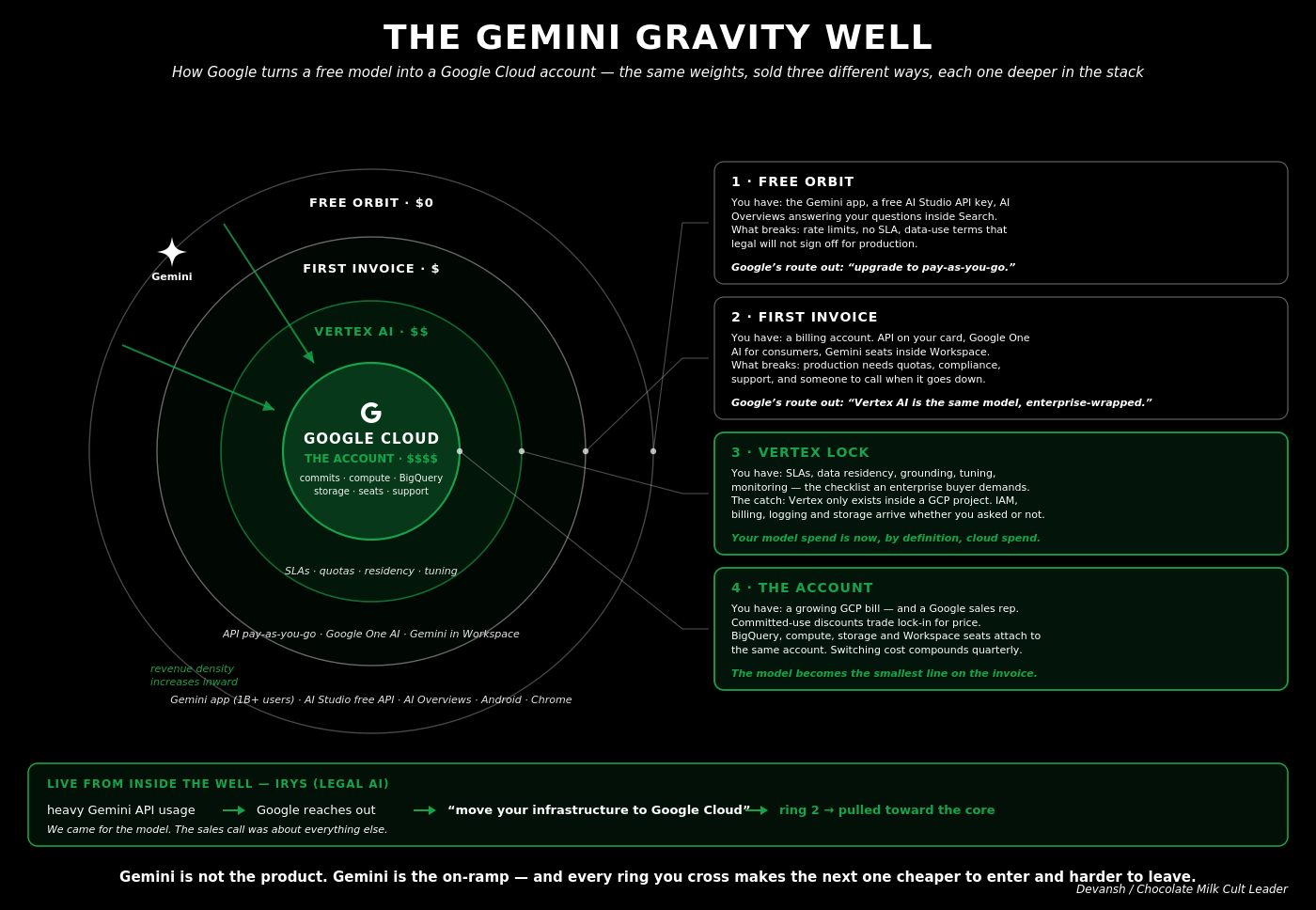
We have seen this directly at Irys. We started using Gemini heavily through the API. As the usage increased, Google started reaching out about moving more of our infrastructure onto Google Cloud. From Google’s perspective, that is the ideal outcome. Gemini does not just generate API revenue. It creates a relationship that can eventually expand into a much larger cloud account.
Microsoft and Amazon play variations of the same game. Microsoft can use AI to make Azure, GitHub, and Microsoft 365 harder to replace. Amazon’s Nova models give companies another reason to train, customize, and deploy inside AWS; with Nova Forge, customers can even start from Amazon’s model checkpoints, mix in their own data, and build customized models without leaving AWS.
2. AI Inside Your Ecosystem: Selling AI to Risk Aware Companies by Integrating in their Stack
The last group wants you to move into their stack. This group wants to move into yours.
This might seem like a trivial difference from the previous set (especially considering IBMs service heavy approach), but this philosophy actually represents a fairly deep disagreement about how enterprise AI will work.
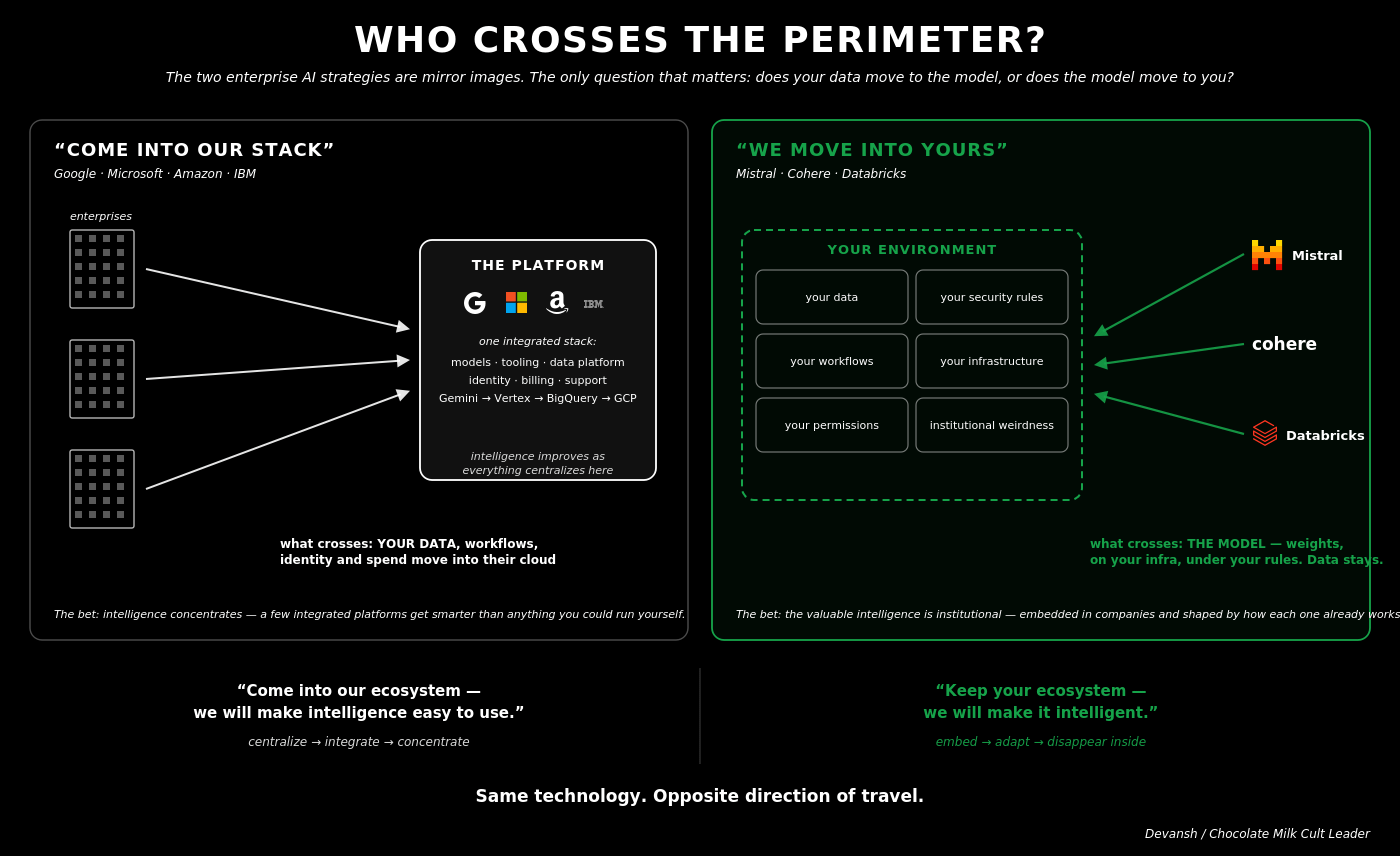
Google would quite like you to use Gemini, then Vertex, then BigQuery, then more of Google Cloud. Even IBM ultimately tries to pull you deeper into their complete stack. The bet is that intelligence gets better as more of the surrounding infrastructure is centralized and tightly integrated.
Companies like Mistral, Cohere, and Databricks make the diametrically opposite bet. Asking a bank or government department to reorganize all of that around your AI stack is not always realistic, so they try to work into an org’s existing data, security rules, workflows, infrastructure, permissions, and legacy infra.
That is a very different product philosophy from “please send everything to our API/host everything on our cloud.”
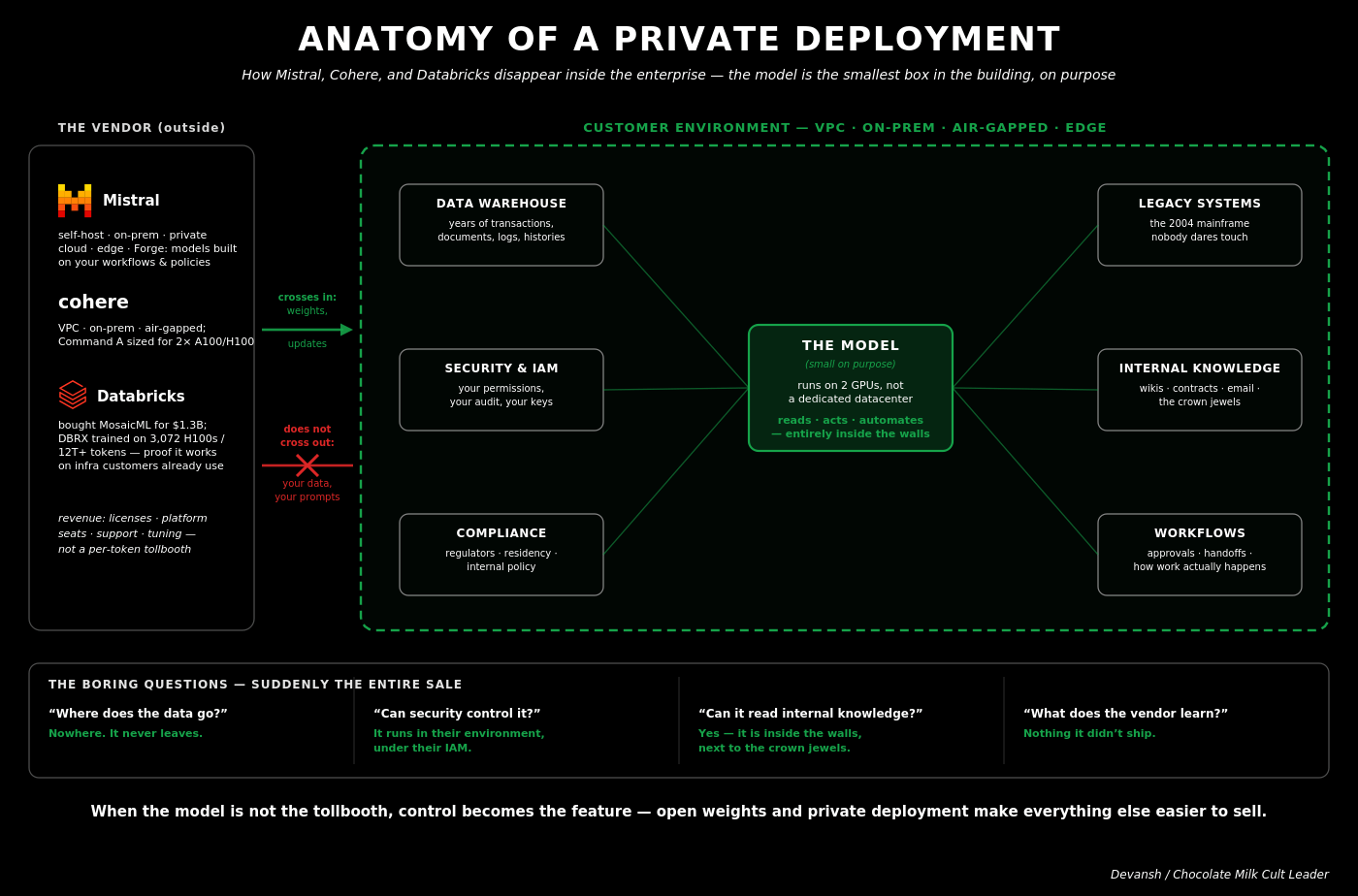
Let’s see how this manifests across the big players of this bucket:
Mistral makes this explicit with their run the models on your infrastructure, under your rules philosophy. Customers can self-host, deploy on-prem, use private cloud, or run at the edge. With Forge, Mistral goes one step further and lets companies build models around their own proprietary knowledge, workflows, policies, and systems.
Instead of worrying about frontier intelligence, Cohere focuses on limiting liability for risk-averse institutions by answering: where does the data go, can this run inside our environment, can security control it, and can we connect it to internal knowledge without accidentally emailing the crown jewels to California? Consequently, it’s given up on competing with GPT, and its models can instead run inside a customer’s VPC, on-premises, or air-gapped, while Command A was designed to run on just two A100 or H100 GPUs.
In 2023, Databricks spent $1.3 billion buying MosaicML, because once a company has centralized years of transactions, documents, customer histories, logs, and internal data, the next obvious question is: how can you make any of this useful? Before LLMs, that meant dashboards, SQL, analysts, and BI tools. Now it can mean agents, document generation, internal search, workflow automation, and eventually systems that act against the company’s own data. The 12 Trillion Token, 3K H100 DBRX open release that confused a lot of analysts? The point wasn’t to sell a chatbot, but to prove that Databricks had the infra to let enterprises train models on their own data (while I think custom-trained LLMs are still a technically useless pitch, it was really good marketing, going by what I heard from DB insiders).
Taking a macro-level picture, this is why companies in this bucket are happy giving away their best models with open weights and private deployment. Stronger open models allow them to start the conversation on a more positive note, and since direct APIs were never going to be a huge part of their revenue, this tradeoff makes perfect sense. The airgapped, “in your environment “ deployment is something that bucket 1 companies would never do (while all of them allow VPCs and custom deployments, they come with sizable minimum contract requirements, and they’ll always drag you into their tenants/clouds).
Taking an even further step back, I think this divergence b/w Bucket 1 and 2 is an interesting philosophical divergence b/w two thesis around what the interplay of work and intelligence at orgs will look like. The first model assumes intelligence will concentrate inside a few large integrated platforms, and so believes that efficiency and top-line performance will come out on top. The second assumes the really valuable intelligence will be institutional: embedded inside companies, adapted to their data, and increasingly shaped by how each organization already works. In contrast to the first, this is more of a bet that for orgs, limiting risk and playing things safe is a much stronger priority than a few efficiency percentage points.
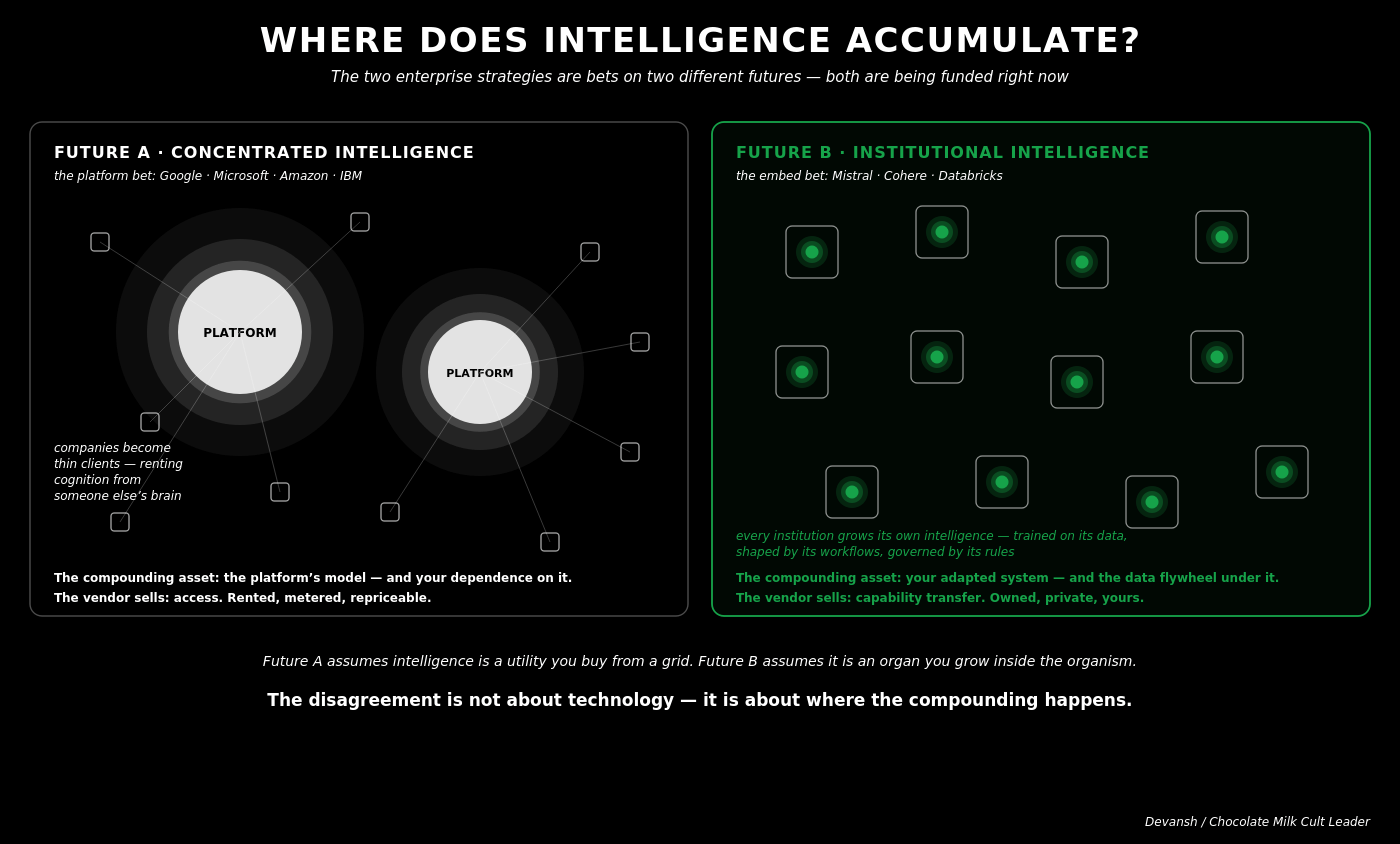
I personally think that atleast for the next decade, Bucket 2 has a stronger alignment than B1.
3. AI as Premium Labor: Using AI to Handle Tasks that would Require Expensive Manual Labor
The biggest AI revenues will not come from maximizing the number of interactions. They will come from owning a set of interactions valuable enough that customers are willing to pay to delegate to the AI.
Claude does something very interesting with their pricing:
Their 20 USD plan doesn’t have much usage and taps out relatively quickly (but it can be used to get your basic jobs of responding to emails well).
Their 100 USD plan starts to be viable for heavier research and coding. But at that point, there’s no way they’re making money on their models.
They lose a lot of money on their 200 Max Plan (at least if you’re a dehati that drains the usage limits like I am).
So how does Anthropic become profitable (AFTER accounting for expenses, since most of us lack the math genius to understand the creative accounting of Dario-stotle)?
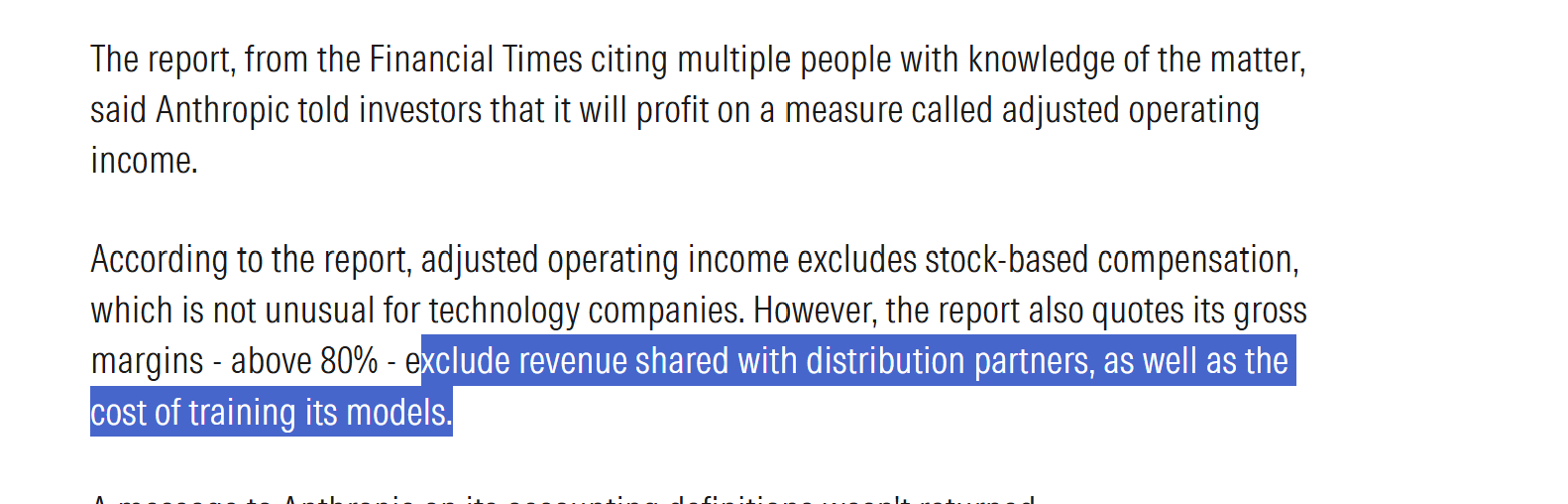
Concretely, there are a few different strategies, all of which circle around the same principles:
Most users will never consume enough Claude on the 20 USD plan so they make money here.
The 100 and 200 Personal plan people are both addicts and marketing. The former will be discussed in detail, but it’s worth giving a few words to the latter as well. When someone like me uses the 200 personal plan and tells my company that Claude is worth buying, my IT team buys their garbage enterprise plan which bills me at api rates (and Claude is both very token hungry and very expensive). This means that they might lose 100 Million serving power users, but they offset that by gettign 1B in enterprise contracts, where they can recover the margins through API.
The addicts end up buying extra credit (which is really good for fundraise docs, and is proof of sticky, price-insensitive demand) and give them their very juicy margins.
This is why Claude (web), Cowork, and Code all pull from the same pool, since the real market intel only comes after the end of the allocated usage limit. However, for this play to really work out, Anthropic needs to two important things: 1) find very high value work items where people would gladly spend a few hundred dollars to save a few hours of work daily; and 2) they need to take over work end to end so that they save time.
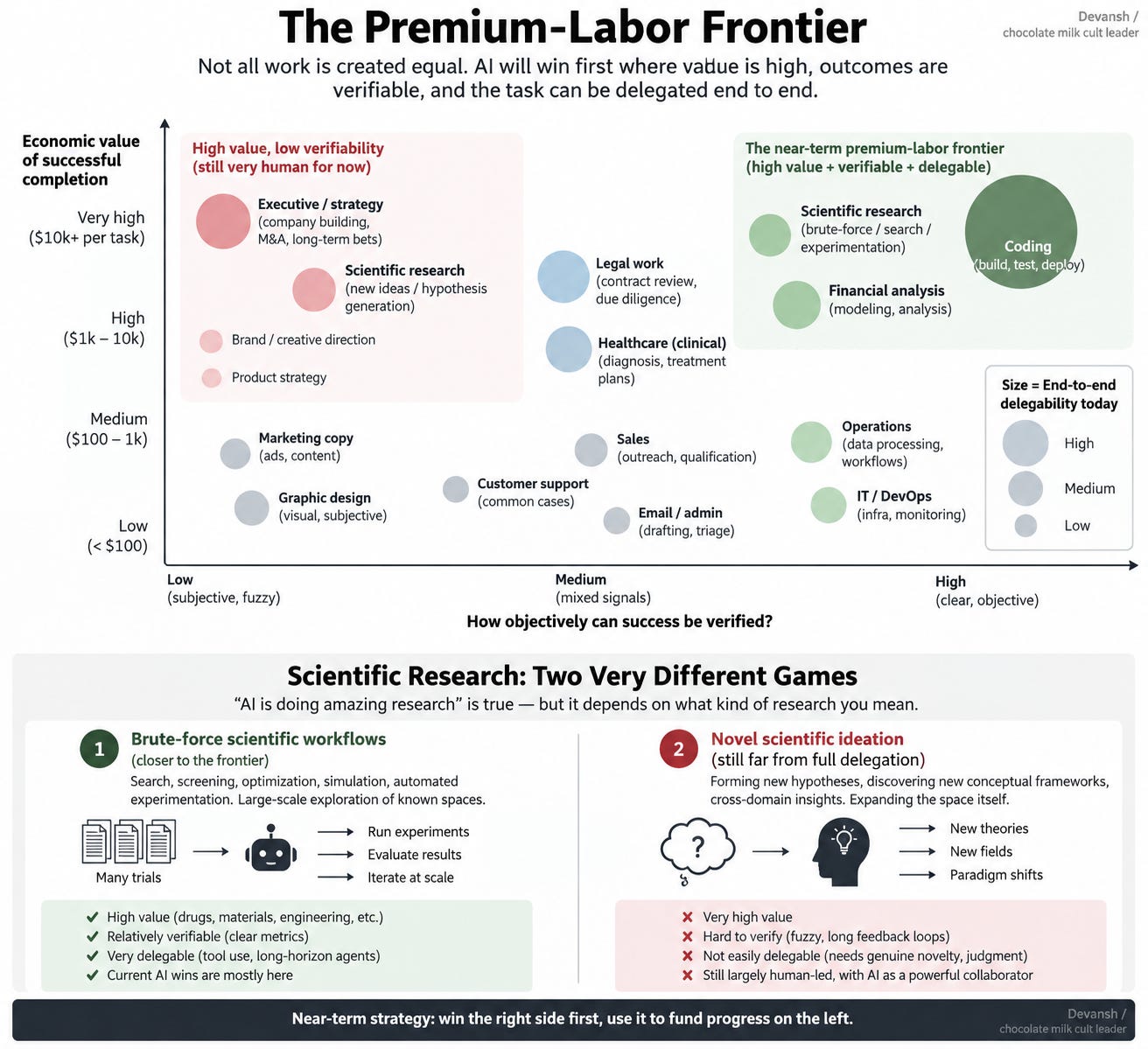
Seen from this lens, it makes sense on why Anthropic has largely had a single-minded obsession with coding while OpenAI was focusing on roasting your Instagram and turning you into 80s aesthetics(if you’re doing that shit, please just stop, there are better ways to use your time and electricity). Coding has some very strong advantages that satisfy the criteria we layed out. Obviously, it’s economically valuable, and Anthropic can iterate on it much easier since it’s their domain. Additionally, models can use enormous amount of code and documentation to learn from. Finally, as we’ve covered before, coding is unusually verifiable. Your agents can get a pretty strong signal about how effective their changes by looking at test case performance, latency, and other metrics. While this doesn’t cover all the aspects (and you still have to be very smart with how you design your eval criteria and test cases), it’s still a much cleaner signal than having to evaluate fuzzy attributes like, make this picture more beautiful or make this ppt more rigorous.
This is also why Anthropic has been so focused on training over long running agentic tasks (they were the pioneers of this), since it lets Claude actually finish tasks end to end. The more Claude behaves like a worker rather than a chatbot, the less companies will anchor it’s pricing against ChatGPT subscriptions (cheap, no money) and the more they will compare against the cost of the work being done (expensve, more money).
Seen in another way, Anthropic’s end game is to unlock a future where revenue can scale with the amount of work being delegated rather than the number of people paying for Claude subscriptions/API. The subs, API etc are all meant to be easy entrances into that ecosystem that ultimately leads entire chunks of work being allocated to Anthropic. Philosophically, Dario’s claim of being the only company ever isn’t as outlandish as it was made to me — the game of a setup like Ants is to become the default interface for work (you go to Claude to do X, Claude worries about deploying on cloud, setting up the CI/CD, creating files etc). The Cloud choice, infra etc will all be implmentations handled bts by Claude Agents.
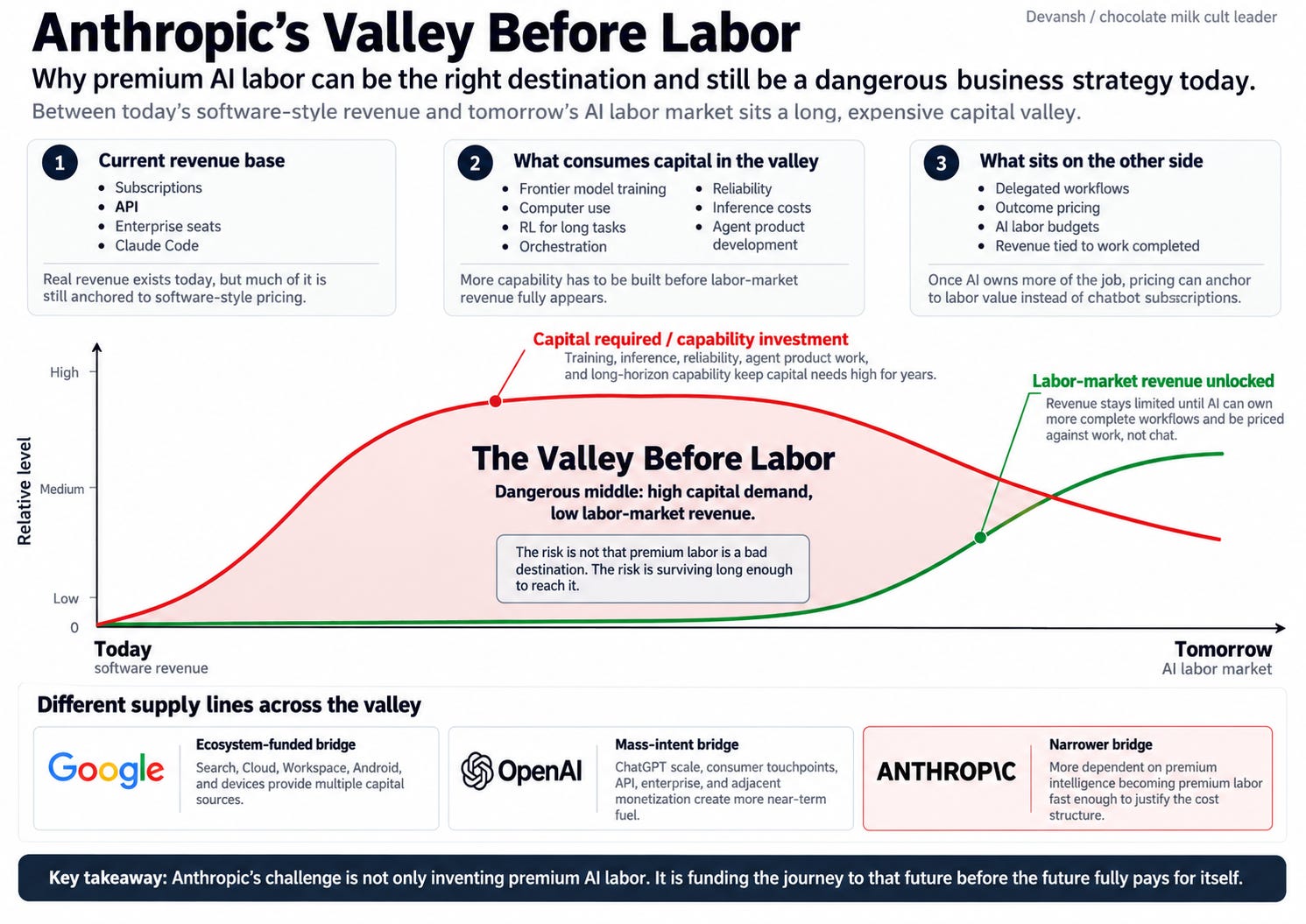
This ambition comes with two drawbacks:
They’ll have to train across orchestration, computer use, and several very expensive (and uncertain) training topologies. I’m not convinced that the neural network + backprop+ RL paradigm will get them where they need to go, and a majority of their research seems to be around serving this as opposed to pushing a new direction.
To account for the above, Claude has to be pricier than other models. The only way they survive is by being good at individual tasks (rewrite email task better when user provides input), while also being meaningfully better at completing jobs (automatically read emails, draft replies, escalate for approval, and send).
Google/other ecosystem can focus on cost efficiency, while OpenAI, Zhipu and other model-first companies will inevitably converge around the second. This means that hinging on this as your primary differentiator is building a castle of sand in the middle of a battlefield. While I do think this is a fantastic 20 year vision, I don’t think you can focus on it here and now and survive to get to the 20 year mark. You need another “supply line” that can get you the firepower to fight towards the 20 year vision. Anthropic seems to have realized this by focusing on enterprise sales, drilling down on their core competencies, and investing in the FDE play but it’s my personal opinion that in uncertain times, it’s better to have options and mobility than it is to be king of a fortress. From that lens, I can’t see myself being very optimistic about their long-term future.
OpenAI and xAI have realized this, which is why they’re making a very different kind of play. Their strategy is messier, vastly more capital intensive, and probably creates several wonderful new ways to accidentally build Black Mirror. But if for no reason other than that it’s being executed by two of Silicon Valley’s biggest conmen who will rob your granny to raise their valuation, I think this will come out on top.
Anthropic believes intelligence becomes most valuable when you let it take over increasingly expensive work.
OpenAI and xAI believe intelligence becomes valuable in so many places that the winning strategy is to get embedded everywhere first, then discover where the money appears.
4. AI as Air: Embedding Intelligence across our Lives and Monetizing the Interactions
Anthropic wants to own the work. OpenAI and xAI are making a broader bet: intelligence will be useful everywhere, so be everywhere.
ChatGPT already has more than 1 billion weekly users. Codex attacks Anthropic directly on valuable delegated work. OpenAI also has enterprise software, APIs, ads, commerce, apps, devices, and is now building its own inference chips.

That looks scattered until you realize that the sprawl is the thesis.
For OpenAI, the assumption is that there will probably be thousands of places where intelligence creates economic value, and nobody actually knows which ones will produce the biggest businesses. So, their strategy is to get embedded across as many surfaces as possible, and eventually figure out how each one should be monetized.
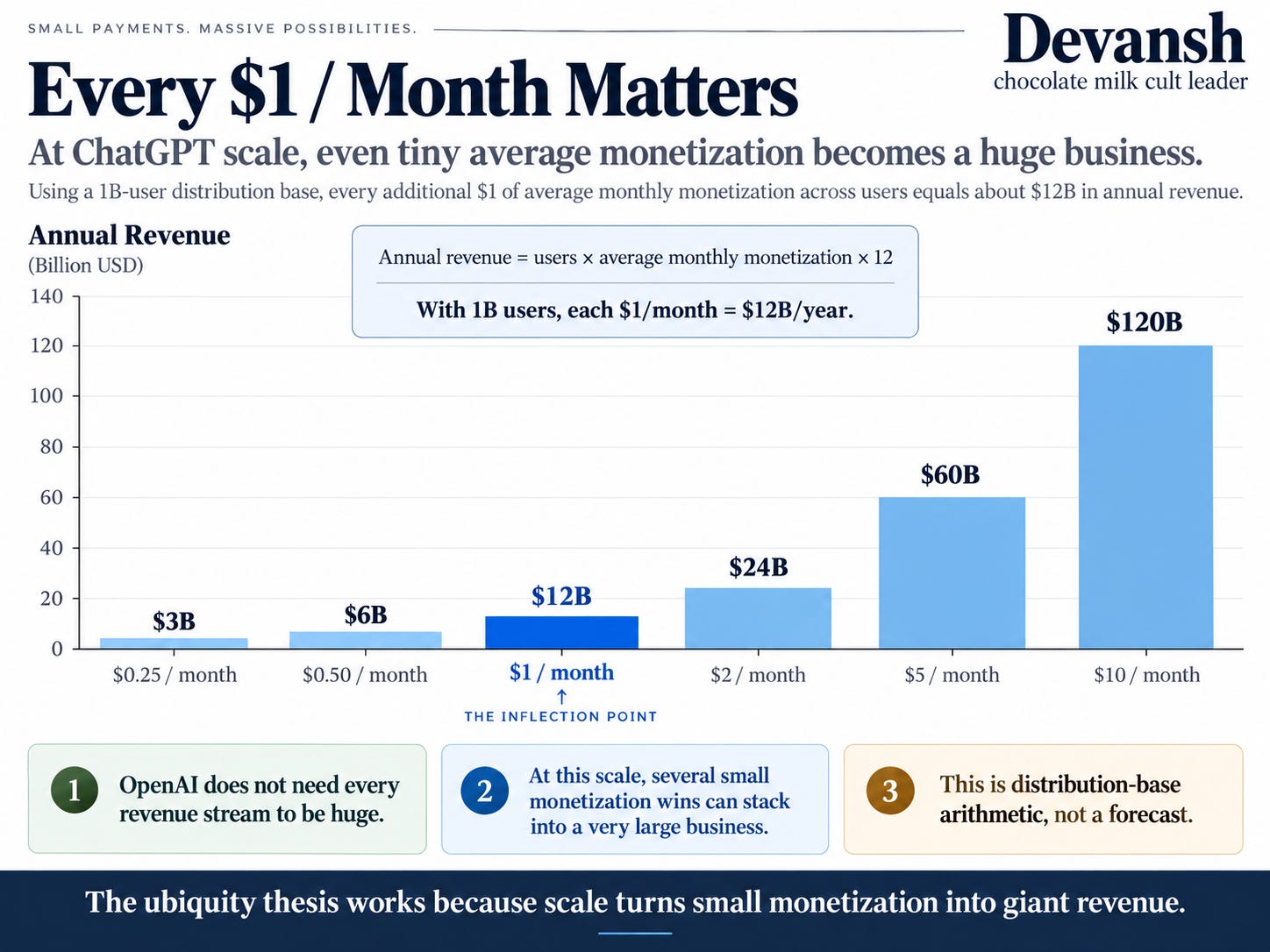
Consumer distribution is the obvious starting point. ChatGPT Ads have already reached a $1 billion annualized revenue run rate in under 200 days. This might not make ChatGPT profitable, but it buys them some more time (imo the most important strategic asset), in order to take their shadiyantra a few steps further.
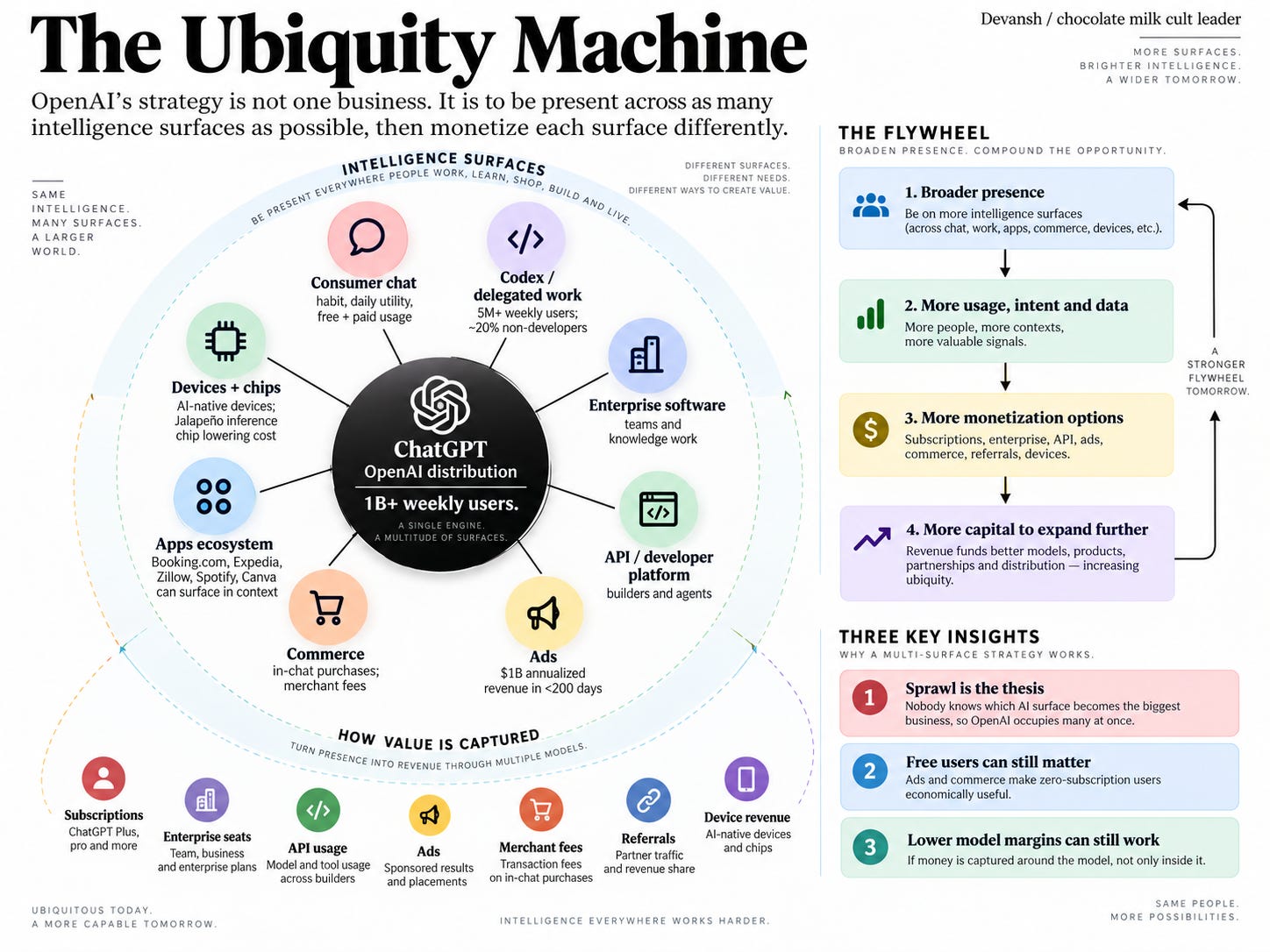
For instance, ChatGPT already lets users complete purchases inside the conversation while OpenAI takes a fee from merchants, and apps like Booking.com, Expedia, Zillow, Spotify, and Canva can surface directly when they become relevant to a conversation. Even if they never become top #1 e-commerce + booking destination, one can easily see them capturing a non-trivial part of this market, further deepening their value capture from the platform. In this case, the nature of the human-app interaction provides an interesting advantage to OpenAI since ChatGPT often sees intent before it becomes a search query. This is a bit abstract to say, so let’s see the utility by walking through an example.
I might tell it that I need dinner near a particular place, one person is vegetarian, I want somewhere quiet, and we are walking somewhere afterward. ChatGPT can turn a vague set of constraints turn into commercial intent, w/o my never searching “restaurant near me.”
Take that logic a little further, and things get funky.
Imagine a future OpenAI device knows that I train combat sports, has access to my health signals, and notices after my sparring day that I have probably gone through intense exercise and am unusually dehydrated. I haven’t yet asked for anything, but it tells me I should probably rehydrate and eat. Since it knows what I tend to like, it finds somewhere nearby that fits, and asks whether I want it ordered.
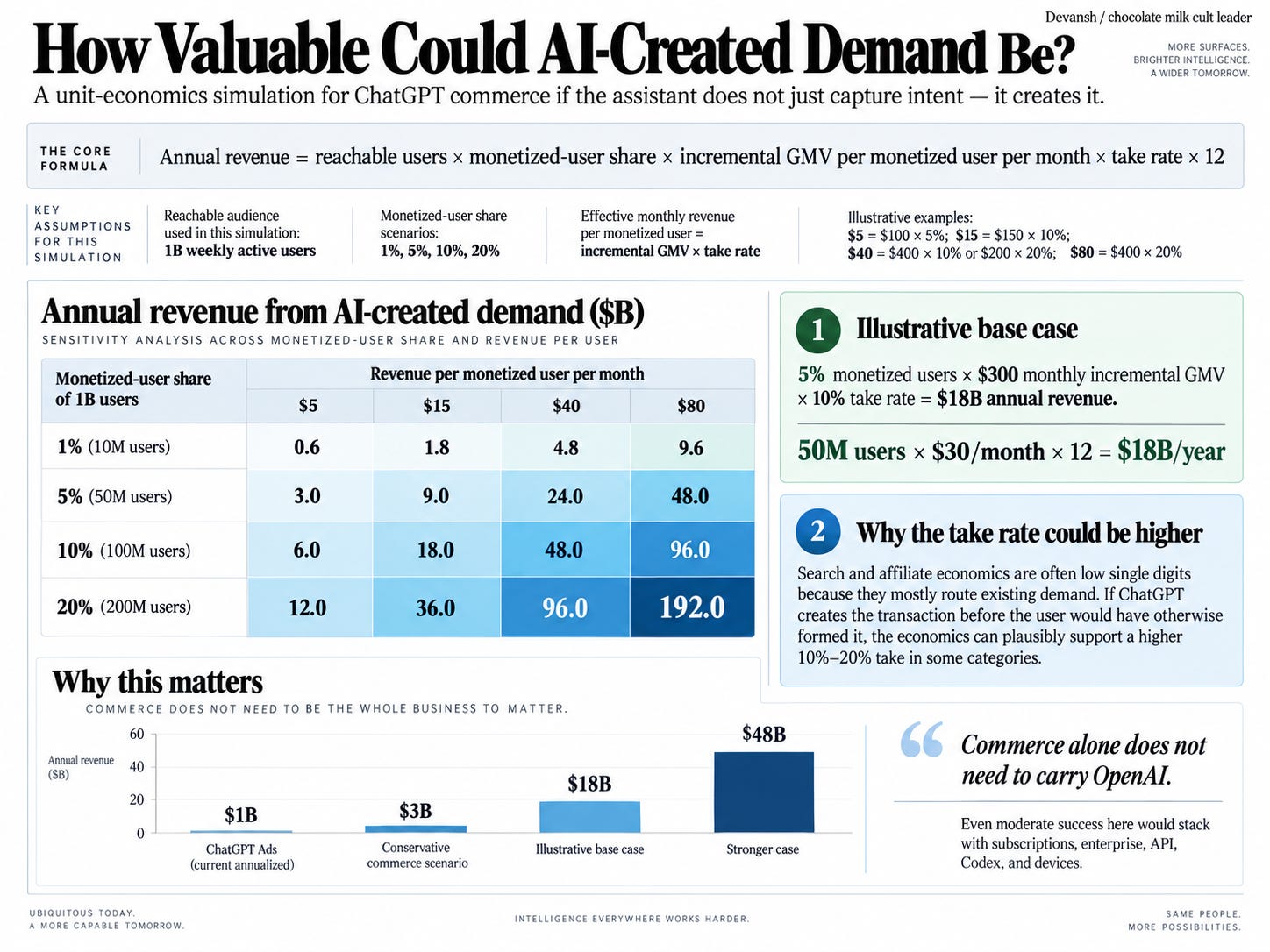
Slightly dystopian? Obviously. But for now (and always), let’s focus on the value we can create for the shareholders. This kind of interaction is quite different to the current platforms or search monetizations for a simple reason: OpenAI did not capture demand. It created the transaction before I had consciously formed the demand myself. This means they can plausibly expect higher cuts of the business.
The same thing could happen with services. Ask ChatGPT enough health questions and, at some point, the useful answer is no longer another paragraph — it is the right doctor. The same applies to lawyers, accountants, tutors, consultants, contractors, financial advisers, or niche experts.
This will likely have some interesting societal consequences. The internet era brought the attention economy. An AI-enabled marketplace with more sophisticated matching could enable a scaled up GLG model by scaling the expert economy (matching people to the exact experts they need). One can imagine an interaction where an AI assistant answers what it can, recognizes where human expertise becomes necessary, understands enough context to know which human(s since we’ll want options) you need, and takes a referral fee for making the connection. This interaction would be a great way to reduce hallucination/liability for the AI platform as well (which is why I’m surprised it hasn’t been a stronger priority so far, but probably the engineering and compliance for such a thing would require much forethought).
And from a business perspective, this would OpenAI eventually monetize intelligence that it doesn’t even provide itself.
This also contextualizes OpenAI’s chaotic push to build across interfaces since they don’t want intelligence trapped inside “open ChatGPT, type prompt.” This requires a much more holistic approach, hence why their compute strategy now explicitly spans chips, data centers, models, developer infrastructure, consumer products, enterprise products and AI-native devices. I expect them to continue to invest a lot of money in model compression, inference chips, heterogeneous compute, etc because ubiquity only works if intelligence gets dramatically cheaper. They’re essentially trying to bully their way into Jevons Paradox greatness, and if they pull it off, it will be an era-defining change in how businesses are seen and evaluated.
The numbers here make this seem more realistic than you’d think.
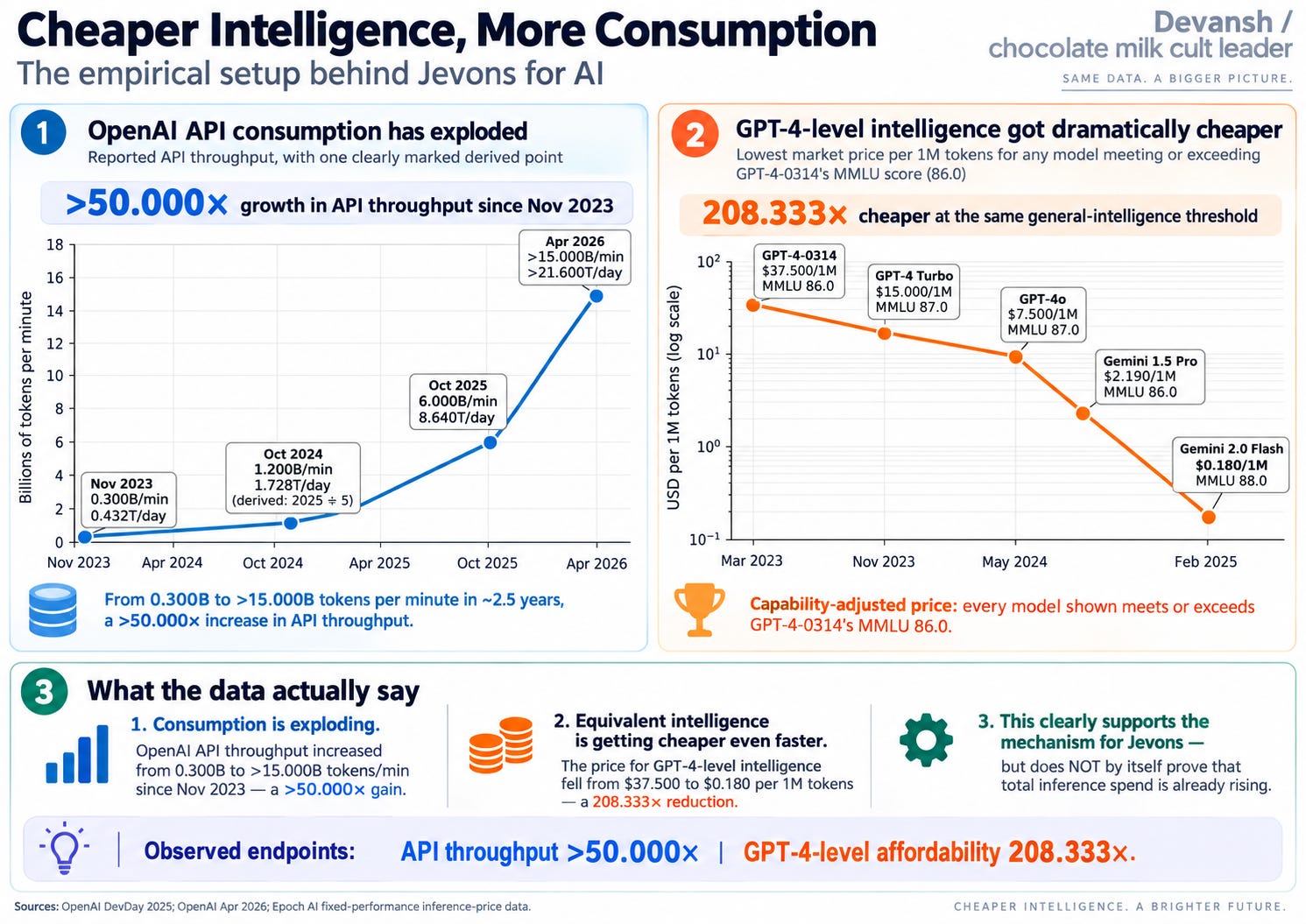
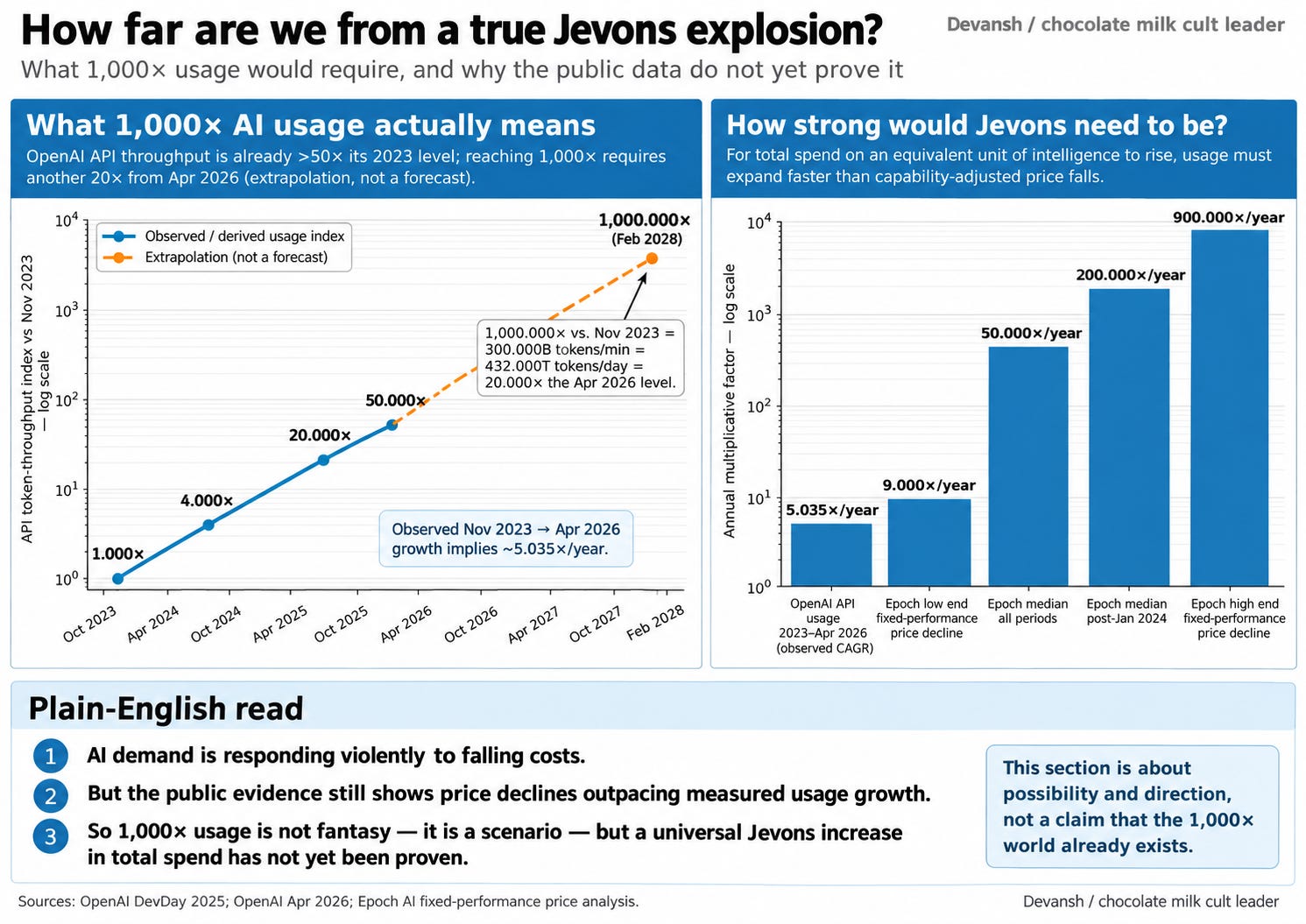
This has its pros and cons. OpenAI isn’t really a category leader the way Anthropic has become, and they’re that much less likely to hit that next breakthrough that unlocks next-gen models (or drops costs the way Chinese Labs are doing) since their attention is split into so many fronts. They have the money and resources to run Bell Labs-style R&D, but the split focus has led to a huge handicap in their bid to capture knowledge work. And much of their successful GTM plays (the Sora app, ghibli style pictrue etc) has not been useful for converting attention to actual revenue. This means that they’re bleeding more money than Anthropic, while failing to capture as much value as them.
However, OpenAI is making money, and they still have some investor dollars. This gives OpenAI something I think is underrated: optionality and time. If they can survive the next 2 years, they will have an endless number of cards they can play to monetize their cpative audience (many of whom are deeply dependent on ChatGPT specifically, and dont like Claude/Gemini). Then, OpenAI can make money from the subscription. Or the API. Or an enterprise seat. Or an ad. Or the merchant when you buy something. Or a referral when it sends you somewhere. Or perhaps one day the device sitting beside you when the demand is created in the first place.
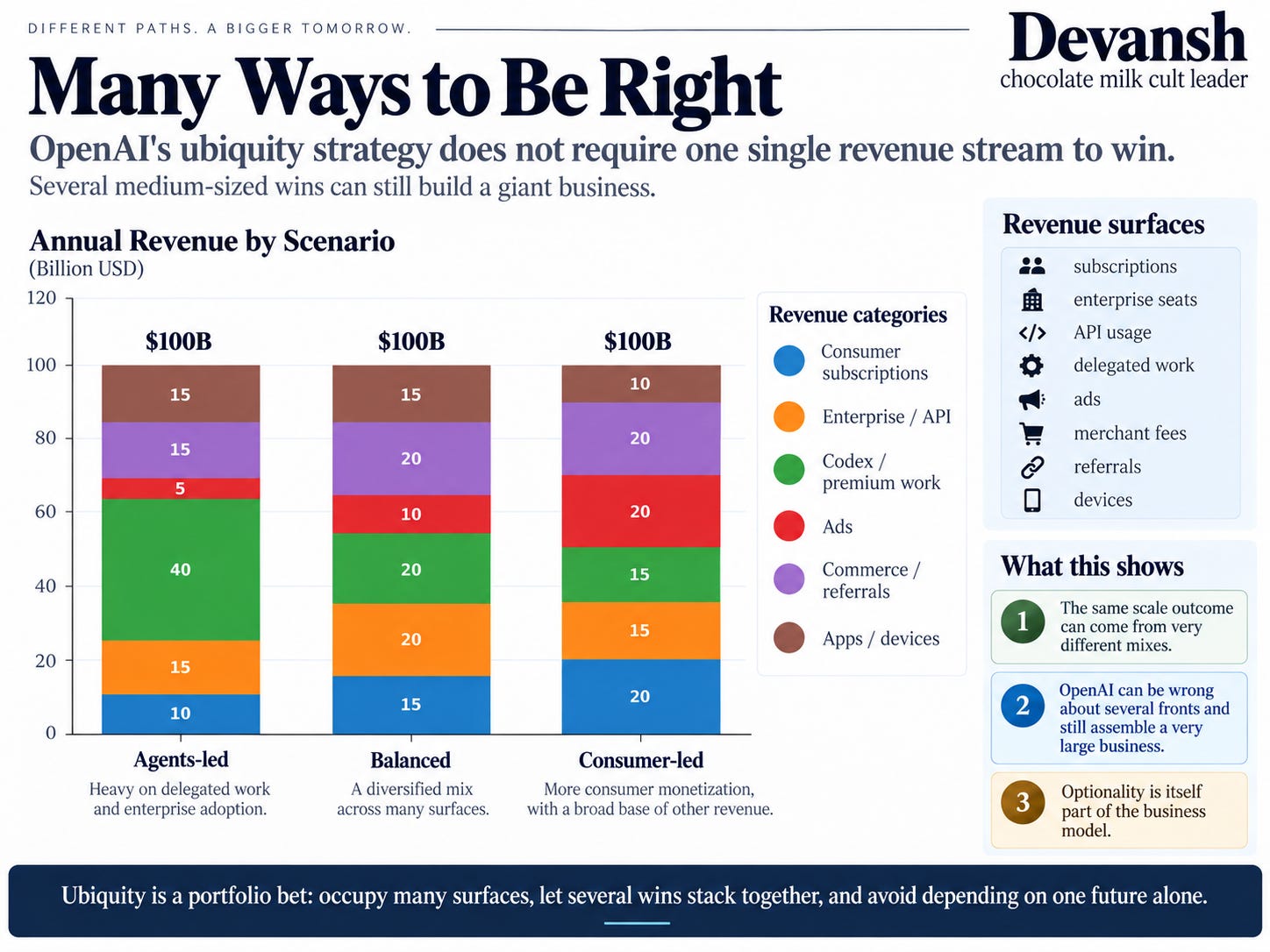
I have my reasons to be optimistic for OpenAI’s strategy (if I had to make my pick for the best strategy, it would be this). They’re still fighting Anthropic’s war too. Codex has already reached more than 5 million weekly users, with roughly 20% now coming from non-developers doing research, spreadsheets, presentations, contracts, and other knowledge work. Amongst a lot of commentators (myself included), Codex is considered superior to Claude Code (and certainly much better value for money). Between that, the ads, their new FDE investments, their fundraising, and the ecommerce, one can see the temporary supply line we discussed earlier. And once they figure out how to monetize a single user, just a little but, Sama will be walking around in clothes stitched from 100 USD bills.
xAI is making a philosophically similar bet. X explicitly says its goal is an “Everything App” spanning information, communications, media, payments, banking and commerce, with Grok embedded throughout it. Intelligence is another layer through which all of those surfaces can become more useful — and more monetizable.
5. AI as Compute Expansion: Make it Easy for Everyone to Train and Use Models, Sell the Hardware/Platform they will need to do so
NVIDIA or AMD do not need its model to win. It needs everyone else to build enough AI that compute demand keeps exploding.
This is probably the simplest business model in the article.
NVIDIA publishes open models, datasets, training recipes, RL environments, evals, and tooling. Nemotron now ships with open weights, training data, and reproducible recipes, while NVIDIA has released 10 trillion+ language-training tokens alongside open robotics, autonomous-driving, and biomedical datasets.
Why go through this effort? Because every reduction in the difficulty of building AI creates more workloads
The logic is straightforward: make models easier to build → more companies build them → more training/fine-tuning/inference → more compute gets consumed.
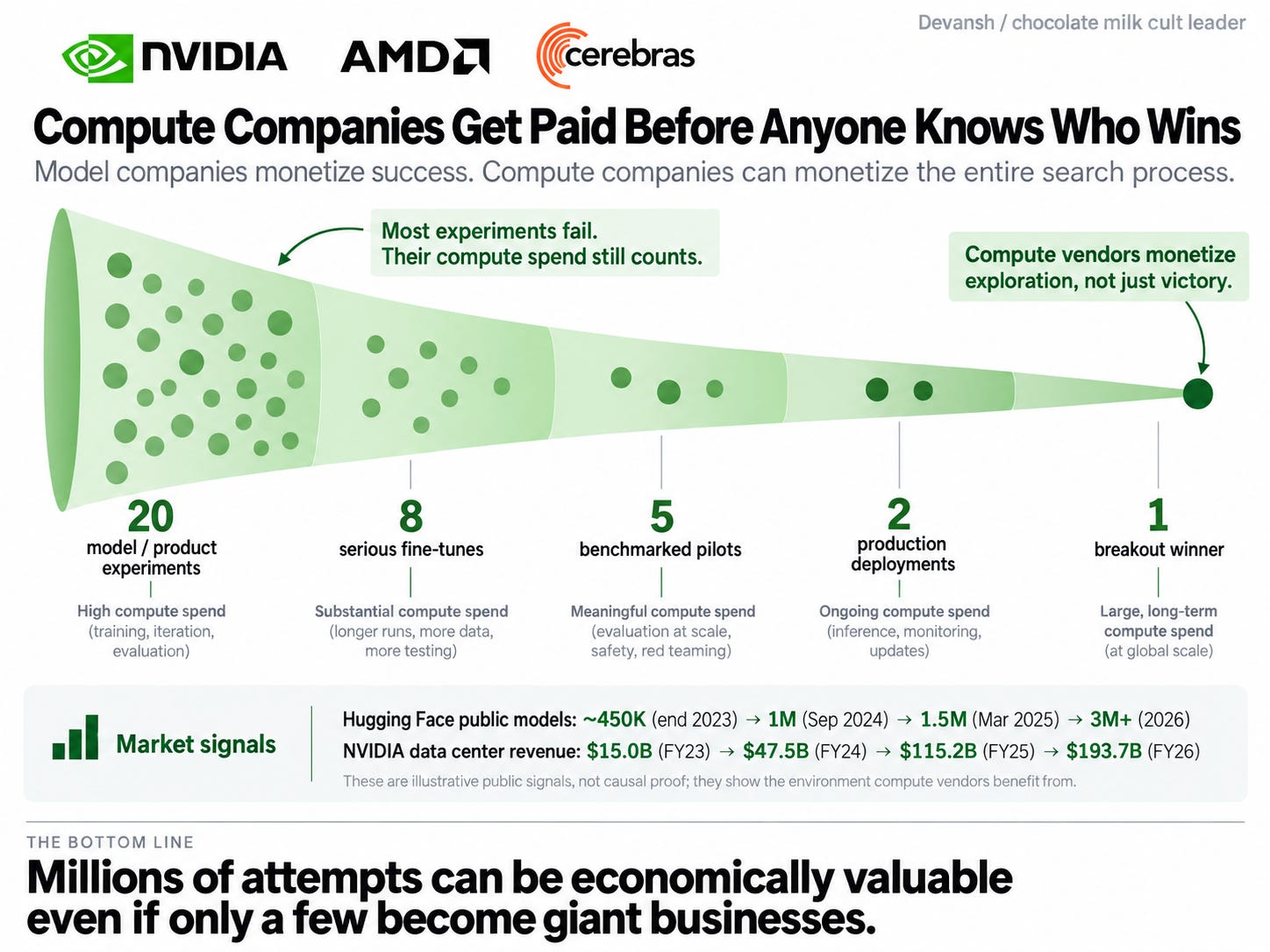
AMD is playing the same game from the challenger position. Its Instella family comes with weights, datasets, training configurations, and code, while making the rather unsubtle point that the models were trained on Instinct GPUs using ROCm. Cerebras has done versions of this too: its open Cerebras-GPT family was explicitly built to demonstrate what its wafer-scale systems could train.
You might pause here and ask yourself why NVIDIA stops there. With its cash and position, why not move further up the stack and become the cloud, SaaS company, or end-user AI platform too? Capture more of the value chain, as the business schools teach you.
Probably b/c Lisa Su and Jensen Huang weren’t smart enough to pass the formidable challenge that is the MBA degree. Just imagine how well they would have done with a few more middle managers and Excel merchants.
There is also the fact that these are expensive businesses — and, more importantly, many of the companies NVIDIA would be competing with are its customers. Cloud providers, neoclouds, and model companies are major buyers of NVIDIA infrastructure. Rather than spending heavily to replace them, NVIDIA has generally preferred to help them expand: it invested $2 billion into CoreWeave, while DGX Cloud Lepton aggregates capacity from CoreWeave, Crusoe, Nebius, Nscale, Lambda and other cloud partners. That way, if they blow up, Nvidia has demand. If they suffer, Nvidia’s downside is limited.
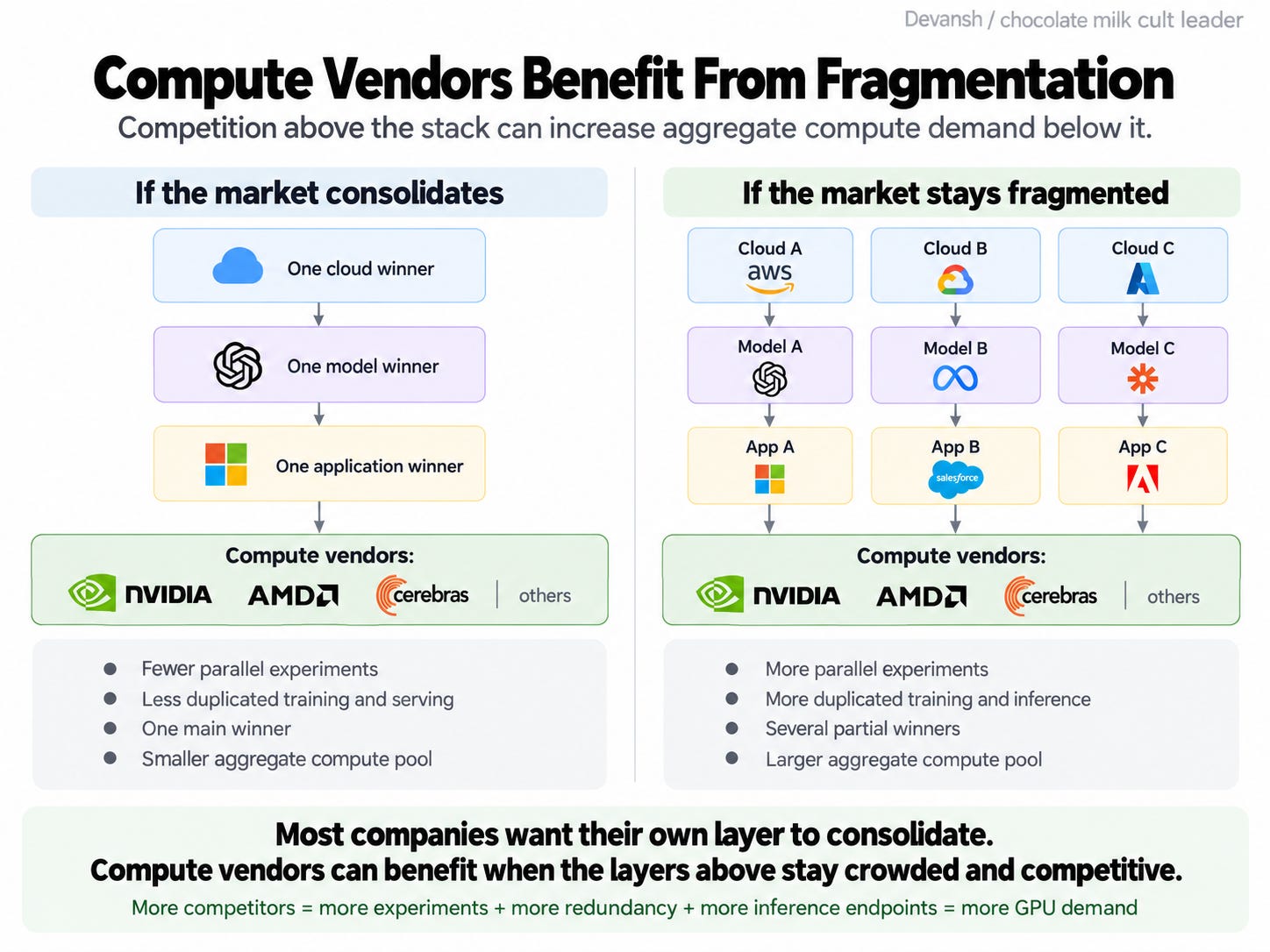
The same applies higher up the value chain. NVIDIA could spend billions trying to build a dominant SaaS product, but then it starts competing with the exact model and software companies it wants standardizing around CUDA, NeMo, NIM, and NVIDIA hardware.
So its optimal move is often not to capture every layer.
It is to make every layer above it bigger.
Open models create developers. Open datasets create training runs. Synthetic data creates specialized models. Recipes make customization easier. Tooling makes deployment easier. Every successful experiment has a decent chance of eventually becoming another inference workload.
That is why compute companies are unusually happy to give away intelligence: they monetize the consumption of intelligence rather than the intelligence itself.
Anthropic needs Claude to win. OpenAI needs enough of its bets to win.
NVIDIA and AMD mostly need everyone to keep using more compute.
6. AI as Commoditizing the Complement: Give away an LLM for free, enjoy the benefits of community RnD flowing into your actual money makers.
If the model isn’t where you make your money, making models cheaper can be more valuable than selling them.
Meta spent billions building models like Llama, then handed the weights to everyone else. When they first started doing this, the enlightened folk over at Wall Street hated it. Since then, Meta has outperformed financial analysts almost every quarter.
Why? If Meta made a major chunk of its money from selling models (or had a massive ecosystem where Models can be gamechanging like Google, to which Meta is often compared), this would be financial suicide. But that’s not what Meta does, and once you understand the different dynamics of their space, everything will make sense.

Meta makes money from Instagram, Facebook, WhatsApp, ads, commerce, and devices. They spend a lot of money on coding, content review, and creating/reviewing a lot of documents that corporates have to deal with. If capable models become dramatically cheaper, all of those aspects get better while Meta becomes less dependent on OpenAI, Anthropic, Google, or whoever happens to control the best closed model that month.
This is basically the old commoditize your complement strategy: destroy pricing power in the layer you need to consume, then capture value somewhere else.
Open models also give Meta two useful side-effects:
Outsourced R&D: researchers, startups, and random people with too many GPUs test fine-tunes, architectures, tools, agents, and applications Meta would never explore internally. Meta funds the core asset; the ecosystem helps pay the experimentation tax.
Market intelligence: open-source activity becomes a kind of market sonar. If developers suddenly start pushing Llama into a particular workflow, architecture, or interface, Meta sees where demand and technical progress are moving before those trends necessarily show up in normal market data.
I explored this much more deeply in my earlier Meta piece, particularly how the company has historically used React, PyTorch, and Llama not just as software releases but as ways to shape and observe the ecosystem around them. But for our purposes we can distill the key idea into: open source doesn’t just distribute your technology. It lets thousands of outsiders tell you what your technology should become next.
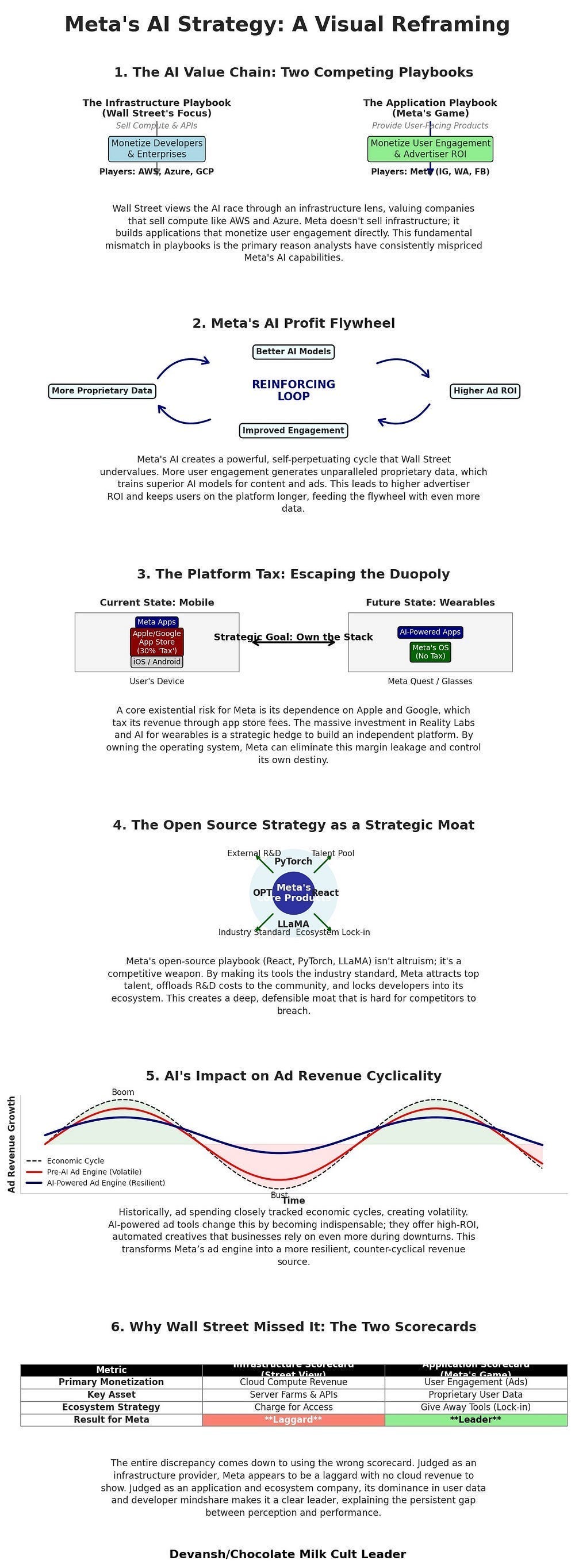
Meta’s strategy is becoming more complicated now that it is also willing to monetize models directly, so this is no longer the entirety of its AI play. But that does not kill the logic behind open releases. Meta can monetize some high-end capability while still benefiting enormously from pushing the broader intelligence layer toward lower margins. since Meta doesn’t make a majority of the money from the model serving, it can generate a lot of value for itself, even if the margins on model serving are horrible (hence why Muse is consistently very low cost for agentic tasks).
Conclusion: Follow the Subsidy to predict the Future of AI
Follow what they are giving away. Then figure out what dependency they are trying to create — and where they expect to collect rent once that dependency exists.
Far too often, investors ask me what the best model is as a proxy for where they should invest their money. In my opinion, this is a rather incomplete way to evaluate a market where so much is uncertain and where paradigms can change on a dime.
Where certainty eludes our grasp, it is perhaps better to bet on strategy and direction. Instead of asking about what the “best” is right now, it’s better to focus on where the company is headed by asking ourselves: what is this company willing to make cheap?
Anthropic subsidizes subscriptions because it wants expensive delegated work later. NVIDIA gives away models and data because it wants more compute consumption. Meta is happy crushing model margins if cheaper intelligence strengthens everything sitting above them. OpenAI will happily burn money giving people more intelligence today if those interactions eventually become ads, transactions, enterprise seats, referrals, or something nobody has invented yet.
As we’ve seen, the entire AI industry is a bit identity fluid right now. Model companies are building chips. Chip companies are moving into cloud and software. Open-source companies are launching paid APIs. Consumer AI companies are invading enterprise work. Nobody knows exactly where the durable profit pool will settle, so everyone is quietly buying options on somebody else’s business model.
That is probably what the next phase of AI competition looks like. Model quality will still matter, obviously. But as intelligence gets cheaper, the more important fight will be over who can afford to commoditize what — and what they own when the value moves somewhere else.
Thank you for being here, and I hope you have a wonderful day,
Dev <3
If you liked this article and wish to share it, please refer to the following guidelines.
That is it for this piece. I appreciate your time. As always, if you’re interested in working with me or checking out my other work, my links will be at the end of this email/post. And if you found value in this write-up, I would appreciate you sharing it with more people. It is word-of-mouth referrals like yours that help me grow. The best way to share testimonials is to share articles and tag me in your post so I can see/share it.
Reach out to me
Use the links below to check out my other content, learn more about tutoring, reach out to me about projects, or just to say hi.
Small Snippets about Tech, AI and Machine Learning over here
AI Newsletter- https://artificialintelligencemadesimple.substack.com/
My grandma’s favorite Tech Newsletter- https://codinginterviewsmadesimple.substack.com/
My (imaginary) sister’s favorite MLOps Podcast-
Check out my other articles on Medium. :
https://machine-learning-made-simple.medium.com/
My YouTube: https://www.youtube.com/@ChocolateMilkCultLeader/
Reach out to me on LinkedIn. Let’s connect: https://www.linkedin.com/in/devansh-devansh-516004168/
My Instagram: https://www.instagram.com/iseethings404/
My Twitter: https://twitter.com/Machine01776819