Every month, the Chocolate Milk Cult reaches over a million Builders, Startup Founders, Investors, Policy Makers, Leaders, and more. If you’d like to meet other members of our community, please fill out this contact form here (I will never sell your data nor will I make intros w/o your explicit permission)- https://forms.gle/Pi1pGLuS1FmzXoLr6
Every day, there is news about a massive fundraising round for a new AI startup, a new data center/infra buildout, investment in a new model, or a new billion-dollar model drop. At the same time, when one sees millions going to startups with no revenue or differentiation and a complete lack of rationality in the AI discourse, one can’t help but draw parallels to the Dot Com Bust or 2008 Crisis. In both cases, the larger underlying category might have been solid (internet stocks recovered to rule the world within 20 years), but people lost a lot of money because they picked the wrong horse. And in an ecosystem with so much hype, false promises, and ignorance (and a stunning lack of profit or sustainability)— there is bound to be a violent resetting of the market as people misprice strutural inefficiencies.
All this leads us to an interesting question: when this market correction happens, which players are the safest and which billion-dollar horses are going to get swept in the current? This question gets more interesting when you see two very contradictory markets forces, which force the market in two very different futures. On one side, we see data like:
Three years ago, GPT-4 cost $30 per million input tokens and $60 per million output tokens. Today, Gemma 4 E4B scores the same 7 on Artificial Analysis’s Intelligence Index while costing roughly $0.02 in and $0.10 out. Using a simple 3:1 input/output blend, that takes us from about $37.50 to $0.04 per million tokens.
In other words, the same band of intelligence got roughly 940× cheaper.
More recently, the exceptionally hyped JEV has been making the rounds for its cost, speed, and “no hallucination” guarantees. Instead of using a general-purpose LLM for every problem, it targets narrower structured decisions, where TypeSafe reports up to 193.6× faster and 444.6× cheaper performance on its evaluated workflows.
The homegrown open-source research we’ve done in our community all focuses on driving down the cost of AI through structure w/ Stateful Swarms (beat costly models with a cheap, non-thinking model by building a better reasoning infra), Latent Reasoning (help a frozen, pretrained model reason better by exploring their latents better) or fractal embeddings (using geometry to organize information more efficiently).
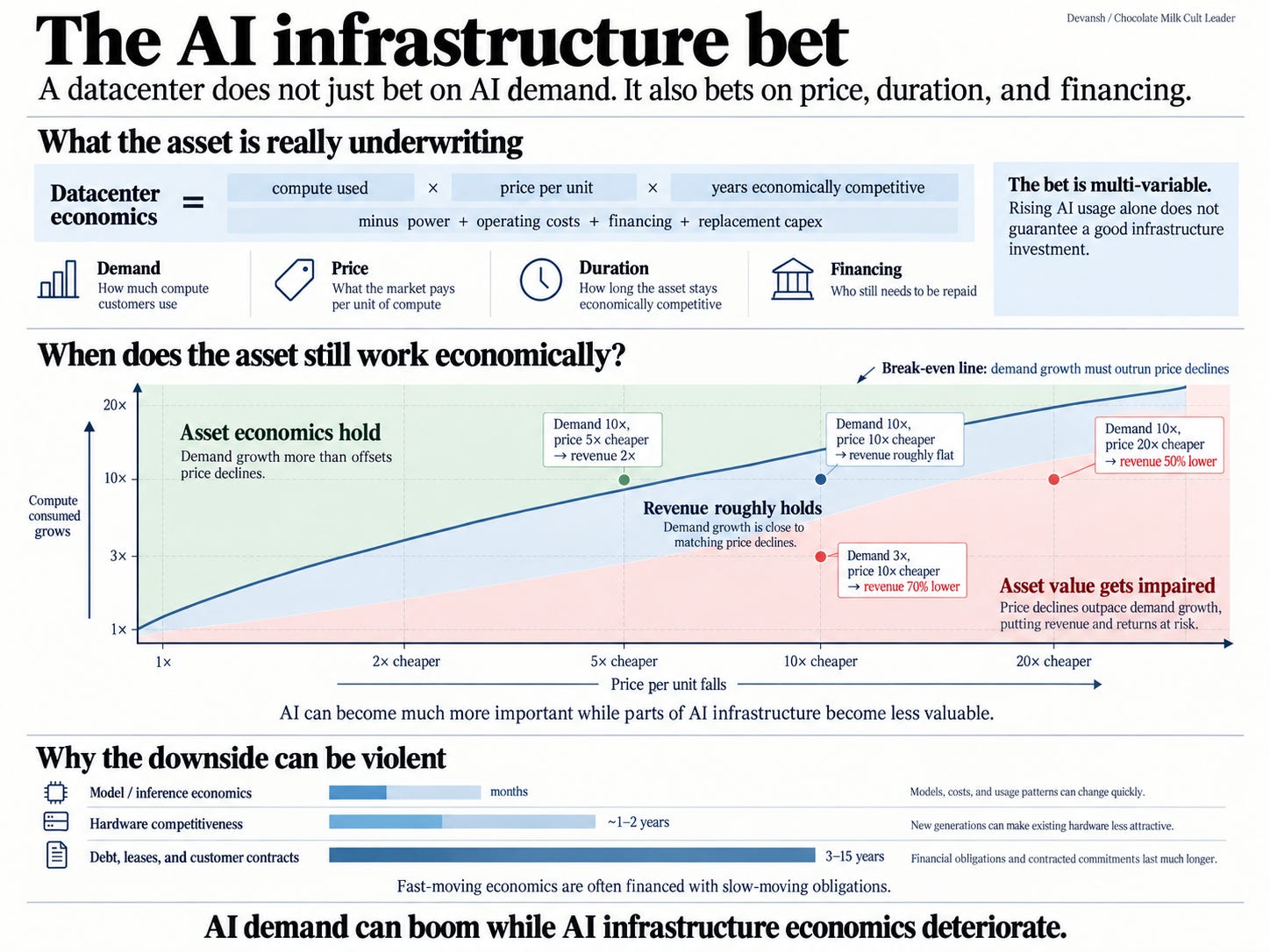
In other words, everyone building and buying on AI trying to make AI cheaper. So far, so good; nothing groundbreaking. However, several major companies are making enormous bets on the opposite side of that equation with Alphabet, Amazon, Meta, Microsoft, and Oracle expected to spend roughly $750 billion on capex in 2026 (around 38% of their combined revenue). Increasingly, that infrastructure is sitting behind multi-year customer contracts, debt, leases, guarantees, and other financing structures.
This creates two possible outcomes:
Compute demand grows faster than efficiency. Great. More intelligence gets consumed, the infrastructure stays busy, and the spending will create induced demand that will generate ROI.
Or the downwards pressure causes a collapse. That does not require AI demand to collapse since compute can keep growing while prices fall, workloads move, new hardware arrives, customers renegotiate, or a supposedly valuable asset simply earns less than expected (like with Vector DBs which never captured the market people expected them to).
If the latter happens, it will cause a massive correction given how many people are betting their money on assumptions about what compute will be worth several years from now.
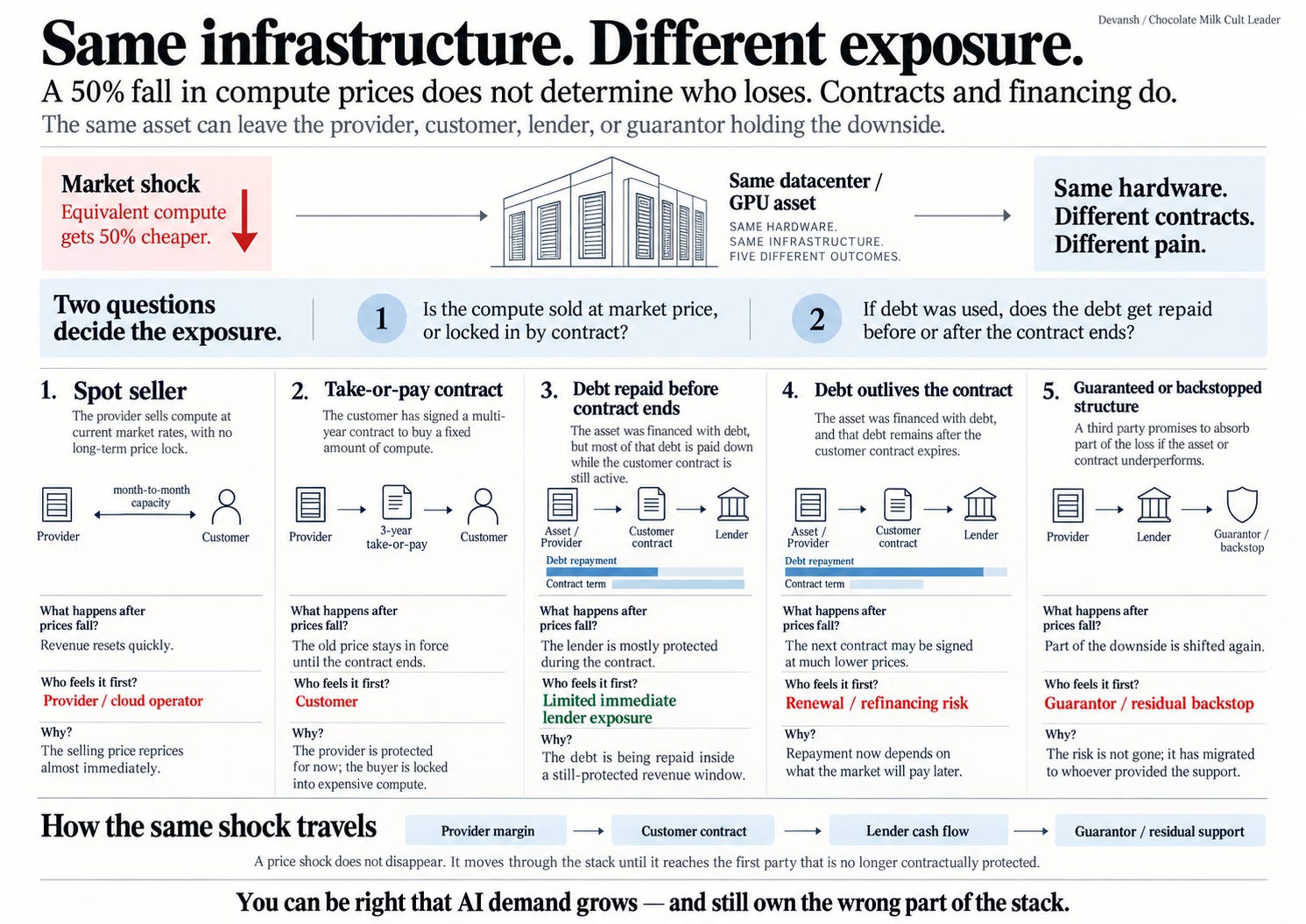
Given all that, it’s worth asking: when the correction happens, who actually takes the risk ?After all, even if AI as a whole will boom, different pricing structures, different parts of the stack, and different companies Even if the internet took off, the growth of Pets.com, Cisco, and Amazon were very different.
So I went through the financing structures, contracts, and guarantees behind the AI infrastructure boom to answer three questions:
Who is most exposed?
Who is better protected than they look?
And where has the risk quietly moved instead?
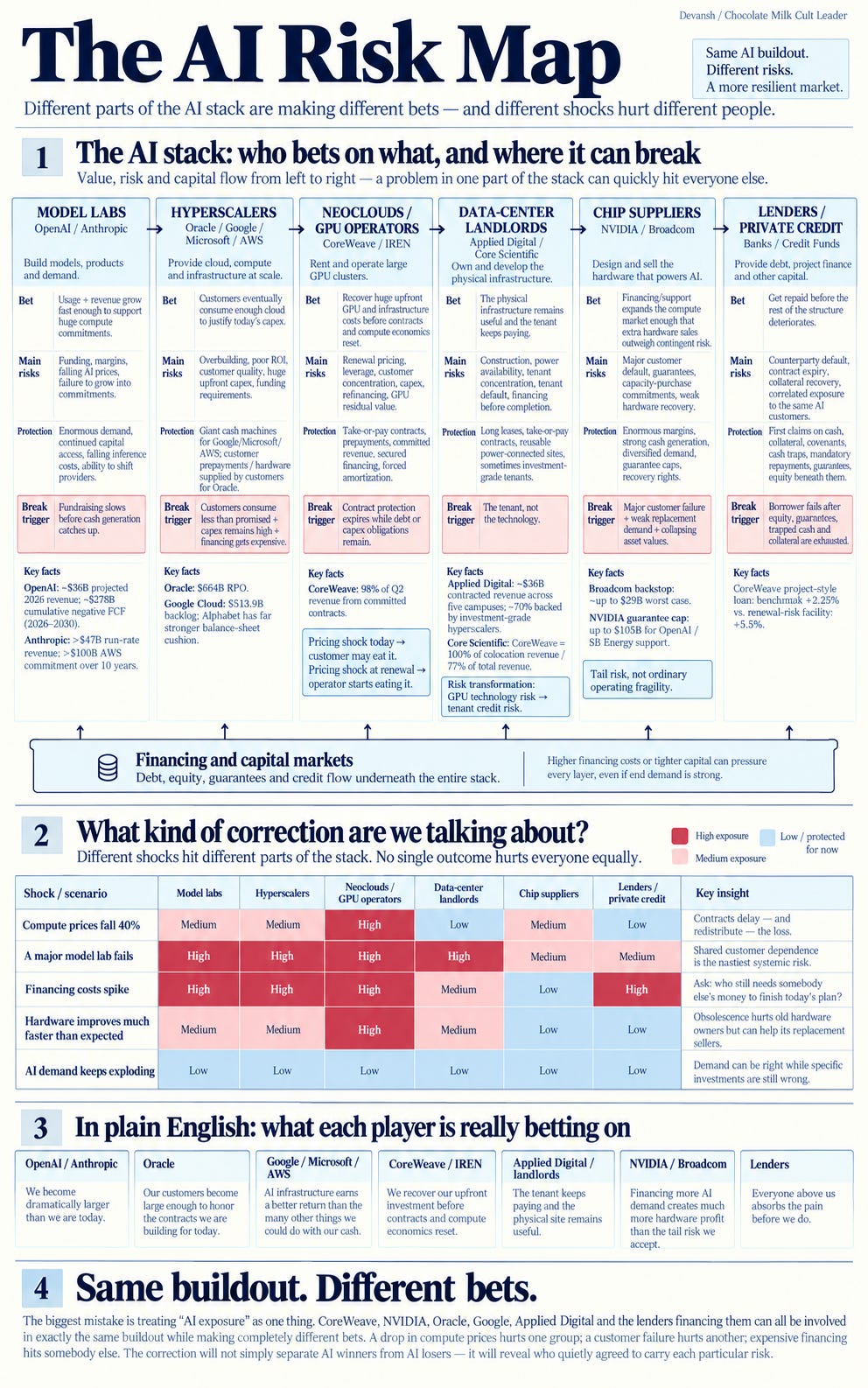
This exploration produced a comprehensive report of the various players in the AI Industry, what risks they’re taking, what they need to succeed, how vulnerable they are to industry shocks, and what kinds of developments would hurt them the most. Below is a preview of the findings—
Behind the paywall, we will dig very deep into the financing structures, AI research trends, and regulatory pressures to help us answer questions above. We will visit each aspect of the stack, look at how it interacts with all the others, and ultimately try to figure out how we can spot any cracks or breaking events before they blow up in our face. Keep reading if that interests you—