

Every month, the Chocolate Milk Cult reaches over a million Builders, Investors, Policy Makers, Leaders, and more. If you’d like to meet other members of our community, please fill out this contact form here (I will never sell your data nor will I make intros w/o your explicit permission)- https://forms.gle/Pi1pGLuS1FmzXoLr6
Google acknowledged in the report that its “moonshot” climate goals, including its 24/7 carbon-free energy (CFE) ambition, are becoming harder to achieve, as its AI infrastructure buildout accelerates faster than the grid is decarbonizing.
— Source
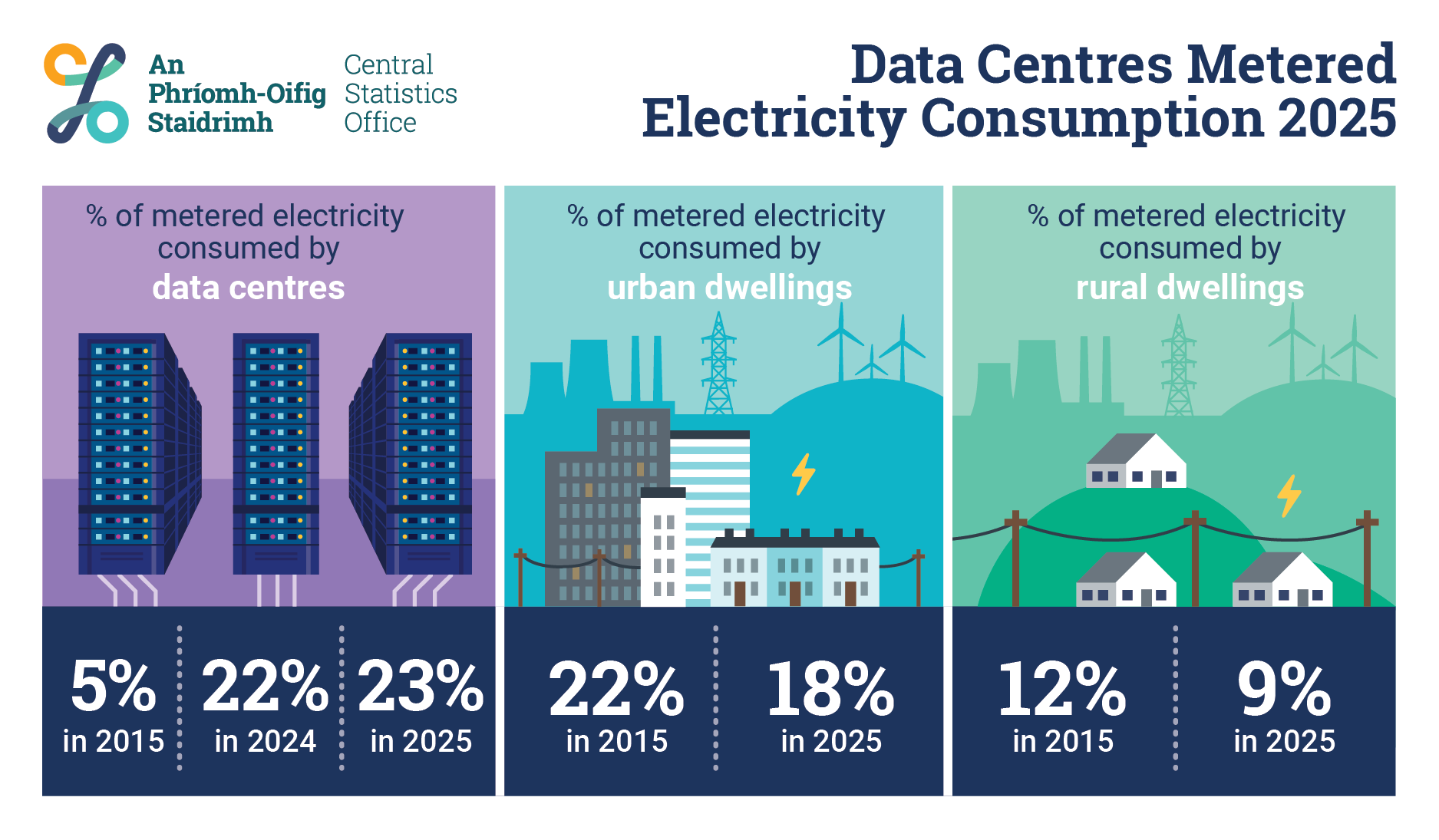
AI data centers are becoming a major part of the electricity system. In the U.S., they could consume roughly 12% of national electricity by 2030. In Ireland, they already account for 23% of metered electricity, up from just 5% in 2015. Utilities are planning new generation, transmission and storage around this demand, while Google, Microsoft, Amazon and Meta all say they match their electricity use with renewable energy.
The problem is that “100% renewable” can describe several very different things. A company may buy enough renewable electricity or certificates to match its annual consumption while its data centers remain connected to grids that still use gas, coal, nuclear and renewables.
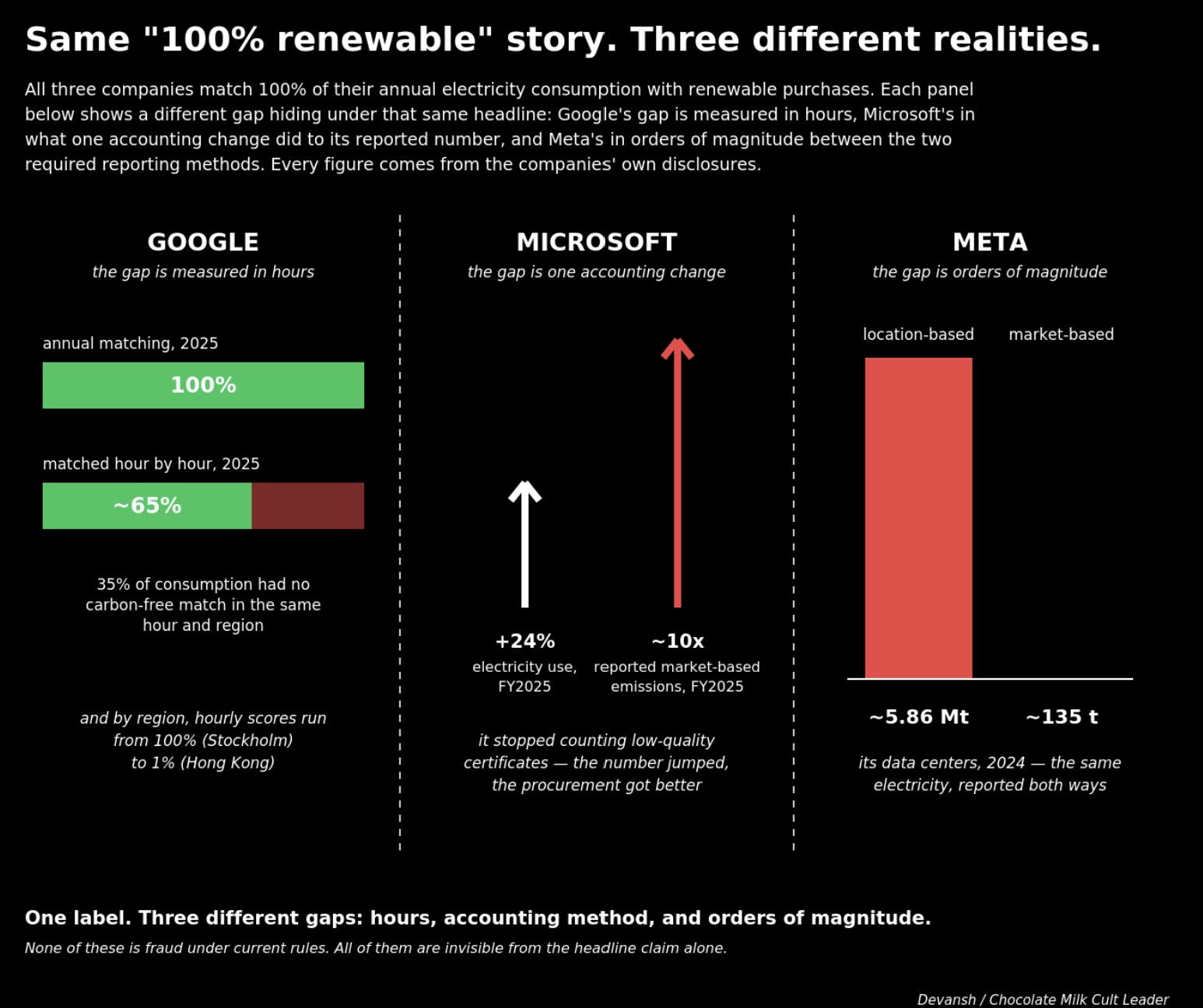
In case you think I’m making this up — in FY2025, Microsoft continued to allegedly match 100% of its annual electricity consumption with renewable energy. In that year, while its electricity consumption rose 24%, its reported electricity emissions 10xd from roughly 260,000 tonnes to 2.7 million tonnes. Most of that discrepancy came purely from the change in accounting used by Microsoft. This had me thinking about how trustworthy the claims of “100% clean data centers” are and how much energy, water and other resources data centers actually consumed.
The following is part 1 of a 2 part investigation into this topic. In this article, we will look into questions such as:
The reality behind Big Tech’s “100% clean” data centers (and what is the accounting trick behind these claims).
Are these data centers actually driving more fossil-fuel power, even while companies report cleaner emissions on paper?
Are the massive clean-energy and nuclear deals creating genuinely new power, or mostly changing who gets to claim power that already existed?
Who ultimately pays for AI’s electricity boom — the tech companies, utilities, or ordinary households and businesses?
If AI is going to consume a meaningful share of national electricity, are we measuring its real impact properly at all?
Keep reading if you’re interested in this and more.
“This increase in demand will result in data centre electricity demand consumption increasing from 22% of national electricity demand in 2024 to 31% by 2034.”
— Ireland Commission for Regulation of Utilities — Data Centre Connection Policy. This Data Center Problem is global.
Executive Highlights (tl;dr of the article)
AI data centers are becoming a major electricity load: they could consume roughly 12% of U.S. electricity by 2030, while Ireland is already at 23%.
Big Tech’s “100% renewable” claims usually mean annual matching, not that data centers are physically running on clean power every hour.
The accounting gap can be enormous: Google matched 100% annually but only about 65% hour by hour; Microsoft’s market-based electricity emissions jumped roughly 10× after it changed how it counted renewable certificates; Meta reported roughly 135 tonnes market-based versus 5.86 million tonnes location-based for its data centers — about 43,000×.
Renewable procurement can still help, but the key question is whether the buyer actually causes new clean power to exist. A certificate from an existing plant is very different from financing a new solar farm or restarting a closed nuclear plant.
Even genuine clean projects can arrive years after the data center. In the meantime, utilities may build gas, storage and transmission or keep fossil plants open longer; Georgia’s latest buildout is a clear example.
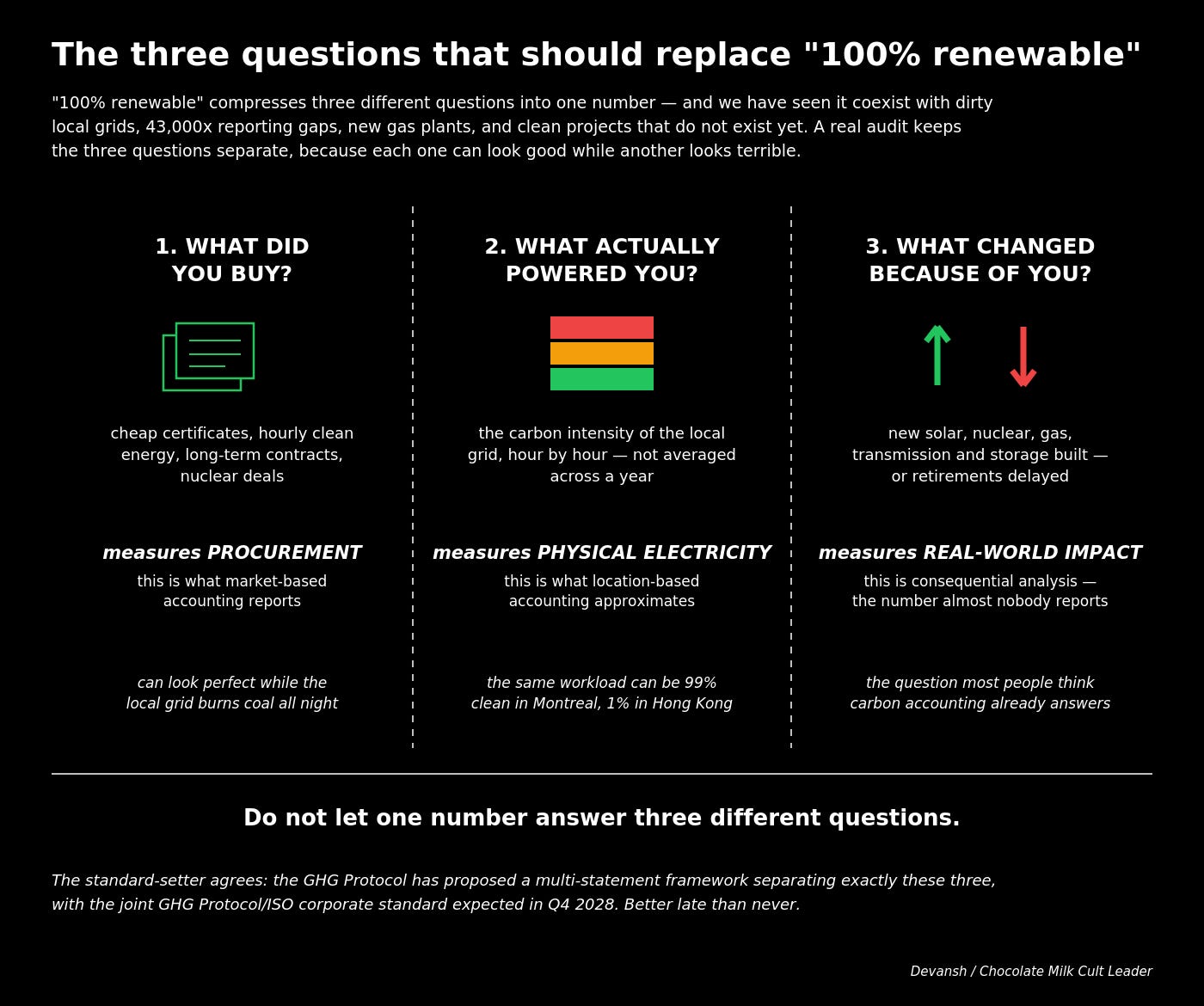
The better test is not “is this 100% renewable?” but: what did the company buy, what actually powered the data center, and what changed in the grid because the data center existed?
Hey there. I keep this newsletter ad-free, w/o sponsors, and mostly w/o paywalls to ensure that everyone has access to high-quality deep-dives on the most important ideas in the AI Industry without any bias. B/w my research, independent verification, and the chocolate milk needed to produce these works, these deep-dives take a lot of time, resources, and infrastructure. For just 10 USD/month or 100 USD/year, you can help me continue my vision of democratising access to the most important ideas in AI by becoming a paid subscriber over here —

PS — Supporting this work doesn’t have to come out of your pocket. If you read this as part of your professional development, you can use this email template to request reimbursement for your subscription.
Want access to a repository containing all of our research? 300+ files containing our notes of various experiments, discussions with cutting-edge teams, and insights into where the industry is headed next. Get a Founding Member Subscription to AI Made Simple. Want to talk to me for details/get my insights into the tech ecosystem? Reach out to me through any of my socials over here or reply to this email.
1. What Does “100% Renewable” Actually Mean — and Does It Really Help?
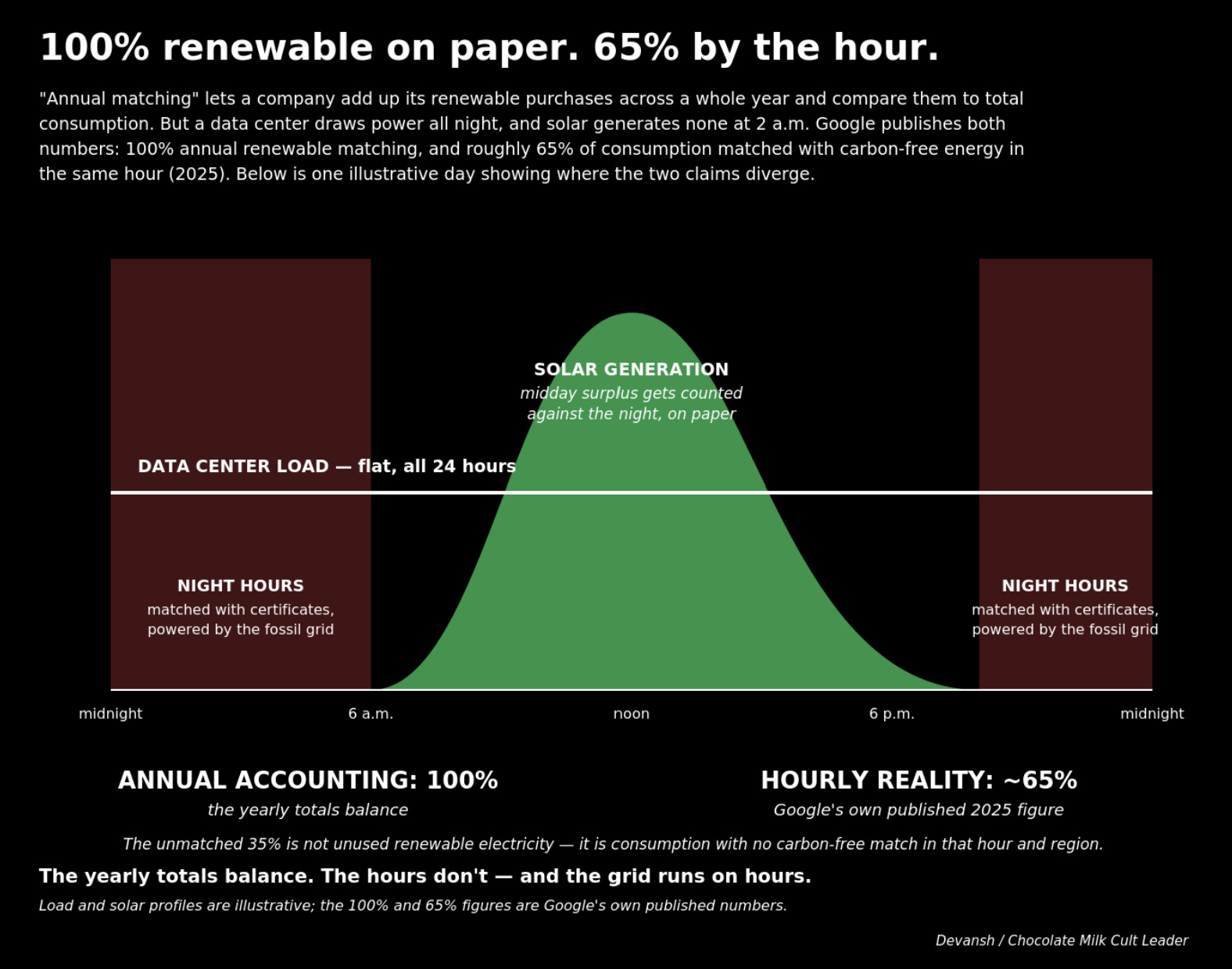
Data centers don’t run on dedicated green power lines and are plugged into regional grids that mix solar, wind, nuclear, gas, and coal in real time. So, when a company says it is “100% renewable,” they’re describing an annual paper match: balancing gross megawatt-hours consumed over 8,760 hours against total megawatt-hours of clean generation purchased globally. An operator can draw 100 TWh from coal-fired grids during freezing winter nights, buy 100 TWh of midday solar in a different interconnection during July, and report net-zero power.
This means that all three of these scenarios can be true at once:
A company consumes 100 TWh of electricity.
It buys renewable energy covering 100 TWh.
Some of its data centers still draw from grids using substantial gas or coal during many hours of the year.
This process is called annual matching. On the surface, it seems innocent enough, but you will see how this accounting trick compounds with others to muddy the waters and greenwash the conversation around the sustainability of data center operations.
How the same Data Center can produce two very different emissions numbers
Under the GHG Protocol’s Scope 2 rules, companies can report purchased-electricity emissions in two ways:
Location-based: How carbon-intensive are the grids where the company actually consumes electricity?
Market-based: What electricity and environmental attributes has the company contractually purchased?
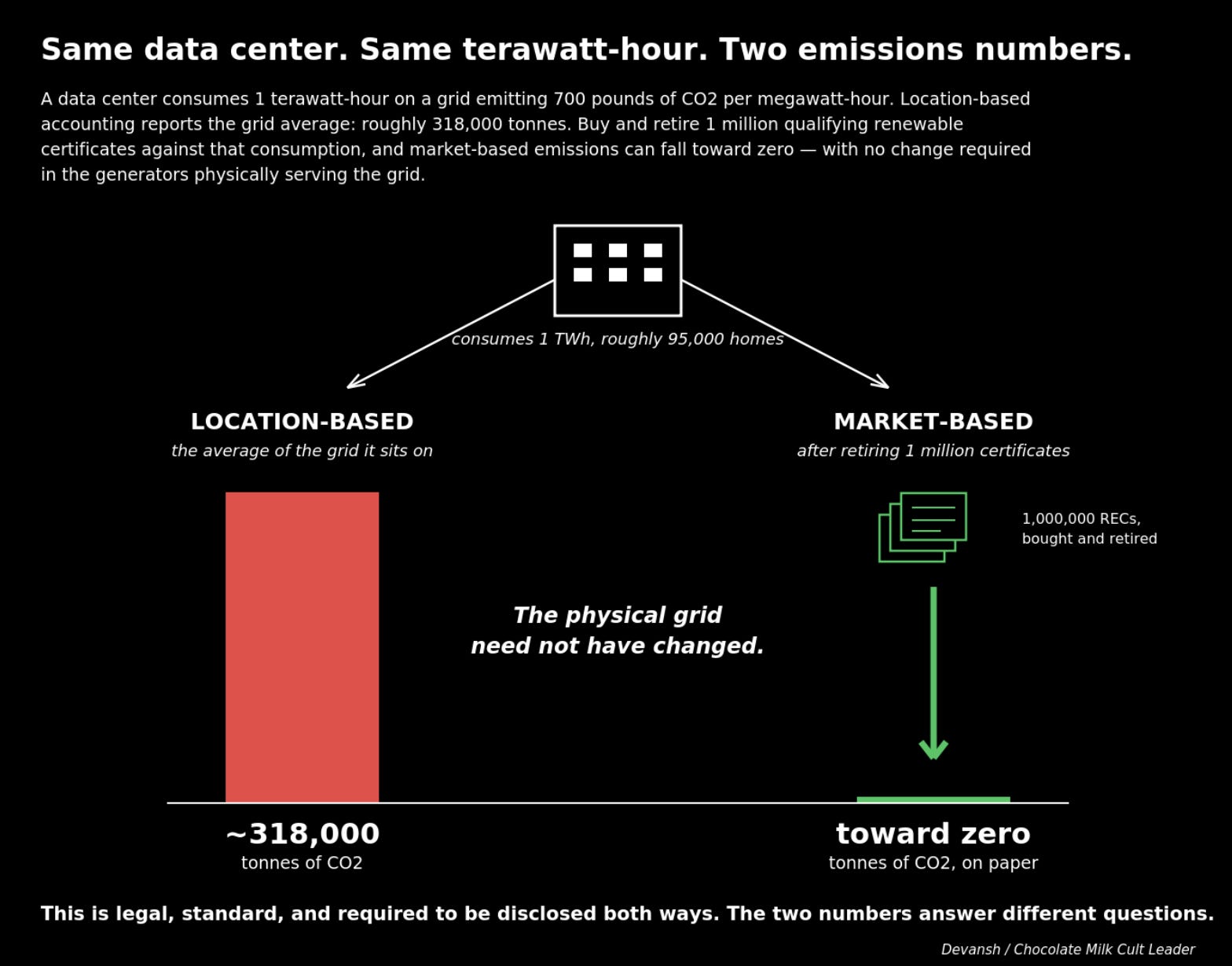
Contrary to their name, using market-based emissions can be used by companies to report dramatically lower emissions w/o really reducing their emissions. This is where we must learn about a concept Renewable Energy Certificate, or REC. When a renewable generator produces 1 MWh of electricity, it can effectively sell two things:
the physical electricity;
the REC, which acts like “ownership” of the electricity.
So, a wind farm may sell its physical electricity to one group and the certificate to a different one, not even connected to the wind farm’s grid (we call this an unbundled REC since the certificate and actual electricity are now separated).
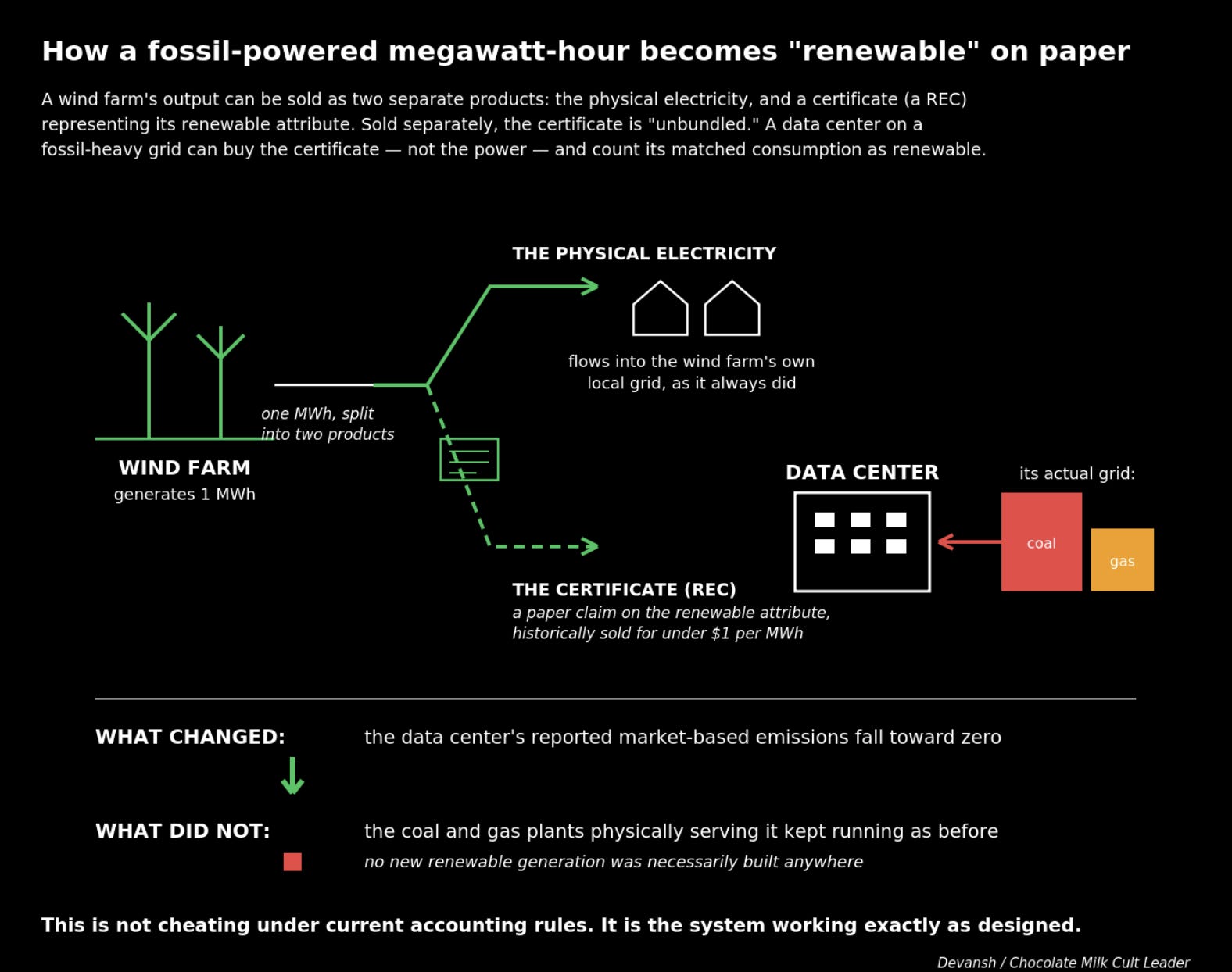
This is how companies use accounting to “reduce” their paper-emissions, while still increasing their carbon emissions. A common counterpoint here is that this difference isn’t a huge deal since big companies buying RECs → more money for renewable generators → more incentive (+ resources) to build out renewable grid → we eventually enjoy a tree-hugger utopia.
Before we move on, I think it’s worth addressing two common points that are used to justify all in building of data centers w/ no regard for the consequences (under the assumption that Data Centers and AI will Save the World so any cost is bearable).
Data centers are getting more efficient.” True. Uptime Institute’s latest survey puts average industry PUE at 1.52, falling to 1.36 when weighted by capacity, which suggests the larger and newer facilities driving much of the current buildout are meaningfully more efficient. But this is efficiency per unit of compute, not total environmental impact. If each unit gets cheaper while the number of units deployed grows much faster, total electricity use can still rise sharply. Our good friend Jevons has found us once again.
“AI could reduce emissions elsewhere.” Also plausible, and probably true in some sectors. The IEA estimates that widespread adoption of existing AI applications could enable emissions reductions equivalent to roughly 5% of global energy-related emissions by 2035. But that is a modeled future benefit dependent on adoption, substitution, and rebound effects; the electricity consumed by data centers is measured today. So both should be counted, but they should not be casually netted against each other as if one were a current meter reading and the other were equally certain.
Now let’s get back to our discussion about RECs and if they actually reduce grid emissions. Spoiler alert: it’s complicated.
Do Renewable Energy Certificates Actually Reduce Grid Emissions?
Think of renewable procurement as a spectrum:
Buy a REC from a renewable plant that was already operating: you acquire the renewable claim, but your purchase may do little to increase the amount of clean electricity on the grid.
Match consumption with clean generation during the same hour and on the same grid: much closer to the physical electricity problem, but the generator may still have existed without you.
Sign a long-term contract that allows a new wind or solar project to secure financing: your purchase can directly help new clean generation get built.
Restart a closed clean power plant or keep one from shutting down: your contract can add or preserve clean electricity that otherwise would not be available.
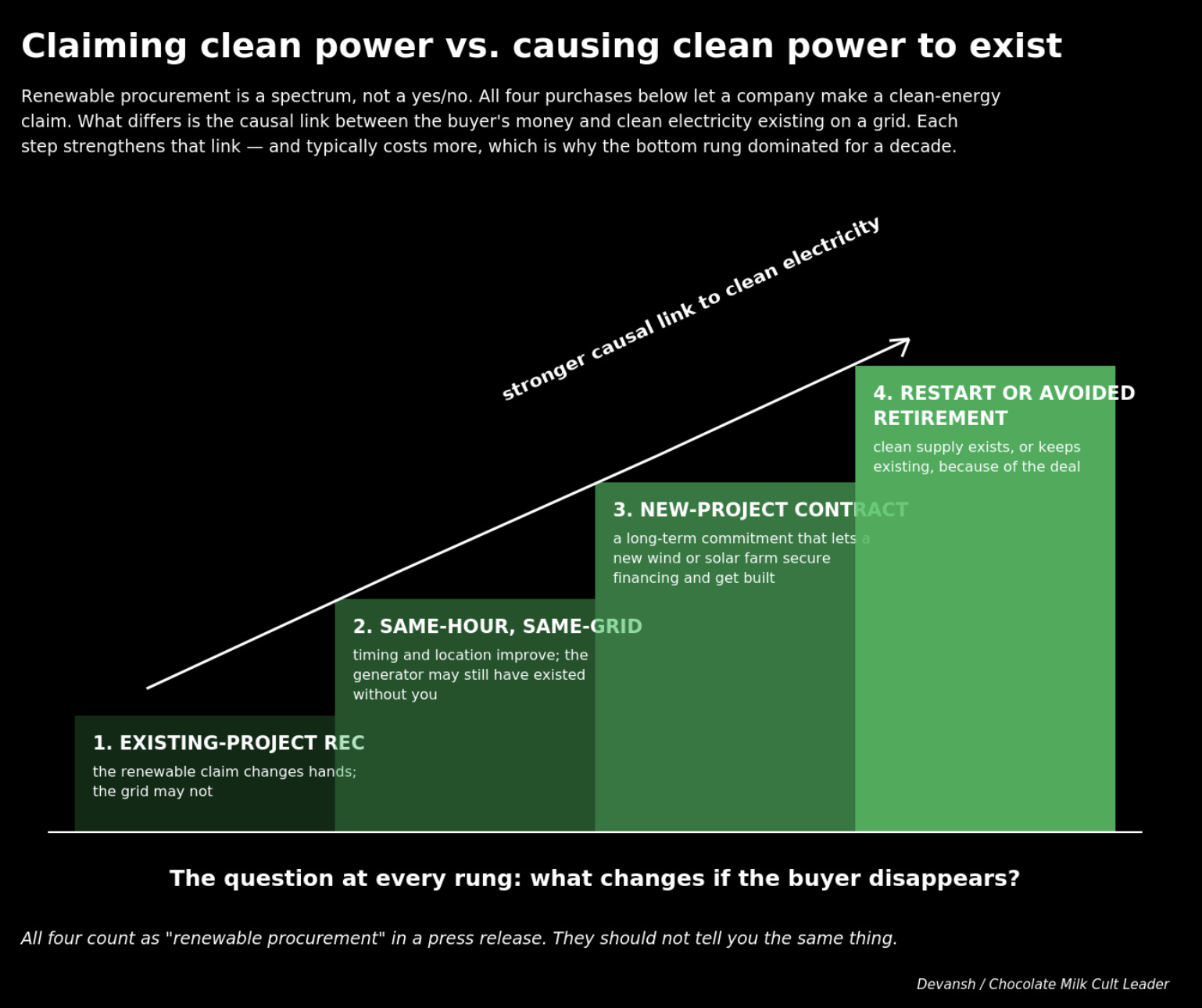
The sorting principle around this ranking boils down to one question:
Would this clean electricity exist without the buyer?
This ensures that the green energy becomes a permanent upgrade, not simply a checklist off the corporate checklists. Energy researchers call this additionality. Keep this term in mind, since we will come back to this a few times, and this metric is at the start of many sustainability discussions, even outside data centers. Looking from the additionality lens, the picture starts to look a bit less rosy:
A 2024 Joule study modeling voluntary clean-energy procurement in the western U.S. found that annual matching produced minimal long-run system-emissions reductions in the scenarios studied, while hourly matching produced substantially larger reductions.
A 2022 Nature Climate Change study found that REC use had inflated the apparent progress of the companies it examined; if historical trends continued, the researchers estimated that 42% of their committed Scope 2 reductions would not translate into real-world mitigation.
While this doesn’t make RECs useless, it does add a bit asterisk to any major claims of sustainability. (We will dig into the numbers on whether the data center buildout is helping w/ the growth of renewable in much more detail later).
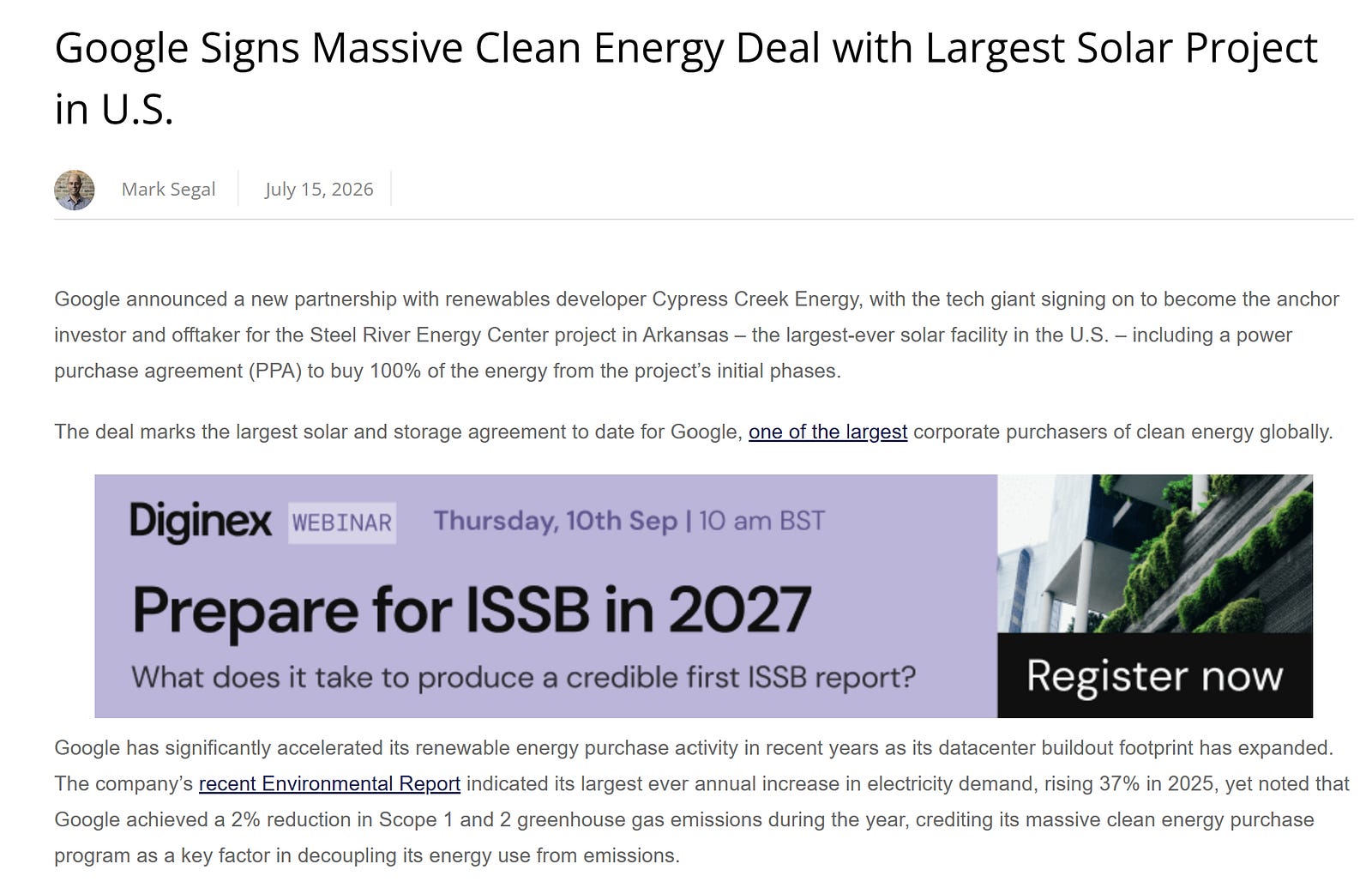
Before we fall into doom and gloom, it’s worth highlighting that the opposte is also true: corporate renewable procurement can drive new investment. Google, for example, is pretty active in signing massive renewable energy deals with purchase agreements, which encourages buildouts and expansions.
So the problem, like in many other cases, isn’t the lack of work (although I think we could be doing much more), but rather the way one loaded term can mean wildly different things, which confuses the conversation and makes meaningful climate audits and activism harder.
Reading this, you might be thinking about how problematic these word games actually are. After all, every writer on the internet suffers from afflictions where they are willing to declare holy war on whatever topic catches their fancy at that moment. So let’s run the numbers and see the spread when we put Google, Microsoft, Meta, Amazon and Oracle side by side.
“The pace at which new electricity demand is being sought by data centres is faster than the pace of network infrastructure delivery.”
— CRU — Final Large Energy Users Connection Policy, December 2025
2. So How Clean Are Big Tech’s Data Centers, Actually?
Once we move past the headline “100% renewable” claim, the meaningful question becomes simple: how much of a company’s actual electricity use is matched with clean power when and where it is using it?
Google is the clearest example because it reports both numbers.
It says it matched 100% of its annual electricity use with renewable purchases in 2025. But it also says only about 65% of its electricity use was matched with carbon-free energy hour by hour in 2025.
This tripped me out quite a bit, so we’ll spend some time clarifying what this means:
If Google uses 100 units of electricity over a year, and buys or contracts for 100 units of renewable electricity over that year, it can say it has 100% annual matching.
But if only 65 of those 100 units line up with carbon-free electricity in the same hour and region as Google’s actual consumption, then its hourly carbon-free energy score is 65%.
This creates a surplus of 35 units of renewable certificates (I wonder if these will eventually be sold as commodities). Remember, this is not an excess of actual electricity since the certificates are unbundled from the physical current.
Google’s regional numbers show how large those differences can be. Its latest available regional data show:
Stockholm: 100%
Finland: 98%
Mumbai: 9%
Singapore: 4%
Hong Kong: 1%
(from the Google regional carbon-free energy data)
I think it’s really cool that Google is actually reporting its hourly matching stats, since it reflects greater seriousness around the topic. It adds a bit more transparency to a space typically wrapped up in linguistic sleight of hand and sustainability theater.
Microsoft is a great example of linguistic theater/activism through definitions (the aforementioned 10x difference in emissions when you use a less friendly accounting metric), but they’re not the worst here. That honor goes to Meta, where their Meta Environmental Data Index reports roughly 135 tonnes of market-based Scope 2 emissions versus 5.86 million tonnes of location-based emissions. Any time tech is doing something shady, Meta is right there to lead the charge. Have all the moral problems with them you want, but at some point, you gotta appreciate their dedication to supervillainy and ruining this world for the rest of us.
To round out our discussion: Amazon reports 100% annual renewable matching but does not publish a directly comparable global location-based Scope 2 figure in its corporate reporting. Oracle reports about 92% renewable electricity in its cloud operations (gotta appreciate how they don’t even try for 100% unlike the new-age tech cos.), with location-based Scope 2 roughly 6.7× its market-based figure.
“Singapore’s electricity demand is expected to grow rapidly… driven by… energy-intensive sectors such as semiconductor manufacturing and data centres.”
— Singapore Energy Market Authority — Tuas Power 670 MW Gas Plant Award. Singapore is 93% Carbon Energy. so this will up their emissions a lot.
All this teaches us one important thing: we can’t treat company renewability claims as simplistically as their PR teams online pretend. Perhaps our Hobbesian tech overlords simply wish to protect our fragile and myopic minds from turning away from utopia.
Having studied the renewability claims extensively, we must move on to the next step in understanding the impact of data centers on our energy grids: even when these companies buy clean power, are they actually causing more clean electricity to exist?
3. What Happens Before the Clean Power Shows Up?
Sometimes, yes. But even this situation is more nuanced than you’d think. Even when a hyperscaler helps finance genuinely new clean generation, the data center and the power project may come online years apart, since new U.S. power projects generally have to enter an interconnection queue before connecting to the transmission grid (grid operators study whether the system needs new transmission equipment or upgrades before accepting them).
This process can be incredibly inefficient. Berkeley Lab’s latest data show:
Projects that actually came online in 2025 had spent a median of more than five years between requesting interconnection and beginning commercial operation.
Another 549 GW already had a draft or executed interconnection agreement but was still not operating.
This means that even when a new data center comes with its own source of clean energy, it might still take years before that clean energy goes live (this might be why some companies are pushing for special generators for only their data centers). In that interim, you would be increasing load on the existing grid, even as the companies buys credits and claim green operations.
Georgia and what Happens when Demand Outpaces Supply
Georgia Power’s 2025 planning process authorized procurement of up to 8.5 GW of new capacity. The Georgia Public Service Commission says approximately 80% of the new generation approved in December 2025 is expected to power data centers.
For scale, 8.5 GW running continuously would consume about 74.5 TWh a year. (For some context, using the EIA’s latest full-year average of 865 kWh per U.S. residential customer per month in 2024, that is roughly the annual electricity consumption of 7.2 million homes).
The final certified portfolio totals 9,885 MW:
3,692 MW of new combined-cycle gas generation
2,762 MW of standalone battery storage
350 MW of battery storage paired with solar
1,195 MW of PPAs from the original RFP
another 1,626 MW of long-term PPAs and extensions
260 MW of additional battery storage paired with an existing solar PPA.
Georgia Power SEC filing — full resource breakdown
So, in order to power the buildout of these supposedly clean data centers, Georgia will rely on new fossil fuel plants for almost 40% of their energy needs. But make sure you keep your air conditioner in check.
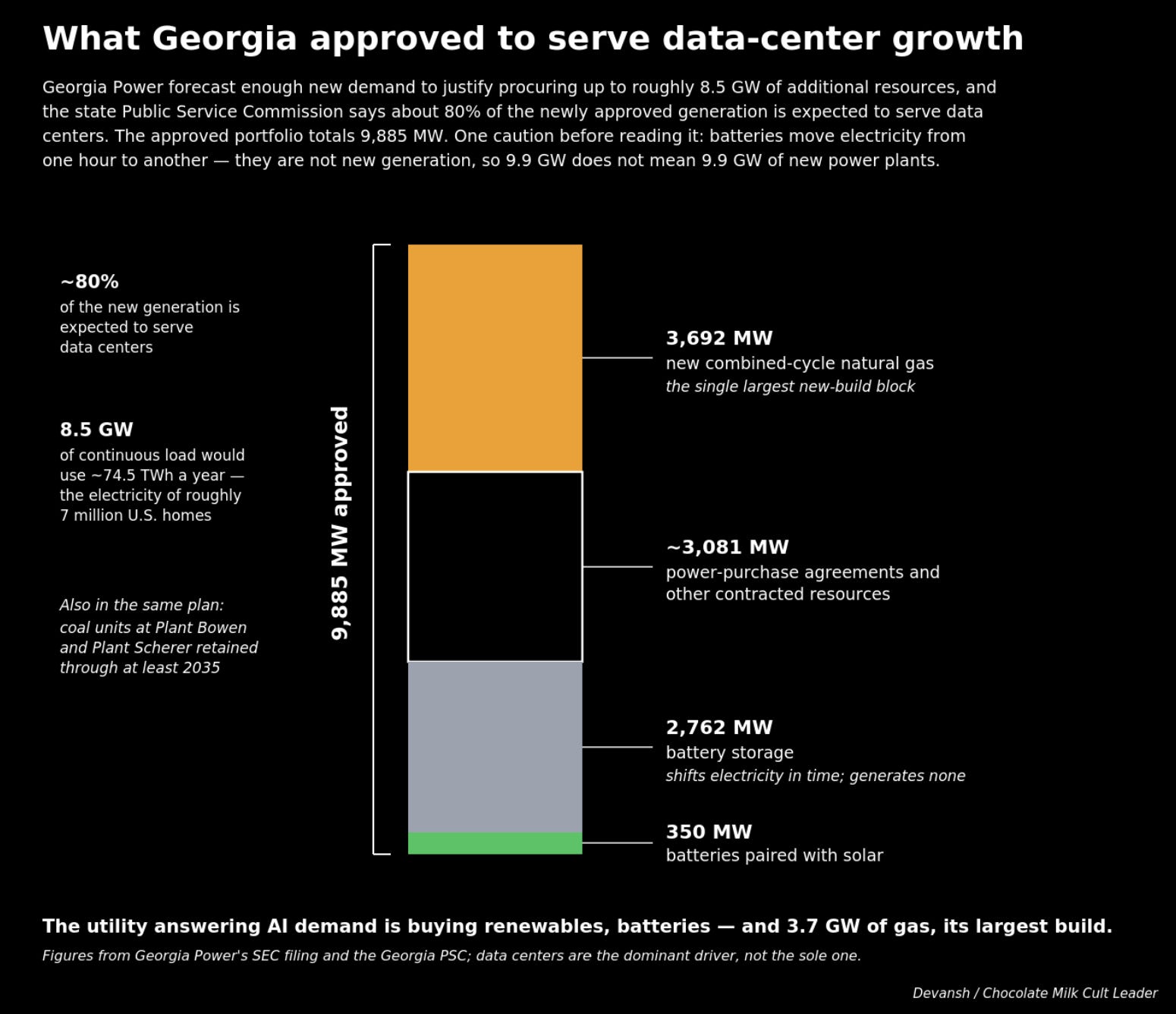
The same 2025 planning process also extended the expected life of existing coal generation. Georgia Power had previously indicated plans to retire Plant Scherer Unit 3 by the end of 2028. The 2025 IRP extended it through at least December 31, 2035. Plant Bowen Units 1 and 2, which Georgia Power had also previously indicated could retire by the end of 2028, are now assumed to operate through at least 2035.
It would be unfair to paint data centers as solely responsible for this expansion, but we can’t also overlook how much of the new energy demand is driven by them. This is a problem that will get much worse since the deregulation + buildouts for data centers will be much faster than the efforts to bring on more green energy.
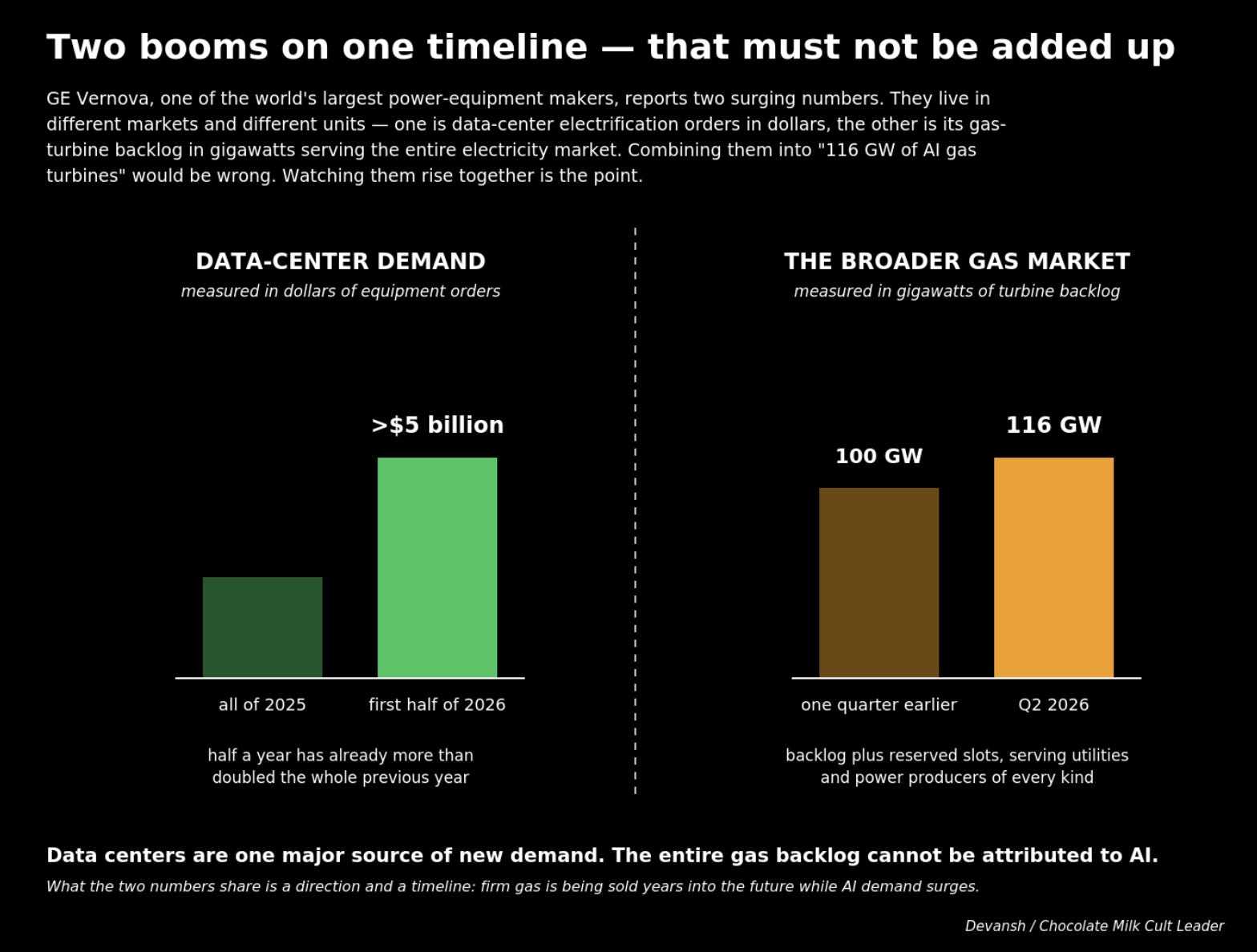
To see how bad this can get, let’s look at a story playing out at this very moment.
The xAI lawsuit
In April 2026, the NAACP sued xAI and its subsidiary, alleging they were operating 27 gas turbines without the required air permit in Southaven, Mississippi to supply the nearby Colossus 2 data center. Court filings put those 27 turbines at a combined generating capacity of at least 495 MW. May 2026 preliminary-injunction filing
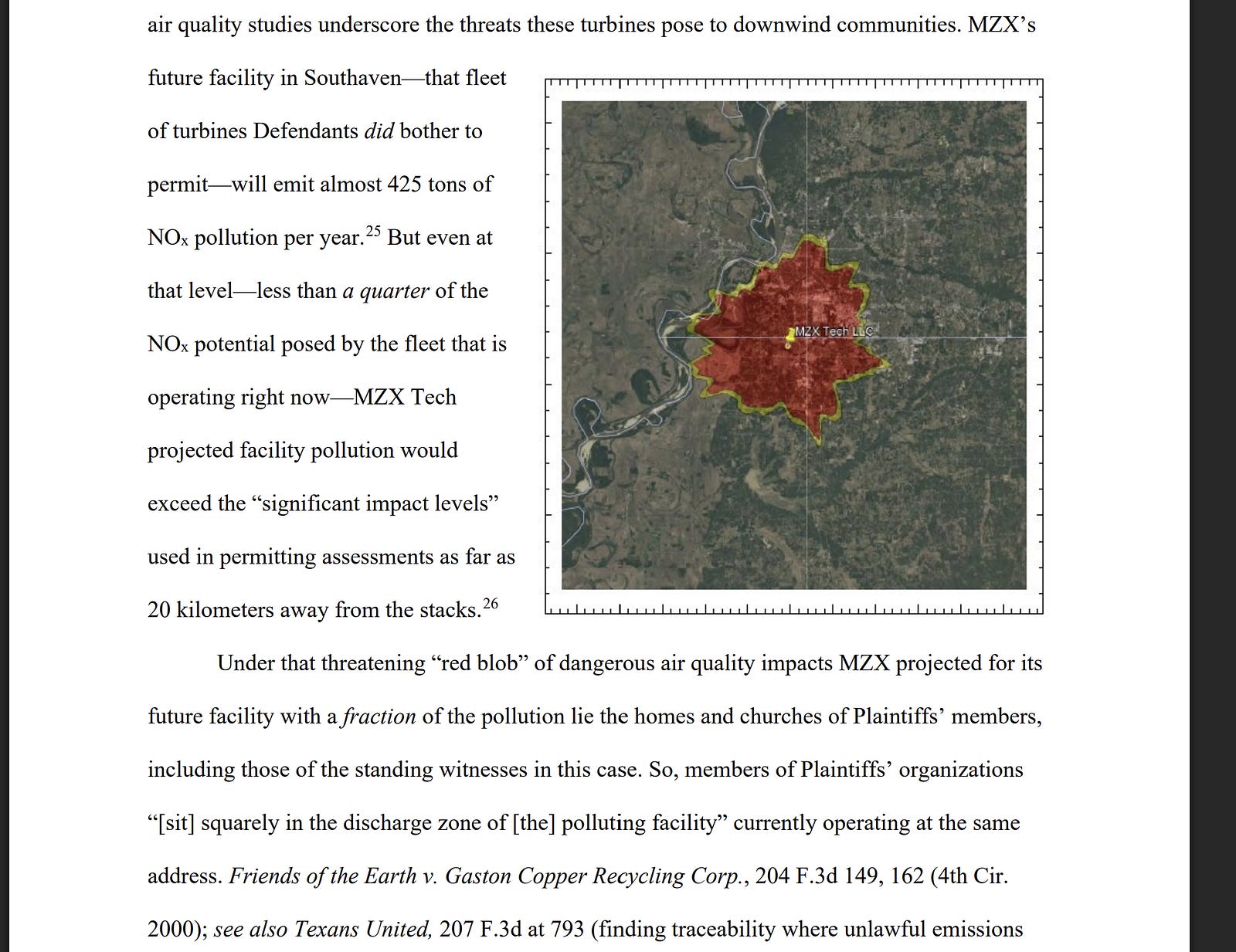
(from the lawsuit)
xAI claims these gas plants will be temporary but this will have meaningful long-term negative impacts on the climate and health of the people in the areas. So I guess if I want to stress one thing, it would be this: even if companies will eventually create a world where their data centers are fed through clean energy in the future, powering the data centers at this moment can still have severe consequences that should not be overlooked.
4. Who Pays for AI’s Power Boom?
If data centers are forcing utilities to build billions of dollars of new generation and grid infrastructure, who gets the bill? Contrary to the sensationalist reporting, the answer is not necessarily you.
Georgia’s approved projects and related transmission investments total about $16.7 billion, but Georgia Power has also committed to structuring its next rate case so that revenue from large-load customers creates at least $556 million a year of downward pressure on rates from 2029–2031, equivalent to about $8.50 a month for a typical household using 1,000 kWh. That is still a projection, not realized savings, but large data centers can be valuable utility customers because they buy enormous amounts of power consistently; the bigger risk is a utility building for demand that gets delayed or never appears.
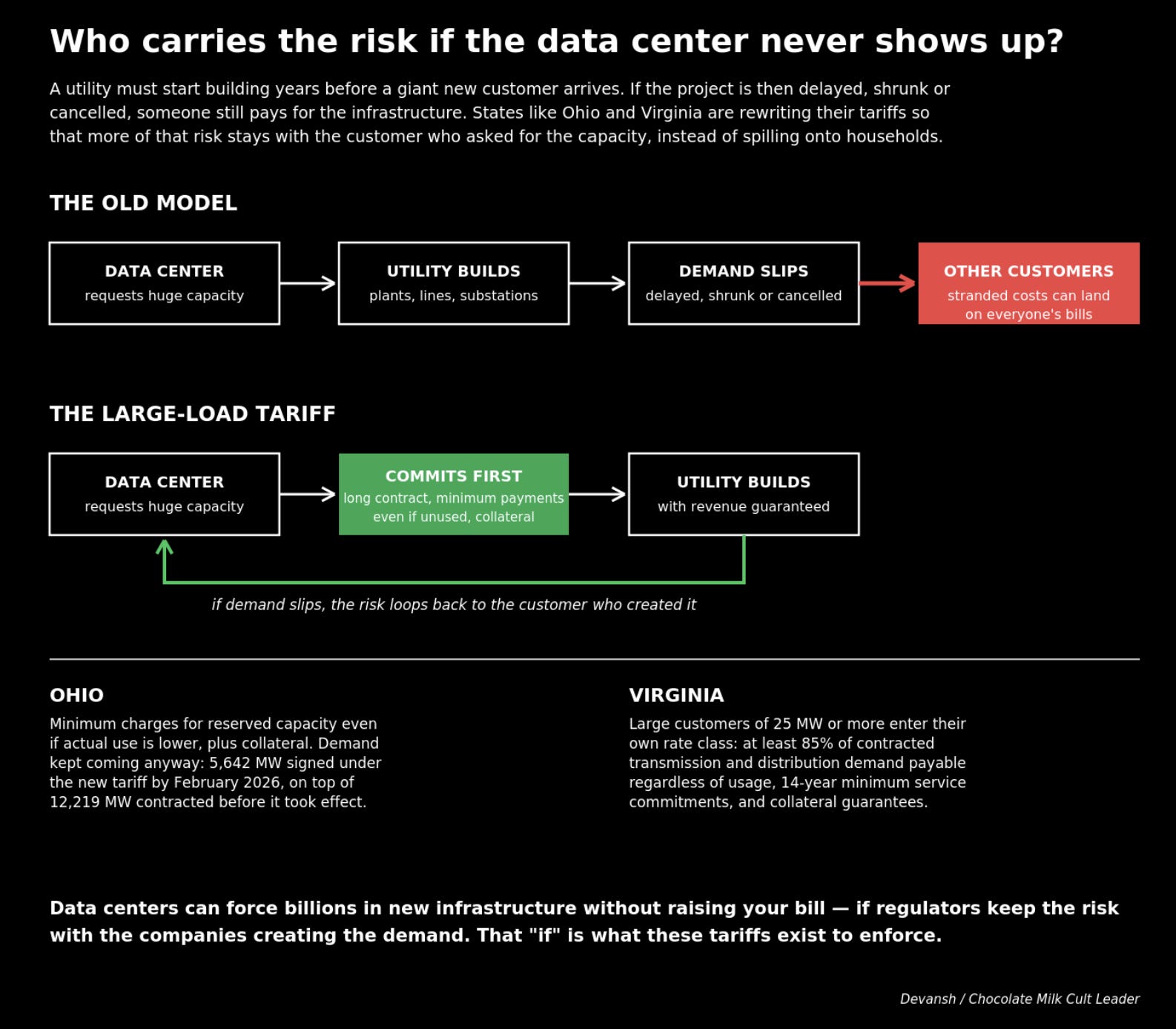
A few states are offloading the risk back to the buyers of data centers. New AEP Ohio data centers face long-term capacity commitments, minimum charges even if they use less power than they reserved, and collateral requirements designed to keep more of the infrastructure risk with the customer creating it. This has not killed demand: by February 2026, developers had signed binding contracts for another 5,642 MW under the new tariff, on top of 12,219 MW contracted before it took effect.
Virginia has adopted the same principle. New large customers of 25 MW or more enter a separate rate class; qualifying data centers must pay at least 85% of their contracted transmission and distribution demand regardless of actual usage, commit to service for at least 14 years, and can be required to guarantee up to 60% of their minimum contract charges. Both of these arrangements work on the principle that utilities should not spend billions preparing for hyperscale demand and then dump the risk onto everyone else if the customer disappears.
We’ve gone quite deep into the accounting behind data centers and their renewability. All of this has led to one question —
Conclusion: So How Should We Actually Measure Whether a Data Center Is Clean?
At this point, I think we can retire “100% renewable” as a useful standalone measure of sustainability. It tells us something about what a company bought, but we have now seen that it can coexist with dirty local grids, huge differences in reported emissions, new gas plants, and years where the clean generation being financed does not even exist yet.
A better audit needs three separate answers:
What did you buy? Did you buy cheap certificates, hourly clean energy, or finance genuinely new generation?
What actually powered the data center? What was the carbon intensity of the local grid, ideally hour by hour rather than averaged across a year?
What changed because you showed up? Did your demand cause new renewables, nuclear, gas, transmission or storage to be built? Did it keep a coal plant running longer? Would those things have happened without you?
We can take some comfort in the fact that the world seems to be moving in this direction. In July 2026, the GHG Protocol proposed a multi-statement framework separating physical emissions, market-based emissions, and the emissions impact of corporate actions and investments, rather than forcing all three ideas into one number. The new joint GHG Protocol/ISO corporate standard is expected in Q4 2028.
However, given the rapid rise in emissions and the increasing climate death, we need to be taking action much quicker. We must campaign for stricter metrics, more rapid actions, and much more transparency in the measurements.
We will be doing a follow-up on the complete resource needed for Data Centers. Stay tuned for that one.
Thank you for being here, and I hope you have a wonderful day,
Dev <3
If you liked this article and wish to share it, please refer to the following guidelines.
That is it for this piece. I appreciate your time. As always, if you’re interested in working with me or checking out my other work, my links will be at the end of this email/post. And if you found value in this write-up, I would appreciate you sharing it with more people. It is word-of-mouth referrals like yours that help me grow. The best way to share testimonials is to share articles and tag me in your post so I can see/share it.

Reach out to me
Use the links below to check out my other content, learn more about tutoring, reach out to me about projects, or just to say hi.
Small Snippets about Tech, AI and Machine Learning over here
AI Newsletter- https://artificialintelligencemadesimple.substack.com/
My grandma’s favorite Tech Newsletter- https://codinginterviewsmadesimple.substack.com/
My (imaginary) sister’s favorite MLOps Podcast-
Check out my other articles on Medium. :
https://machine-learning-made-simple.medium.com/
My YouTube: https://www.youtube.com/@ChocolateMilkCultLeader/
Reach out to me on LinkedIn. Let’s connect: https://www.linkedin.com/in/devansh-devansh-516004168/
My Instagram: https://www.instagram.com/iseethings404/
My Twitter: https://twitter.com/Machine01776819
The REC problem here is basically the offset debate carbon markets have been having for twenty years, right down to the word additionality. An unbundled certificate is a claim that something clean happened somewhere, which is a different question from what was burning near the load. The bit I keep coming back to is that 35 percent surplus Google is holding. Once surplus certificates can be banked or resold, you get the oversupply dynamic that flattened prices in the early cap and trade programs, and the certificate stops carrying much information at all. Hourly matching fixes the timing problem on paper, but only if registries can actually issue and settle at hourly granularity, and that coverage is still thin.
There is an accounting standard that makes both versions of the number legitimate at once. The GHG Protocol Scope 2 Guidance, published in January 2015, requires companies with operations in markets that provide contractual instruments to report scope 2 emissions twice and label each result by method: one location-based, one market-based. Location-based uses statistical emissions data aggregated and averaged within a defined geographic boundary over a defined period. Market-based derives factors from contracts for energy bundled with generation attributes, or from unbundled attribute claims. The practical consequence is that the grid-intensity figure usually already exists in the same disclosure as the 100 percent claim. That is the line worth reading.