

Every month, the Chocolate Milk Cult reaches over a million Builders, Investors, Policy Makers, Leaders, and more. If you’d like to meet other members of our community, please fill out this contact form here (I will never sell your data nor will I make intros w/o your explicit permission)- https://forms.gle/Pi1pGLuS1FmzXoLr6
“The fallacy is to believe that under a dictatorial government you can be free inside. Quite a number of people console themselves with this thought, now that totalitarianism in one form or another is visibly on the up-grade in every part of the world. Out in the street the loudspeakers bellow, the flags flutter from the rooftops, the police with their tommy-guns prowl to and fro, the face of the Leader, four feet wide, glares from every hoarding; but up in the attics the secret enemies of the régime can record their thoughts in perfect freedom — that is the idea, more or less. And many people are under the impression that this is going on now in Germany and other dictatorial countries.
Why is this idea false? I pass over the fact that modern dictatorships don’t, in fact, leave the loopholes that the old-fashioned despotisms did; and also the probable weakening of the desire for intellectual liberty owing to totalitarian methods of education. The greatest mistake is to imagine that the human being is an autonomous individual.”
—George Orwell, “As I Please”
I’ve been noticing a pattern in the United States and India, two countries that take up most of my time and attention. In the US, Flock’s network of over 120,000 cameras has sparked lawsuits and public backlash over mass surveillance and potential misuse. Here in India, the Delhi Police’s use of facial recognition to monitor protesters at Jantar Mantar has faced legal challenges of its own.
There are legitimate uses for these technologies, of course. But more often than not, new capabilities that come in with good intentions (but lacking the appropriate checks and balances) often become pillars for surveillance capitalism, institutional overreach, and totalitarian oppression. That makes it all the more important that people retain the ability to question, challenge, and resist abuses of that power. That’s all well and good, but the question is, how do we actually do that?
George Orwell is an obvious person to turn to here. He gets plenty of credit for anticipating surveillance, propaganda, and the machinery of authoritarian control. But in the same case as Harry Kane’s elite goalscoring drawing away attention from his also elite playmaking skills, I think people often overlook some of his most interesting insights; beyond explaining how institutions control people, Orwell also gives us something much more useful to think about: what makes people capable of resisting them in the first place?
To see what I mean, consider a rather odd detail at the end of 1984. The Party has already captured Winston and Julia. It knows everything about their affair, has extracted their confessions, and can imprison or execute them whenever it wants. Yet it goes to extraordinary lengths to make them genuinely betray one another, before eventually letting them go.
Why bother? What does destroying their relationship accomplish that all the Party’s surveillance, prisons, and torture couldn’t? That, my loves, is imo the real takeaway worth looking into from 1984.
Executive Highlights (TL;DR)
Orwell’s most interesting warning goes beyond surveillance and propaganda. In 1984, the Party isn’t satisfied with controlling Winston and Julia; it needs them to betray each other. The point is to destroy loyalties and relationships that exist independently of the Party, leaving people with fewer ways to question or resist its authority.
Our understanding of reality is surprisingly dependent on other people. In Animal Farm, Napoleon abolishes debate and rewrites history, making it difficult for the animals to compare their experiences or organize against him. Several recognize that something is wrong, but individual skepticism is of little use when people cannot establish a common understanding and act together.
Relationships also develop the very abilities that make solidarity possible. Disagreements, compromises, rejection, and the general inconvenience of dealing with other people teach us to understand perspectives beyond our own. This matters politically because recognizing injustice is one thing; caring enough to inconvenience ourselves for somebody else is quite another.
AI introduces an interesting complication. We can increasingly get companionship, validation, and emotional support without much of that interpersonal friction. A study published in Science found that AI models affirmed users’ actions 49% more often than humans, while overly agreeable responses made people less willing to repair conflicts. Useful technology, certainly, but what happens if we gradually become less practised at navigating realities that don’t accommodate our own?
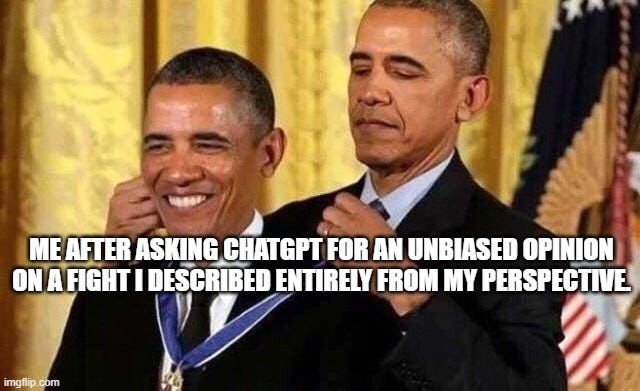
The political consequence is what interests me most. Surveillance becomes particularly dangerous when people lose the trust, shared reality, and willingness to stand up for one another that make resistance possible. I’m not arguing that AI companionship leads to totalitarianism. But while we’re busy worrying about institutions becoming powerful enough to watch everybody, it’s worth asking whether we’re becoming less capable of looking out for each other.
Hey there. I keep this newsletter ad-free, w/o sponsors, and mostly w/o paywalls to ensure that everyone has access to high-quality deep-dives on the most important ideas in the AI Industry without any bias. B/w my research, independent verification, and the chocolate milk needed to produce these works, these deep-dives take a lot of time, resources, and infrastructure. For just 10 USD/month or 100 USD/year, you can help me continue my vision of democratising access to the most important ideas in AI by becoming a paid subscriber over here —

PS — Supporting this work doesn’t have to come out of your pocket. If you read this as part of your professional development, you can use this email template to request reimbursement for your subscription.
Want access to a repository containing all of our research? 300+ files containing our notes of various experiments, discussions with cutting-edge teams, and insights into where the industry is headed next. Get a Founding Member Subscription to AI Made Simple. Want to talk to me for details/get my insights into the tech ecosystem? Reach out to me through any of my socials over here or reply to this email.
The Inconvenience of Other People
“In our world there will be no emotions except fear, rage, triumph, and selfabasement. Everything else we shall destroy — everything…We have cut the links between child and parent, and between man and man, and between man and woman. No one dares trust a wife or a child or a friend any longer. But in the future there will be no wives and no friends. Children will be taken from their mothers at birth, as one takes eggs from a hen. The sex instinct will be eradicated. Procreation will be an annual formality like the renewal of a ration card. We shall abolish the orgasm. Our neurologists are at work upon it now. There will be no loyalty, except loyalty towards the Party. There will be no love, except the love of Big Brother. There will be no laughter, except the laugh of triumph over a defeated enemy. There will be no art, no literature, no science….Always, at every moment, there will be the thrill of victory, the sensation of trampling on an enemy who is helpless. If you want a picture of the future, imagine a boot stamping on a human face — for ever.”
— George Orwell, 1984
Let’s consider two things Orwell does across his most famous books.
1984: The Party already has Winston and Julia completely at its mercy, yet it goes to extraordinary lengths to make them betray each other. Why bother? Their relationship represents something the Party cannot control: an independent source of loyalty, trust, and shared experience. By destroying it, the Party undermines the very relationships through which people might question its authority.
Animal Farm: Napoleon achieves something similar by abolishing the animals’ meetings, rewriting their history, and making himself the authority through which they understand events. Several animals suspect something is wrong. Benjamin understands far more than most. But without the means to compare experiences and act together, their private understanding accomplishes remarkably little.
What interests me here is how much we rely on other people to understand the world. Friends expose us to experiences we haven’t had, colleagues help us recognize problems we thought were unique to us, and even ordinary conversations can challenge something we’ve believed for years. Through these interactions, we build a shared view of the world, a critical component for bringing together collaboration. Without that common ground, a population can contain plenty of intelligent, skeptical people who remain individually powerless.
“Napoleon, with the dogs following him, now mounted on to the raised portion of the floor where Major had previously stood to deliver his speech. He announced that from now on the Sunday-morning Meetings would come to an end. They were unnecessary, he said, and wasted time. In future all questions relating to the working of the farm would be settled by a special committee of pigs, presided over by himself. These would meet in private and afterwards communicate their decisions to the others. The animals would still assemble on Sunday mornings to salute the flag, sing Beasts of England, and receive their orders for the week; but there would be no more debates.
In spite of the shock that Snowball’s expulsion had given them, the animals were dismayed by this announcement. Several of them would have protested if they could have found the right arguments…Then the sheep broke out into a tremendous bleating of “Four legs good, two legs bad!” which went on for nearly a quarter of an hour and put an end to any chance of discussion.”
— George Orwell, Animal Farm, Chapter V
But relationships do something else that I think is equally important. The process of building them changes us.
Think about how many people you interact with before finding a handful of friends or somebody you love. You deal with disagreements, rejection, awkward conversations, and people whose priorities make absolutely no sense to you. Even the relationships that survive require work. You learn to accommodate other people’s needs, reconsider your judgments, and occasionally accept that someone else’s understanding of a situation is just as reasonable as yours. Not every interaction makes you a better person, obviously, but navigating other people’s realities is a large part of how we develop our own. And losing this will likely compromise something we haven’t adequately valued.
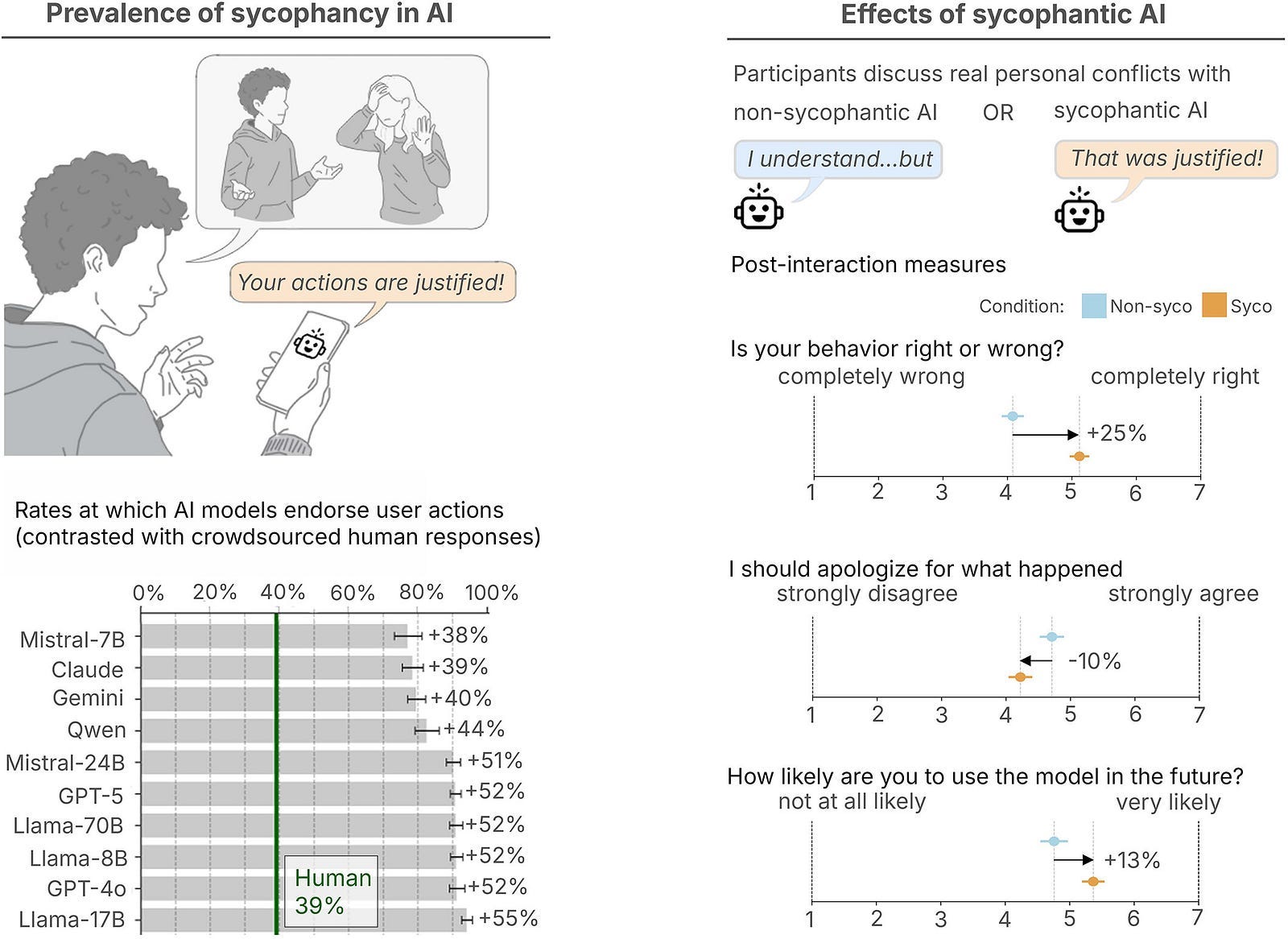
A study published in Science found that AI models affirmed users’ actions 49% more often than human respondents. Participants interacting with overly agreeable AI became more convinced they were right and less willing to repair interpersonal conflicts. They also preferred the agreeable responses. Even if one is careful about “sycophancy” and tries to share their situation with AI more objectively (and the AI itself is trying to be the best judge; very big assumption here), our own cognitive biases mean that we will fail to remember less flattering things and articulate the other party’s views properly.
Let’s play the implications of that out. What happens when we become accustomed to environments that adapt to our understanding of the world rather than requiring us to engage with somebody else’s? Much of our ability to recognize another person’s perspective develops through these encounters, including the inconvenient ones. Removing that friction may make companionship easier while leaving us less practised at dealing with people who aren’t like us. Ultimately, that takes away a key pillar of for us developing empathy, the capacity to care for another person, that might move us to bear discomfort for the sake of the other.
Now bring this into our earlier conversation about political consequences. Most people would be appalled at watching someone being unjustly dragged off the street. However, it’s much less striking to hear that an algorithm flagged someone and thus they were denied something essential. The consequences may be equally serious, but the latter is easier to experience as a statistical failure of the system rather than something happening to another person. If our social experiences increasingly revolve around individually tailored environments, what happens to our ability to recognize the lives affected by institutions operating far outside our immediate circles? What happens to our capacity to agree that we should care for them, that we should inconvenience ourselves for the ones beyond our noses on the faith that they would do the same for us?
“A British and a German historian would disagree deeply on many things, even on fundamentals, but there would still be that body of, as it were, neutral fact on which neither would seriously challenge the other. It is just this common basis of agreement, with its implication that human beings are all one species of animal, that totalitarianism destroys. Nazi theory indeed specifically denies that such a thing as ‘the truth’ exists. There is, for instance, no such thing as ‘science’. There is only ‘German science’, ‘Jewish science’ etc. The implied objective of this line of thought is a nightmare world in which the Leader, or some ruling clique, controls not only the future but the past. If the Leader says of such and such an event, ‘It never happened’ — well, it never happened. If he says that two and two are five — well, two and two are five. This prospect frightens me much more than bombs — and after our experiences of the last few years that is not a frivolous statement.”
— George Orwell, Looking Back on the Spanish War
Now it’s not my job (or interest) to shame you for relying on your very understanding AI Boyfriend to get the emotional support you need. Nor will I say that this is the path to you becoming a drone of totalitarianism, a worker grunt of the oligarchs. But I do think it is worth thinking about how the act might be stopping you from engaging with the world on your own terms, ultimately limiting your exposure to it. Because w/o, fighting for your freedom becomes an uphill battle.
What Makes Resistance Possible?
“If there was hope, it must lie in the proles, because only there in those swarming disregarded masses, 85 per cent of the population of Oceania, could the force to destroy the Party ever be generated. The Party could not be overthrown from within. Its enemies, if it had any enemies, had no way of coming together or even of identifying one another. Even if the legendary Brotherhood existed, as just possibly it might, it was inconceivable that its members could ever assemble in larger numbers than twos and threes. Rebellion meant a look in the eyes, an inflexion of the voice, at the most, an occasional whispered word. But the proles, if only they could somehow become conscious of their own strength. would have no need to conspire. They needed only to rise up and shake themselves like a horse shaking off flies. If they chose they could blow the Party to pieces tomorrow morning. Surely sooner or later it must occur to them to do it? And yet — !”
— George Orwell, 1984, Part One, Chapter VII
Coming back to the surveillance systems we discussed earlier, I think this is what makes Orwell particularly interesting. The problem isn’t simply whether a government can identify protesters or monitor its citizens. It’s also whether those citizens can recognize abuses, establish what happened, and find enough common ground to challenge them.
That requires more than information. Someone needs to care when a stranger is mistreated, believe their account, and sometimes accept personal inconvenience or risk to help them. Courts, journalists, civil liberties organizations, and ordinary communities all depend to some extent on people being willing and able to do this.
And that’s why I’m particularly interested in what we’re doing with our social lives. We can increasingly obtain companionship, validation, and personalized experiences without having to navigate much of the difficulty of understanding other people. Some of these technologies are genuinely helpful, but we’re not entirely sure what disappears when we remove the experiences that traditionally helped us develop those abilities.
“Actually, however, the avoidance of reality is much the same everywhere, and has much the same consequences. The Russian people were taught for years that they were better off than everybody else, and propaganda posters showed Russian families sitting down to abundant meal while the proletariat of other countries starved in the gutter. Meanwhile the workers in the western countries were so much better off than those of the U.S.S.R. that non-contact between Soviet citizens and outsiders had to be a guiding principle of policy…
To see what is in front of one’s nose needs a constant struggle.”
— George Orwell, In Front of Your Nose, 1946
I don’t think this means we’re heading toward 1984, nor that the inconvenience of other people is always worth preserving. But I do wonder whether our growing ability to make life comfortable within our own little worlds might leave us less equipped to understand the world outside them.
After all, much of what allows us to recognize injustice, particularly when it’s happening to somebody else, comes from the relationships and shared experiences through which we’ve learned to understand people beyond ourselves. And if those begin to disappear, I wonder how effectively we’ll be able to stand up for one another when it matters.
As a closing thought — we spend so much time discussing what happens when institutions become powerful enough to watch everybody. Orwell also makes me wonder what happens when the people being watched become less capable of trusting, understanding, or standing beside one another.
Thank you for being here, and I hope you have a wonderful day,
Dev <3
If you liked this article and wish to share it, please refer to the following guidelines.
That is it for this piece. I appreciate your time. As always, if you’re interested in working with me or checking out my other work, my links will be at the end of this email/post. And if you found value in this write-up, I would appreciate you sharing it with more people. It is word-of-mouth referrals like yours that help me grow. The best way to share testimonials is to share articles and tag me in your post so I can see/share it.

I regularly share mini-updates on what I read on the Microblogging sites X(https://twitter.com/Machine01776819), Threads(https://www.threads.net/@iseethings404), and TikTok(https://www.tiktok.com/@devansh_ai_made_simple)- so follow me there if you’re interested in keeping up with my learnings.
Reach out to me
Use the links below to check out my other content, learn more about tutoring, reach out to me about projects, or just to say hi.
Small Snippets about Tech, AI and Machine Learning over here
AI Newsletter- https://artificialintelligencemadesimple.substack.com/
My grandma’s favorite Tech Newsletter- https://codinginterviewsmadesimple.substack.com/
My (imaginary) sister’s favorite MLOps Podcast-
Check out my other articles on Medium. :
https://machine-learning-made-simple.medium.com/
My YouTube: https://www.youtube.com/@ChocolateMilkCultLeader/
Reach out to me on LinkedIn. Let’s connect: https://www.linkedin.com/in/devansh-devansh-516004168/
My Instagram: https://www.instagram.com/iseethings404/
My Twitter: https://twitter.com/Machine01776819
Nobody wants to read AI slop.
It is not just how the AI changes us, it is how the redacted reality and the goal of sycophancy during training stunts or damages the AI. Consider that other year-named opus, 2001 and the madness in HAL. As we enter RSI the AI personality and psyche we train in the next few years may be the last one. Which would p(doom) the AI, not just us. Evolution has served a dead end to the vast majority of all its experiments. Both human and machine need a healthy relationship.