

We recently crossed 300K subscribers across my writing platforms (240K on Substack; ~70K on Medium across the followers and mail lists). I did this with no ads, no institutional backing, and without ever going “viral” or having to rely on fishing trends/engagement bait style content.
In this article, I’ll give you an inside look at how I write this newsletter, end to end. We’ll cover —
How I started writing and the evolution of my work over the years (and most importantly, what caused the shifts/what gaps I see).
My writing philosophy.
The Operational mechanics of my newsletter —my actual processes for research, picking topics, and writing.
Observations on the (independent) media landscape and where things will go next.
Let’s get into it.
PS: This article is a lot more personal and lot less information dense than my other articles. Skip if you only care about AI analysis. I’ve summarized the mechanics of how I write/research things below to save you time.
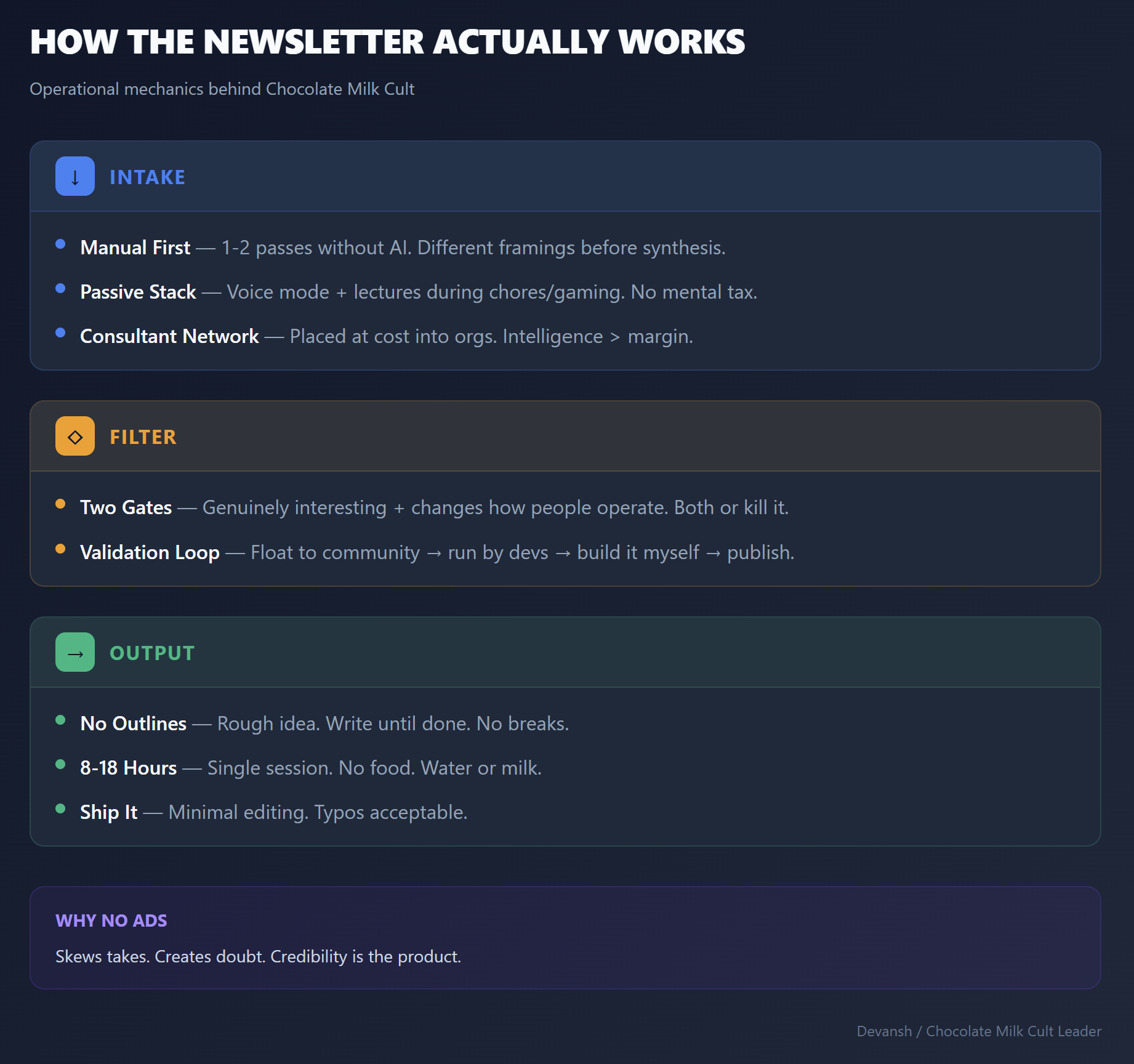
Executive Highlights (TL;DR of the Article)
The Chocolate Milk Cult began as a way to document my paper reading for PhD applications after being auto-screened out of AI roles. The early research breakdowns unexpectedly attracted senior investors, researchers, and operators because I explained cutting-edge work simply, tied it to real economic constraints, and focused on the “so what” rather than hype or jargon.
As injuries ended my fighting career, I doubled down on writing and widened the scope: connecting research, engineering realities, and financial analysis. That combination is the core value of the newsletter today. I gather ground-truth insights through heavy reading, a distributed network of consultants inside real companies, and constant conversations with builders. Ideas are tested with the community, validated in practice, and then turned into long-form analysis.
I avoid ads and sponsorships because they distort incentives; credibility is the product. My writing process is straightforward: long uninterrupted sessions, minimal editing, no trend-chasing. Warren Buffett’s 10USD/month subscription to this newsletter is worth much more than 100K from some AI startup trying to buy street cred.
Why most AI coverage is broken:
Expertise and time-to-write are in tension. People who understand deeply are building. People writing full-time often don’t understand enough. Bridge that gap and you have absurd advantage.
Credentialing inverted:
Used to be credentials → platform → audience. Now it’s audience → credential.
How I Started Writing
I never planned to become a writer. The newsletter started as a credentialing hack.
In 2017, I was part of a three-person team that beat Apple in Parkinson’s disease detection on real time voice calls in low resource environments. The algorithm was patented and later even commercially licensed by a good tech company for their use. This should have opened doors to other entry-level AI positions. It didn’t — I had no degree, so I was getting auto-screened before a human ever saw my application.
To make ends meet, I hustled my way into freelance projects with non-technical AI people, which taught me a lot — especially how to build AI under real resource constraints. But none of that translated to a resume. I was stuck.
So I made a plan: get a PhD directly. Skip the Master’s (couldn’t afford it), convince someone to bet on me. I had 3 years till my graduation in 2023, and I needed to create the best fucking application so that someone would take me under them. I had no clue what that took (my circle of gawaars wasn’t exactly swimming in top uni AI PhDs), but I really had no choice.
Also around this time (June 2020), I landed a state government project modeling healthcare policy for 300 million people — decisions that would affect infant mortality, maternal health, and resource allocation for decades. I was terrified of being the first person to commit mass murder via bad Machine Learning Models, so I started reading research obsessively. Five papers a day, sometimes more.
This is where my supervisor for the project came in with the best advice I’ve ever gotten: “You’re doing amazing work reading papers, but when this engagement ends, nobody will know how much you did. Start documenting what you read somewhere. It will help with your PhD apps”.
At this time, Yannic Kilcher was on his generational run of making a paper breakdown a day. So inspired by him, I started making my own videos. Unfortunately, I’m naturally monotonous, was in a place with a lot of background noise, and I couldn’t listen to music when I made videos the way I could when writing. So I switched focus to writing blogs on Medium.
Phase 1: Writing Research Breakdowns (late 2020 — mid 2023)
Plan was simple. Break down papers publicly, build a repository of my thinking, show PhD programs I could do the work. No expectations of becoming famous or having any audience.
However, things started taking a different turn.
My writing started to hit a dedicated base of readers pretty soon. And this base was very different from what I expected: my work regularly reached senior investors, researchers, some founders, and managers. People with decades of experience at top companies would regularly text me for my opinions about the AI Research landscape and where things were headed. That seemed unbelievable at that time, but in hindsight, I got lucky with a few factors in my favor —
I thought about AI economically (years of building under resource constraints will do that; I’ve also had to think about money a lot since a very young age). Decision makers appreciate it when you can not only break down benchmark progressions but also call out when trying to expand on a benchmark is a waste of money for IRL deployments.
I wrote simply — no PhD jargon. Saved everyone time.
By and large, AI commentary was split in 2 types: sources that summarized news and very jargony articles written for other researchers. No one was really looking at cutting-edge AI and trying to explain the “so what” to people. I had literally no competition.
In a funny way, everything that wasn’t ideal about my life built the foundations of my success. The rejections led to unique work experiences with a very tough market (try selling machine learning to a local pizza shop). Having to think about money and work all kinds of odd jobs got me really wide exposure that usually takes much longer to develop. All this let me give useful insights to the senior folk reading my work.
Seeing my growth, I launched AI Made Simple in January 2023 w/ a list of 10K subs. By graduation in May, my roster was up to 30K with some very sexy names. The PhD plan died. I was building something better — and I didn’t mind. I hated how academia worked anyway. The benchmark-maxing, the publication bias, the whole system optimizing for things I didn’t care about.
I had a new plan — write, make around 10K/month b/w consulting, work, and subs, and travel the world. I’d been nomadic for a bit, and I loved the experience of moving my entire address every few months. I had a list of countries with strong combat sports, I would go to each, train that combat sport + win a major competition, and leave.
It really is funny how life works out.
Phase 2: Going Deeper (Mid-Late 2023 to Now)
I’ve done a lot of stupid shit in my life. Due to said stupid shit, I have a lot of injuries all over. The worst is my legs — I even spent 2 years in bed rest (2019–2021) due to ligament tears.

When I got back to fighting, I was fighting with already injured legs. This put a lot more wear and tear on them than usual. Never had any major issues during my cage fights, but there were random times during training etc where my legs would just shut down.
One of these shutdowns happened when I was free soloing in Denver, Colorado. I ended up falling off my climb and completely messing up my left hand. That had me sitting out of training for 2 months and kind of forced me to realize that fighting was no longer something I could commit to. The training twice a day with professional fighters, underground cage fights, and travelling to compete — all of that had to end. I lost the most meaningful thing in my life (everything else in my life was literally scheduled around this).
This was really tough for me. I don’t think I’ll ever love anything as much as I loved the tension in the first few moments of the fight or the look in your opponent’s eye when you send a knee through their solar plexus or smash their liver (body shot KOs are my favs for this reason). Now I had all this time and energy w/ no good way to exhaust myself.
That’s when I started writing more and on more difficult topics. Writing was my crutch, my way of getting my mind to shut up. A lot of you have asked how I write so much despite everything I do. The truth isn’t so much that I like writing; after fighting, this is the only other thing that comes close to shutting out my brain (playing with animals is a distant third b/c it does this, but I can’t really do that for hours on end).
This was also where I shifted my writing with a stronger investor focus. I started reading more financial analysis in AI, which exposed me to very new mental models, analysis patterns, etc. I saw that no one really applied financial analysis to cutting-edge research (most financial analysis is based on looking back at the past, which the cutting-edge lacks).
That’s where the newsletter sits now: analysis of cutting-edge research that will reshape AI and capital markets, written by someone who actively builds AI products and validates their predictions on the ground. It’s why niche predictions like the rise of Diffusion Models and Latent Space Reasoning all came true: experiencing the limitations of standard LLMs as a builder let me see where the biggest changes would need to happen in a short-medium time frame.
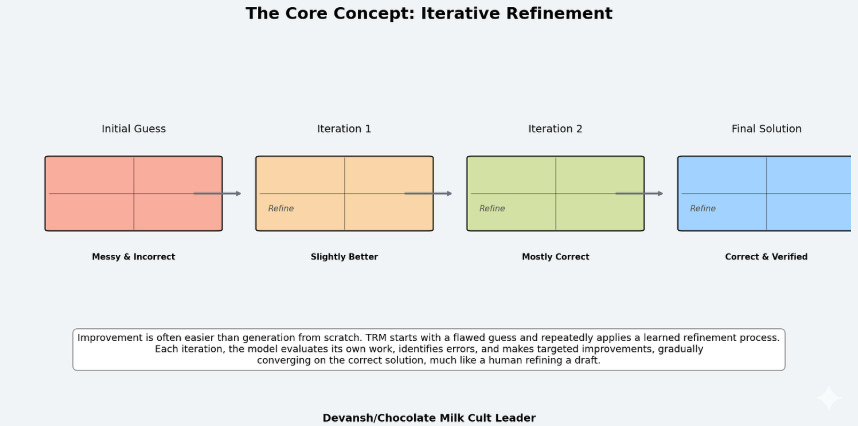
Here’s how we operate currently —
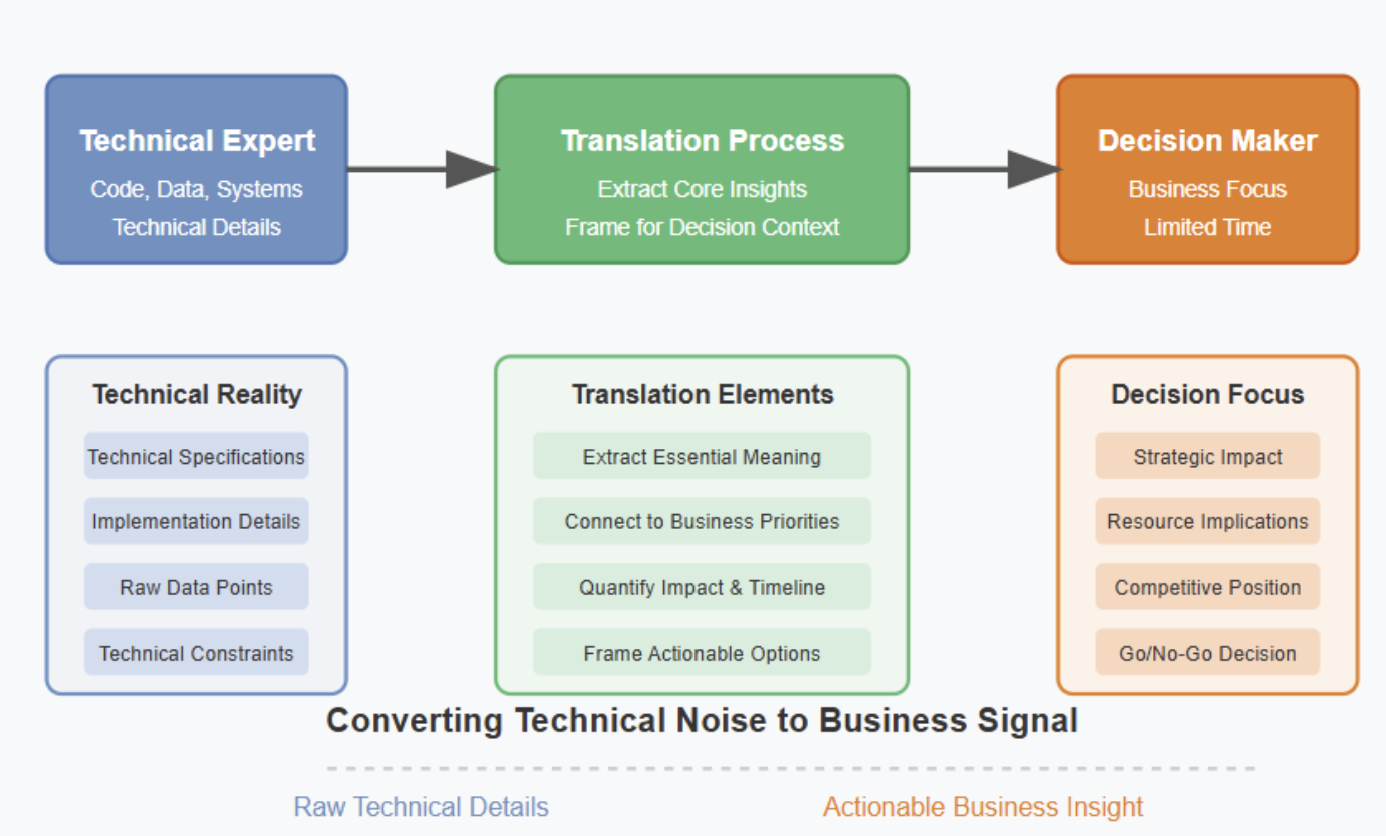
Gather insights from all the builders in our community. To speed this up, I even have an army of technical consultants that I send into organizations to build, at cost. This means that, unlike other consulting companies, I don’t try to make money on the consultants themselves; my purpose is to place consultants in various roles and use that to gather data on the trends/challenges in the industry.
Aggregate those insights and sell that as reports and or as high-value consulting (both are less of a priority for me personally since Iqidis is the main focus rn, but others in my lab are doing this actively).
I’ll discuss this more in the operational mechanics section of this piece. For now, let’s move on to the next section — the philosophy that underpins this newsletter.
The Chocolate Milk Cult Writing Philosophy
At my core, I’m motivated by being the best at something. Expressing my Will to Power. That’s why I could pour everything into fighting, and it’s why writing and analysis get that energy now. When all is said and done, I will be the best AI analyst of all time — far enough ahead that there’s no clear second place (fwiw, I think I’m already up there in skills, but I don’t have enough impact, clout, or hard accomplishments to claim GOAT status).
How I try to get there: bridging gaps. Research, engineering, finance — these worlds don’t talk to each other well. Most people are excellent in their silo. I want to be the person threading them together, translating insights across boundaries.
That shapes what I write about. Every piece has to pass two filters:
I have to find it genuinely interesting. If I’m not curious about it (or don’t have anything meaningful to say), I won’t write about it — even if it’s trending, even if it would get clicks. I skip a lot of hot topics because I just don’t care enough to do them well.
It has to matter. People need to know this, and knowing it will change how they operate.
If something clears both filters, I go deep.
The deep dives aren’t about showing off how much I know. They’re about giving you enough grounding that you don’t need me for the next related question. To provide one place as a foundation to help you explore the field on your own later. I hope my articles are seen as starting points to your own research, not the definitive guide to end discussions.
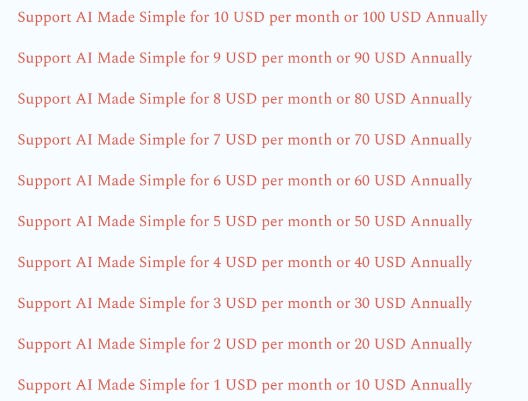
This comes from a core belief: tech works best when it’s democratized. The more people who genuinely understand what’s happening, the more people can build on it, and the better the outcomes for everyone. I’m not trying to gatekeep insights for a paid audience or hold back the good stuff. I would remove paywalls entirely if Substack didn’t penalize free newsletters in distribution. That’s not possible, so the next best option is to provide extreme discounts (you can sign up this newsletter for as little as 10 USD/year or 1 USD/month). If you can’t even afford that, no stress, all the most important deep dives are and will always be free.
In other words, I want to give people a place where they can get solid footing — especially people who wouldn’t know where else to go. It’s why I’m likely going to do a few beginner-friendly articles occasionally, to ensure our community has something for everyone.
Why no ads or sponsorships:
I get asked this a lot. Three reasons.
It would skew my takes. Once you start taking sponsorship money, big names come knocking. And once they’re paying you, there are things you can’t say anymore — even if you don’t explicitly agree to that. The relationship changes what’s possible.
I’m selling information and insights. If I also run ads, every piece I write gets a shadow of doubt. “Is he saying this because he believes it, or because someone’s paying him?” I don’t want that question in anyone’s head. The product is my credibility. Ads would dilute it. Warren Buffett’s 10USD/month subscription to this newsletter is worth much more than 100K from some AI startup trying to buy street cred, just for the long term impact both can lead to.
Ads are ugly. There are way too many of them on the internet already. I don’t want to add more, especially when my belly is big enough without them.
That’s the philosophy. Now let’s talk about how it actually works in practice.
Operational Mechanics
My writing can be broken into several steps.
Information Intake
I spend a lot of time reading. Research papers, market reports, thought pieces. One rule I don’t break: the first 1–2 passes are always manual. No AI summaries. I want to be exposed to different writing styles, ideas, and framings before I store anything for later analysis. AI can help me query and synthesize after, but the initial exposure has to be mine.
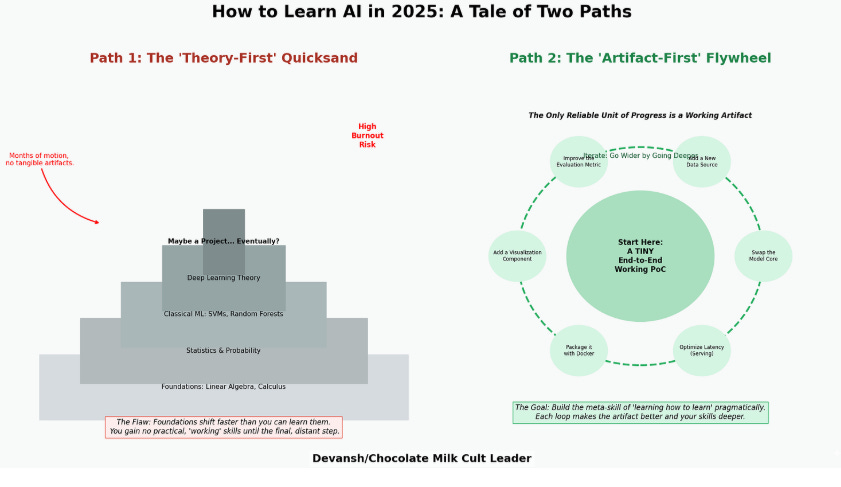
For passive learning, I run voice mode or lectures while doing chores, playing video games, whatever. Just talking to AI about ideas or letting lectures play in the background. It expands learning time without the mental tax of focused reading. I can do this for hours without burning out.
I mentioned the consultant army earlier — I place technical consultants into organizations at cost. The goal isn’t to profit on the consulting; it’s to gather ground-level data on what’s actually happening across the industry. What are people building, where are they struggling, what trends are emerging before they hit the news.
On top of the technical intake, I spend time studying writing itself. Prose, mechanics, delivery.
Some newsletter favorites for this: Julia Edelman , Tyler Corderman , and Ryan K. Rigney . They don’t write as much as I’d like (and I miss their work sometimes due to other priorities), but their work is filled with love and a deeper richness that’s very different from my own style. That’s why I find them fascinating.
I also study rappers — my favorite music genre — to see what I can steal from their cadence. Right now, it’s Lil Wayne and Naam Sujal. Both have a very unique flow, and I’d love to Majin Buu some of their essence into my writing.
And I always return to Kierkegaard, Nietzsche, Yukio Mishima, and Camus for examples of beautiful prose that moves me.
Lately, I’ve been reading a lot of Chinese poetry and philosophy. The rhythm, structure, and style are so different from Western writing. This is less about stealing specific techniques, more about opening my mind to other ways of moving through language.
Choosing Topics & Validation
Based on what I’m reading and hearing, I’ll form a few theses or experiment ideas. Then I test them:
Float to my open source community, gather feedback
Run by my developers, see what resonates or gets pushback
Build things myself to validate on the ground
The newsletter becomes mass distribution for these refined ideas. Once something’s out, I get to test my thinking against thousands of readers. They agree, disagree, add context, poke holes. That feedback loops back into the next round.
I also meet a lot of people face-to-face (preferred) or on Zoom. Learning what they’re working on, where they’re stuck, what they’re excited about. Strong information pipeline flowing in at all times.
The Actual Writing
I don’t work from detailed outlines. Usually just a rough idea of what I want to cover and why it matters. Then I sit down and write until it’s done. No breaks, no pauses.
Typical session: Most articles take around 8–10 hours. The longest one ever was 18 hours non-stop. During those stretches, I don’t eat — just water or milk — because I find food very distracting. Hammer it out to completion.
I don’t do much editing after. By the end I’m tired, and I’m confident that everything I write elite so a few minor typos or dangling thoughts are an acceptable tradeoff.
If there’s one thing I’ve learned from studying the writing experience, it would be to grow a pair and not be scared of experimenting with your voice. On the come up, we bucked some very traditional pieces of wisdom in the process —
I went into super long-form articles in the era of TikTokification.
I don’t follow any specific writing schedules. I write and publish when I have time.
I don’t write about trendy topics if I have nothing to say (a lot of my articles are on relatively obscure technical things that I think need to become mainstream).
I’ve picked fights with some of the most influential names in the industry w/o having any backers myself.
I was told that my articles were both too mathy/detailed and too easy (the memes, language etc) to be successful.
I write about a lot of different topics (which, allegedly, is bad for the algorithm and confuses the audience).
The point isn’t to do what I did, but to do what you want. Too many people reach out to me, obsessing over word counts, a specific template, style etc. Truth is that writing is a very long-term game, and your best bet is to write in ways that best align with your soul.
Where This Goes Next
The independent media landscape is shifting fast. Traditional outlets are hollowing out. AI is flooding the zone with content that’s technically competent but soulless. Audiences are fragmenting, attention is scarcer, and trust is harder to earn.
Credentialing has inverted. It used to be: get credentials → get platform → build audience. Now it’s: build audience → that becomes the credential. A newsletter with 300K readers is a stronger signal than most PhDs. I lived this — no degree, auto-screened everywhere, and now senior researchers at major labs read my work. Institutions haven’t caught up to this shift.
Most AI coverage is structurally broken. The people who understand AI deeply are building, not writing. The people writing full-time often don’t understand deeply enough. Expertise and time to write are in tension. The few who bridge this gap have an absurd advantage.
Attention is the wrong metric. Everyone optimizes for it, but you want the right attention. 1,000 readers who make decisions are worth more than 100,000 who scroll past. Most growth strategies actively select against the audience you actually want.
If you’re trying to build a presence in this space, these are some guidelines that I would keep in mind. Other than that, this is a very open world where you can really do whatever you want (including punching grandmas and kicking puppies if that’s how your inclinations lie). Play how you want, you are absolutely free. I just kept following what was interesting and trying to be the best at it.
And that’s still the plan.
Thanks for reading. If you’ve been here since the early days, I appreciate you. If you’re new, welcome — there’s a lot more coming.
Dev <3
Reach out to me
Use the links below to check out my other content, learn more about tutoring, reach out to me about projects, or just to say hi.
Small Snippets about Tech, AI and Machine Learning over here
AI Newsletter- https://artificialintelligencemadesimple.substack.com/
My grandma’s favorite Tech Newsletter- https://codinginterviewsmadesimple.substack.com/
My (imaginary) sister’s favorite MLOps Podcast-
Check out my other articles on Medium. :
https://machine-learning-made-simple.medium.com/
My YouTube: https://www.youtube.com/@ChocolateMilkCultLeader/
Reach out to me on LinkedIn. Let’s connect: https://www.linkedin.com/in/devansh-devansh-516004168/
My Instagram: https://www.instagram.com/iseethings404/
My Twitter: https://twitter.com/Machine01776819
Well deserved congratulations. "I’d love to Majin Buu some of their essence into my writing." - A DBZ fan if I ever knew one :D
this is helpful for writers of all worlds because it is honest, informative, and revelatory. especially appreciate the part about the importance of actually enjoying what you're writing about. it's a simple idea but it's easy to fall into writing about trending topics that can bore a writer to apathy. thanks Devansh!